
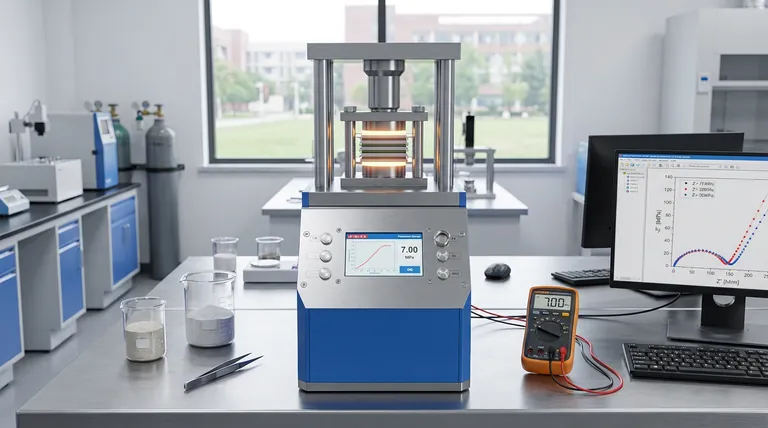
Precision pressure control serves as a fundamental tuning knob for solid-state battery performance, not merely a method of assembly. The ability to adjust pressure from 1.5 MPa to 7.0 MPa allows researchers to directly manipulate the physical interface between solid layers, thereby optimizing critical metrics like overpotential and critical current density (CCD). Without this control, it is impossible to distinguish between intrinsic material limitations and failures caused simply by poor physical contact.
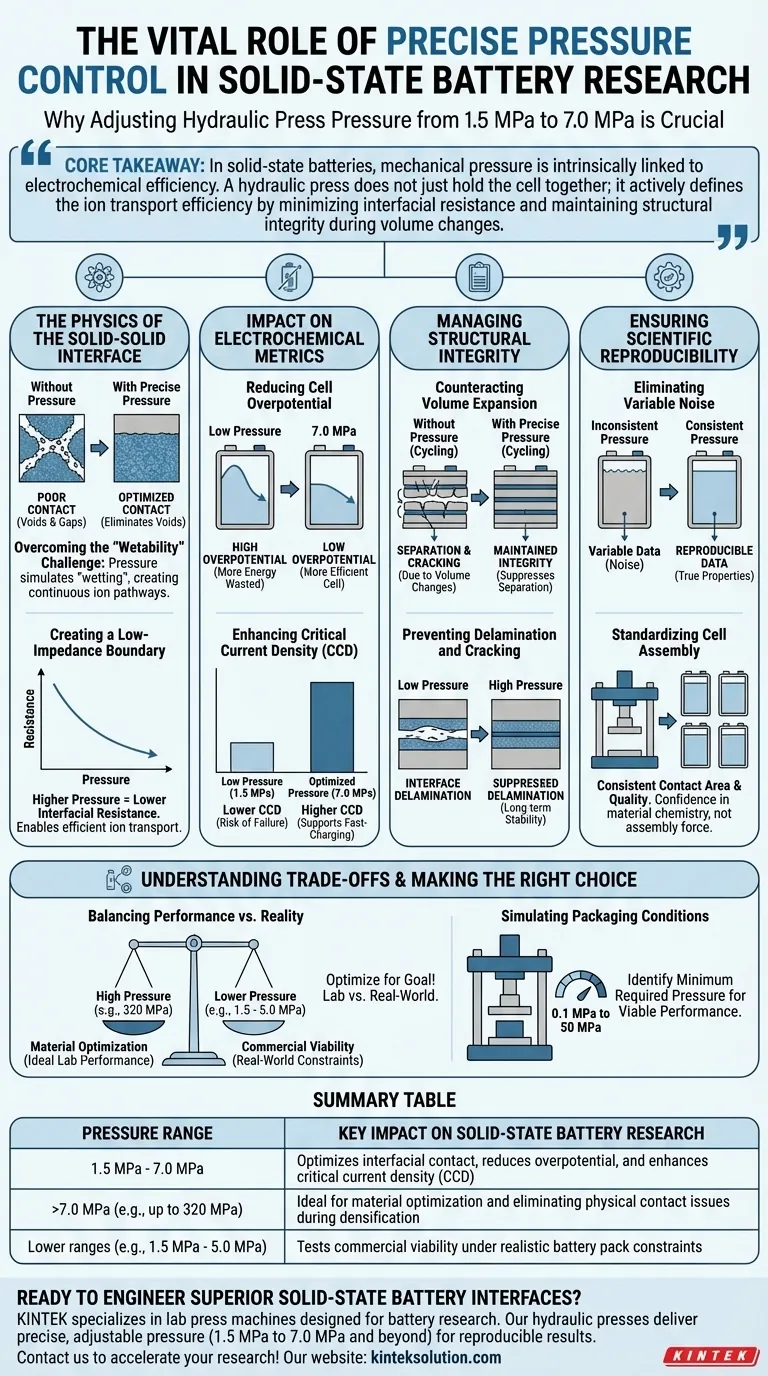
Core Takeaway In solid-state batteries, mechanical pressure is intrinsically linked to electrochemical efficiency. A hydraulic press does not just hold the cell together; it actively defines the ion transport efficiency by minimizing interfacial resistance and maintaining structural integrity during volume changes.
The Physics of the Solid-Solid Interface
Overcoming the "Wetability" Challenge
Unlike liquid electrolytes that flow into porous electrodes, solid electrolytes require physical force to establish contact. Precise pressure application is the only way to simulate "wetting" in a solid-state system.
By compacting powdered materials, you eliminate microscopic voids and gaps between particles. This creates the continuous pathways necessary for ions to move from the cathode to the anode.
Creating a Low-Impedance Boundary
The application of high pressure (e.g., during formation or cycling) ensures a low-impedance solid-solid interface.
If the pressure is too low, the interface resistance spikes, blocking ion transport. Adjustable pressure allows you to find the exact threshold where this resistance drops to an acceptable level for operation.
Impact on Electrochemical Metrics
Reducing Cell Overpotential
Research demonstrates that increasing stack pressure—for example, shifting from 1.5 MPa to 7.0 MPa—effectively reduces cell overpotential.
Higher pressure forces better contact, reducing the energy barrier the battery must overcome to move charge. This leads to a more efficient cell that wastes less energy as heat.
Enhancing Critical Current Density (CCD)
Pressure is a key parameter for improving Critical Current Density, which determines how fast a battery can charge or discharge before failing.
By maintaining tight contact, the hydraulic press allows the cell to withstand higher current densities without shorting or degrading. This is essential for developing batteries capable of fast-charging applications.
Managing Structural Integrity
Counteracting Volume Expansion
Cathode materials, such as Nb2O5, experience significant volume changes during charge and discharge cycles.
Without sufficient external pressure, this "breathing" causes the material layers to separate. Precise uniaxial pressure suppresses this separation, keeping the layers mechanically connected.
Preventing Delamination and Cracking
Adjustable pressure control is critical for suppressing interface delamination.
By maintaining a constant compressive force, you minimize the formation of cracks and voids that typically form as materials expand and contract. This directly contributes to long-term capacity stability.
Ensuring Scientific Reproducibility
Eliminating Variable Noise
Inconsistent pressure leads to inconsistent interfacial resistance.
If two identical cells are assembled with slightly different pressures, their impedance spectra will differ significantly. This creates noise in the data that can mask the true properties of the materials being tested.
Standardizing Cell Assembly
A hydraulic press ensures that the contact area and quality remain constant across every sample in a batch.
This consistency allows researchers to generate repeatable data. When performance changes, you can be confident it is due to the material chemistry, not a variation in assembly force.
Understanding the Trade-offs
Balancing Performance vs. Reality
While higher pressure generally improves lab performance (e.g., 320 MPa for densification), it may not reflect commercial constraints.
Real-world battery packs cannot always maintain massive pressures due to the weight and cost of the necessary bracing.
Simulating Packaging Conditions
The value of a hydraulic press lies in its ability to simulate various packaging conditions, ranging from 0.1 MPa to 50 MPa.
Researchers must avoid optimizing solely for high pressure if the end goal is a low-pressure application. You must use the press to identify the minimum pressure required for viable performance.
Making the Right Choice for Your Goal
To leverage pressure control effectively in your research, define your primary objective:
- If your primary focus is Material Optimization: Apply high pressures (e.g., >7.0 MPa or up to 320 MPa for forming) to eliminate physical contact issues and isolate the intrinsic electrochemical properties of the material.
- If your primary focus is Commercial Viability: Restrict testing to lower pressure ranges (e.g., 1.5 MPa to 5.0 MPa) to determine if the cell can survive under realistic battery pack constraints.
Mastering pressure control transforms mechanical force from a passive variable into an active tool for engineering superior electrochemical interfaces.
Summary Table:
| Pressure Range | Key Impact on Solid-State Battery Research |
|---|---|
| 1.5 MPa - 7.0 MPa | Optimizes interfacial contact, reduces overpotential, and enhances critical current density (CCD) |
| >7.0 MPa (e.g., up to 320 MPa) | Ideal for material optimization and eliminating physical contact issues during densification |
| Lower ranges (e.g., 1.5 MPa - 5.0 MPa) | Tests commercial viability under realistic battery pack constraints |
Ready to engineer superior solid-state battery interfaces with precise pressure control? KINTEK specializes in lab press machines—including automatic lab presses, isostatic presses, and heated lab presses—designed to meet the exacting demands of battery research. Our hydraulic presses deliver the precise, adjustable pressure (from 1.5 MPa to 7.0 MPa and beyond) you need to optimize interfacial resistance, enhance critical current density, and ensure reproducible results. Contact us today to discover how KINTEK’s solutions can accelerate your research and drive innovation in energy storage!
Visual Guide
Related Products
- Automatic High Temperature Heated Hydraulic Press Machine with Heated Plates for Lab
- Heated Hydraulic Press Machine with Heated Plates for Vacuum Box Laboratory Hot Press
- Manual Heated Hydraulic Lab Press with Integrated Hot Plates Hydraulic Press Machine
- Laboratory Hydraulic Press 2T Lab Pellet Press for KBR FTIR
- Laboratory Hydraulic Press Lab Pellet Press Machine for Glove Box
People Also Ask
- Function of a Laboratory Hydraulic Press with Heated Platens in SSE? Enhance Battery Density & Conductivity
- What are the requirements for electrode pressing with high-viscosity ionic liquids like EMIM TFSI? Optimize Performance
- How does a laboratory heated hydraulic press facilitate PBN sample prep for WAXS? Achieve Precise X-Ray Scattering
- What are the industrial applications of heated hydraulic presses? Master Heat & Force for Precision Manufacturing
- Why is a laboratory hydraulic press with heating plates required for PLA/TEC films? Achieve Precise Sample Integrity



















