
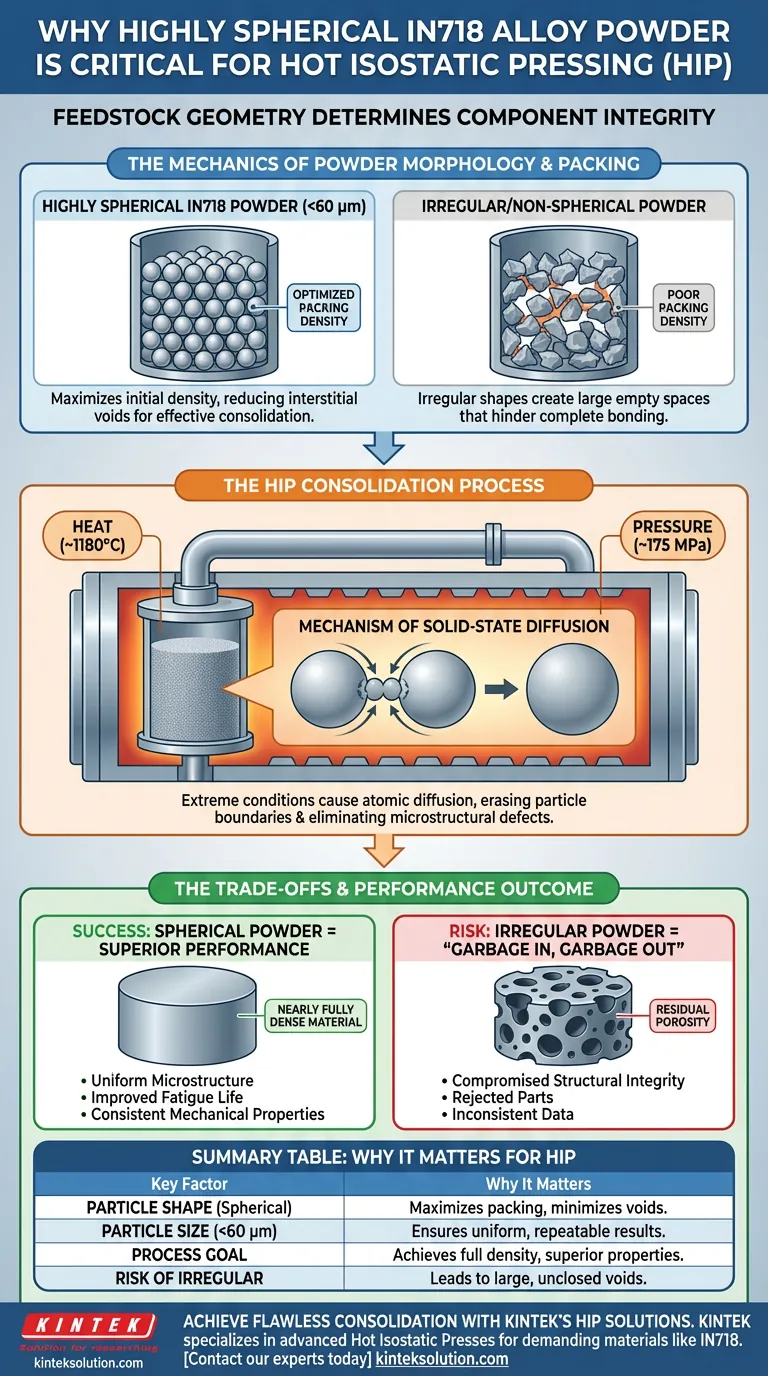
The geometry of the feedstock determines the ultimate integrity of the final component. In the case of IN718 alloy, utilizing highly spherical powder is critical because it maximizes the initial packing density of the material inside the canister. By reducing the volume of interstitial voids between particles before the process begins, you provide the Hot Isostatic Pressing (HIP) unit with the optimal starting condition necessary to achieve full compaction and minimal porosity.
Geometry dictates density. By using spherical powder to minimize initial voids, you ensure that the HIP process’s heat and pressure can effectively induce solid-state diffusion, creating a nearly fully dense material with superior mechanical properties.
The Mechanics of Powder Morphology
Optimizing Packing Density
The primary reason for selecting highly spherical IN718 powder—specifically with a particle size under 60 micrometers—is packing efficiency. Spherical particles settle against one another more naturally than irregular shapes.
Irregular particles tend to lock together randomly, creating "bridges" that leave large empty spaces (voids) within the powder bed. Spherical powder avoids this issue, creating a tightly packed bed with a high initial density.
Reducing the Workload on the Process
The HIP process is powerful, but it relies on the starting material having a reasonable density. High packing density reduces the magnitude of volume shrinkage required during consolidation.
If the initial packing is poor due to irregular particle shapes, the HIP unit must overcome significant internal spacing to consolidate the material. Starting with spherical powder minimizes the distance particles must travel to bond with one another.
How HIP Consolidates Material
The Role of Heat and Pressure
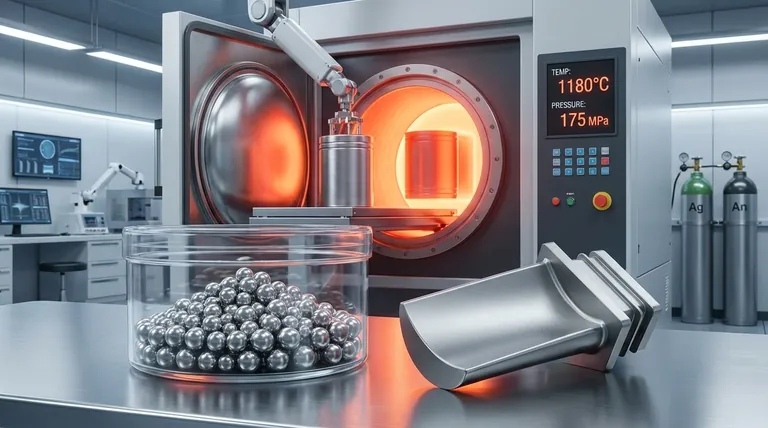
The HIP process subjects the IN718 powder to extreme conditions to force consolidation. The unit applies high temperatures, typically around 1180°C, alongside immense isostatic pressure of approximately 175 MPa.
Mechanism of Solid-State Diffusion
Under these specific conditions, the material undergoes solid-state diffusion and sintering. This physical phenomenon causes the atoms at the contact points of the powder particles to migrate and bond.
This diffusion effectively erases the original boundaries between particles. It transforms a collection of loose spheres into a single, cohesive solid mass.
Eliminating Microstructural Defects
The ultimate goal of this thermal and barometric stress is the total elimination of internal pores. By collapsing the voids that existed between the powder particles, HIP produces a component with a uniform microstructure. This uniformity is directly responsible for the improved mechanical properties required in high-performance applications.
Understanding the Trade-offs
The "Garbage In, Garbage Out" Risk
It is a common misconception that HIP can fix any defect. While HIP is excellent at closing small pores, it struggles to close large, interconnected voids caused by poor packing.
If you utilize non-spherical or irregular powder, the resulting low packing density may leave voids that are too large for solid-state diffusion to close completely. This results in residual porosity and compromised structural integrity.
Cost vs. Quality Balance
Producing highly spherical, fine-grain (<60 $\mu$m) powder is generally more expensive than producing irregular powder. However, this upfront cost is a trade-off for process reliability. Using cheaper, irregular powder often leads to rejected parts or inconsistent mechanical data, negating any raw material savings.
Making the Right Choice for Your Goal
To maximize the efficacy of your IN718 manufacturing process, consider your specific performance requirements:
- If your primary focus is Maximum Fatigue Life: Prioritize highly spherical powder to ensure the elimination of all internal stress-concentrating pores.
- If your primary focus is Process Consistency: Use a strictly controlled particle size distribution (<60 $\mu$m) to guarantee repeatable packing density across different production batches.
By treating powder morphology as a critical design variable rather than a commodity, you ensure that the HIP process yields a fully dense, high-performance component every time.
Summary Table:
| Key Factor | Why It Matters for HIP |
|---|---|
| Particle Shape (Spherical) | Maximizes initial packing density, minimizing voids for effective consolidation. |
| Particle Size (<60 µm) | Ensures a tight, uniform powder bed for consistent, repeatable results. |
| Process Goal | Achieves near-full density and superior mechanical properties like fatigue life. |
| Risk of Irregular Powder | Leads to large, interconnected voids that HIP cannot close, causing part failure. |
Achieve flawless consolidation and superior part performance with the right equipment.
KINTEK specializes in lab press machines, including advanced Hot Isostatic Presses (HIP), designed to meet the demanding requirements of materials like IN718. Our expertise ensures your process starts with the optimal conditions for success.
Let us help you maximize your results. Contact our experts today to discuss how our HIP solutions can enhance your laboratory's capabilities and ensure the integrity of your high-performance components.
Visual Guide
Related Products
- Warm Isostatic Press for Solid State Battery Research Warm Isostatic Press
- Electric Lab Cold Isostatic Press CIP Machine
- Electric Split Lab Cold Isostatic Pressing CIP Machine
- Lab Isostatic Pressing Molds for Isostatic Molding
- Manual Cold Isostatic Pressing CIP Machine Pellet Press
People Also Ask
- Why must composite cathodes be sealed in vacuum lamination bags for WIP? Ensure Battery Stability and Density
- How do sacrificial volume materials (SVM) maintain microchannels in isostatic pressing? Ensure Structural Integrity
- What is the function of elastic molds in warm isostatic pressing? Achieve Uniform Density in Composite Particles
- What is the function of hydraulic pressure in warm isostatic pressing? Achieve Uniform Material Density
- What are the advantages of using a Warm Isostatic Press (WIP) for batteries? Achieve Superior Interface Contact



















