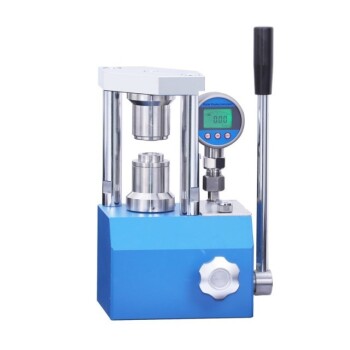
Precisely setting the sealing pressure on a coin cell crimping machine is required to eliminate internal gaps and drive the gel precursor into the porous structure of the battery components.
By applying a specific pressure, such as 60 kg/cm², you ensure tight physical contact between the cathode, separator, and anode, which drastically reduces internal contact resistance and establishes the foundation for efficient ion transport.
Core Takeaway Reliable battery performance depends on transforming stacked layers into a unified electrochemical system. Controlled sealing pressure forces the electrolyte precursor to fully wet the separator and electrode pores, creating continuous ion transport channels essential for high rate performance and cycle stability.
The Physics of Contact and Infiltration
Minimizing Contact Resistance
Battery components are effectively rough surfaces at the microscopic level. Without sufficient pressure, the cathode, separator, and anode merely touch at high points, leaving voids that block electron and ion flow.
Specific sealing pressure compresses these layers together. This maximizes the active contact area and significantly lowers the internal resistance that would otherwise throttle battery performance.
Facilitating Precursor Infiltration
For gel polymer batteries using in-situ polymerization, the timing of pressure application is critical. The electrolyte is introduced as a liquid precursor solution that must penetrate deep into the material structure.
The mechanical pressure drives this precursor solution into the microscopic pores of the separator and electrodes. This ensures that when the solution cures into a gel, it occupies the necessary volume to function correctly.
Establishing Ion Transport Channels
Once the precursor infiltrates the pores under pressure, heat treatment solidifies it into a gel. Because the pressure ensured deep penetration, the resulting gel forms continuous ion transport channels.
If the pressure is too low during this phase, the gel may form on the surface rather than inside the pores. This results in poor ionic conductivity and effectively "starves" the internal chemistry of the cell.
Ensuring Data Integrity and Safety
Preventing Environmental Interference
The crimping process does more than just compress the stack; it seals the internal environment from the outside world.
A precise sealing pressure deforms the gasket and casing to create a hermetic seal. This isolates the sensitive chemical environment from external air and moisture, which could degrade the lithium or sodium components, while preventing the evaporation of volatile electrolyte components.
Guaranteeing Reproducibility
In research and development, data is useless if it cannot be replicated. Variations in crimping pressure lead to variations in internal resistance.
By using a machine with precise pressure control, you ensure that every coin cell in a batch has the same internal physical conditions. This guarantees that differences in test results are due to your material chemistry, not inconsistent assembly techniques.
Understanding the Trade-offs
The Risk of Under-Compression
If the pressure is set too low, the interfacial contact will be insufficient. This leads to high impedance (resistance), poor cycling stability, and potential voltage fluctuations caused by intermittent contact.
The Danger of Over-Compression
While high pressure improves contact, excessive force can be destructive.
Over-compressing the cell can crush the separator, leading to internal short circuits. It may also deform the coin cell casing or the internal spacer springs, compromising the seal and leading to eventual electrolyte leakage.
Making the Right Choice for Your Goal
To optimize your assembly process, align your pressure settings with your specific objectives:
- If your primary focus is High Rate Performance: Prioritize higher pressure (within safety limits) to minimize interfacial resistance and maximize the speed of ion transport.
- If your primary focus is Long-Term Cycle Life: Ensure the pressure is sufficient to create a hermetic seal that prevents electrolyte evaporation over weeks or months of testing.
- If your primary focus is Experimental Consistency: Lock in a specific pressure value and use it for every single cell in the batch to eliminate assembly variables from your data.
Ultimately, the correct sealing pressure is the variable that turns a stack of raw materials into a cohesive, high-performance energy storage device.
Summary Table:
| Factor | Impact of Correct Sealing Pressure | Risk of Deviation |
|---|---|---|
| Contact Resistance | Minimizes impedance by maximizing active surface contact. | High impedance and poor electron/ion flow. |
| Gel Infiltration | Forces precursor into pores for continuous ion channels. | Surface-only gelling; internal chemistry starvation. |
| Cell Integrity | Creates a hermetic seal against air and moisture. | Electrolyte evaporation and material degradation. |
| Data Accuracy | Ensures reproducibility across experimental batches. | Inconsistent results due to assembly variables. |
| Safety | Maintains component structural integrity. | Over-compression can cause internal short circuits. |
Elevate Your Battery Research with KINTEK Precision
Consistency in assembly is the bridge between a breakthrough material and a high-performance cell. KINTEK specializes in comprehensive laboratory pressing solutions designed to give you total control over your experimental variables.
Whether you need manual precision or high-throughput automatic systems, our range of manual, automatic, heated, multifunctional, and glovebox-compatible models ensures your coin cells are sealed with the exact pressure required for optimal gel infiltration and low contact resistance.
Ready to eliminate assembly variables and secure your data integrity?
Contact a KINTEK Specialist Today
References
- Weijian Xu, Lei Tian. Fluorine-free gel polymer electrolyte for lithium oxide-rich solid electrolyte interphase and stable Li metal batteries. DOI: 10.1038/s41467-025-64345-7
This article is also based on technical information from Kintek Solution Knowledge Base .
Related Products
People Also Ask
- Why use standardized CR2032 components & high-precision presses? Ensure reliability in lithium metal battery research.
- Why is a laboratory battery sealing press essential for desolvation energy testing? Ensure Reliable Kinetic Data
- Why is a laboratory hydraulic press or battery sealing machine essential? Ensure Coin Cell Data Integrity
- How do laboratory battery sealing machines ensure performance consistency? Master Your Lithium and LFP Battery Assembly
- What role does a laboratory sealing press play in thermal analysis of solid dispersion films? Ensure Data Integrity