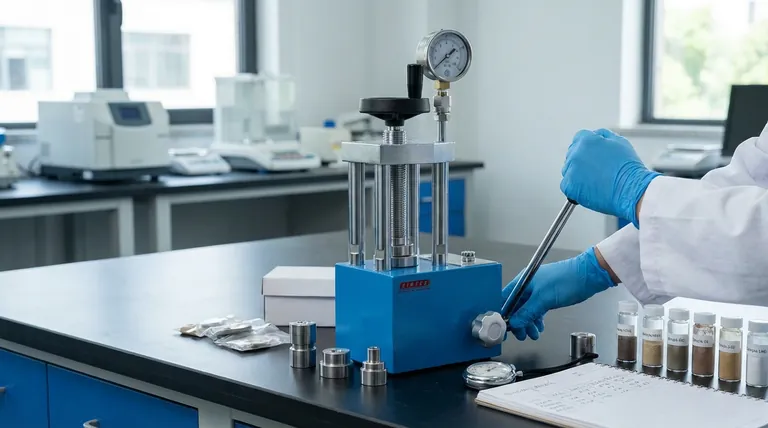
The Allure of Simplicity
There's an undeniable romance to a well-built manual tool. A manual hydraulic press is a perfect example of this. It’s a testament to elegant engineering.
With a simple lever, a piston, and hydraulic fluid, it translates human effort into immense, controlled force. This is Pascal's Principle in its purest, most practical form.
This mechanical simplicity is the foundation of its cost-effectiveness. No complex electronics, no software to debug, no motors to service. Fewer moving parts mean fewer points of failure and a dramatically lower initial purchase price. For a lab on a tight budget or with infrequent needs, it feels like the obvious, smartest choice.
But the sticker price is just the first chapter of the story.
The Hidden Cognitive Tax
Our brains are wired to favor immediate, tangible gains over long-term, abstract ones. We see the low price of a manual press and anchor our decision on that number, often underestimating the downstream operational costs.
This is a classic cognitive bias. The true cost, however, isn't on the price tag; it's embedded in your workflow.
The Cost of Human Input
Consider a quality control lab that needs to prepare 40 KBr pellets for FTIR analysis every day. With a manual press, an operator might spend several minutes on each sample—positioning, pumping the lever, holding pressure, and releasing.
That time adds up. Over a year, this "cost-effective" machine can demand hundreds of hours of skilled labor. That's time not spent analyzing data, writing reports, or developing new methods. An automated press, in contrast, performs this task autonomously, turning a labor cost into a background process.
The Pursuit of Repeatability
Now, imagine a materials science team developing a new polymer composite. Their research hinges on comparing the tensile strength of samples prepared under identical conditions.
Here, the manual press introduces a troubling variable: the operator. Can a technician apply the exact same 10 tons of pressure, for the exact same duration, across 50 different samples? Even with a precise gauge, slight variations are inevitable.
This inconsistency isn't just an inconvenience; it can undermine the statistical validity of the entire experiment. The "cheap" tool suddenly threatens the integrity of expensive research, leading to wasted materials and inconclusive results.
The Operator as a Variable
The performance of a manual press is inextricably linked to the person using it. It requires a "feel"—a level of skill and attentiveness that can vary from person to person, and even from morning to afternoon for the same individual.
In science and industry, the goal is to eliminate variables, not introduce them. An automated system removes this human element, ensuring every sample is prepared to the exact same programmed specifications, every single time. It transforms a craft into a science.
A Framework for True Cost-Effectiveness
The right tool isn't the cheapest one; it's the one that best fits the job. The "cost-effectiveness" of a press is defined entirely by your operational goals.
To make the right choice, you must look beyond the initial investment and evaluate the total cost of ownership within your specific workflow.
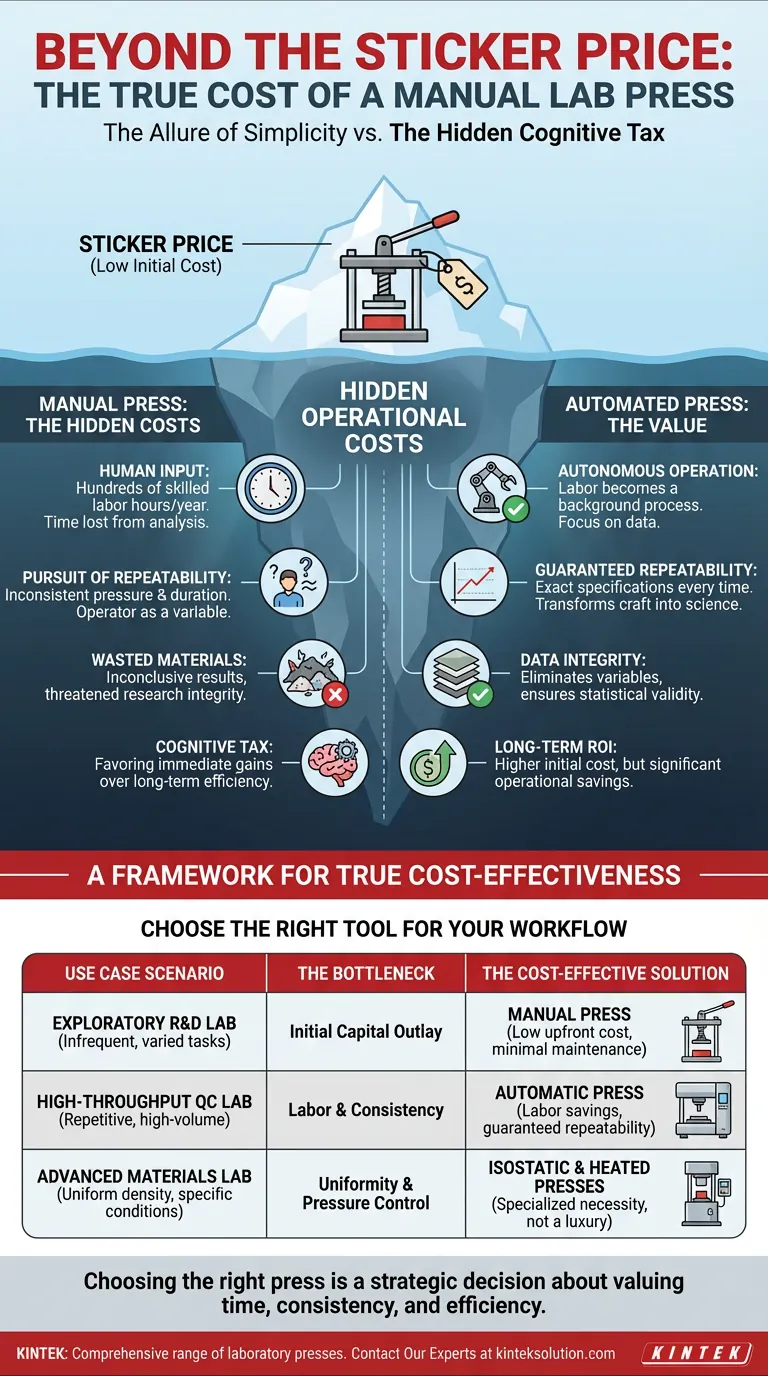
| Use Case Scenario | The Bottleneck | The Cost-Effective Solution |
|---|---|---|
| The Exploratory R&D Lab | Initial Capital Outlay | Manual Press. For infrequent, varied tasks where precision is less critical than versatility, the low upfront cost and minimal maintenance make it the undisputed champion. |
| The High-Throughput QC Lab | Labor & Consistency | Automatic Press. For repetitive, high-volume tasks, automation provides a clear ROI by saving labor costs and guaranteeing the repeatability essential for data integrity. |
| The Advanced Materials Lab | Uniform Density & Pressure | Isostatic & Heated Presses. When pressure must be applied uniformly from all directions or under specific thermal conditions, specialized equipment is not a luxury; it's a necessity. |
Choosing the right press is a strategic decision about how you value your team's time, the consistency of your results, and your long-term operational efficiency. Whether your priority is minimizing upfront costs or maximizing throughput and precision, understanding these trade-offs is key.
KINTEK's comprehensive range of laboratory presses—from robust manual models to fully automatic, heated, and isostatic systems—is designed to meet these diverse needs. We can help you find the instrument that offers the best return on investment for your unique application. Contact Our Experts
Visual Guide
Related Products
- Manual Heated Hydraulic Lab Press with Integrated Hot Plates Hydraulic Press Machine
- Manual Laboratory Hydraulic Press Lab Pellet Press
- Manual Laboratory Hydraulic Pellet Press Lab Hydraulic Press
- Laboratory Manual Heated Hydraulic Press Machine with Hot Plates
- Laboratory Split Manual Heated Hydraulic Press Machine with Hot Plates
Related Articles
- The Architecture of Slow: Why Physical Precision Dictates Chemical Destiny
- From Chaos to Control: The Unseen Power of a Heated Lab Press
- The Slow Creep of Inaccuracy: Mastering the Hidden Physics of Heated Lab Presses
- The Unseen Architecture of a Pill: Why Heat Engineers Pharmaceutical Trust
- Clarity from Chaos: Mastering Sample Preparation for FTIR Spectroscopy



















