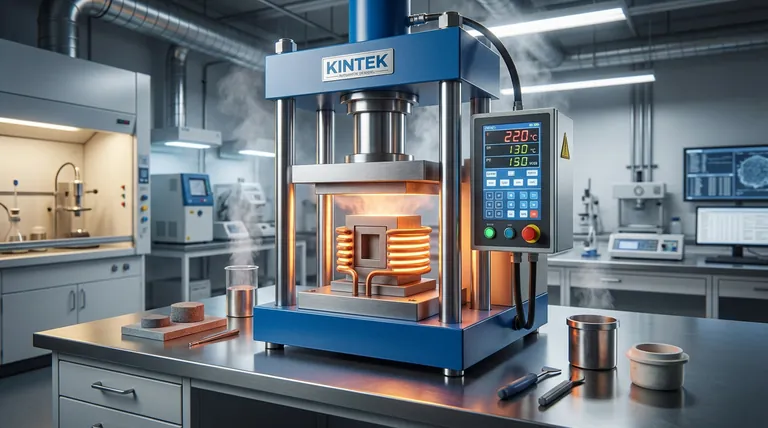
The Pressure to Be Perfect
Imagine a materials scientist working on a next-generation composite. The deadline is tight. The conventional furnace takes hours to heat up and cool down, a clumsy, inefficient process. Each failed sample, warped by uneven heating, represents a day lost.
This scenario isn't about a lack of patience; it's about a lack of control. The desire isn't just for a faster process, but a more deliberate one. This is the core problem that induction heating in a hot press was born to solve.
The Elegant Deception of Induction
At first glance, induction heating seems like magic. There are no flames, no glowing elements. A conductive mold simply... gets hot. The reality is a beautifully direct application of physics.
From Invisible Field to Incandescent Heat
The process starts with a copper coil. When a high-frequency alternating current is passed through it, a powerful, oscillating magnetic field is generated.
When a conductive mold, typically made of graphite or steel, is placed within this field, the field induces tiny, circular electrical currents inside the mold itself. These are called eddy currents.
The mold material naturally resists the flow of these currents. This resistance creates friction at a molecular level, generating intense, rapid heat. The mold becomes its own heating element.
A System of Two Minds: Heat and Pressure
Crucially, this entire heating process is electromagnetic and happens independently of the mechanical pressure system. While the mold heats from within, a separate set of hydraulic or pneumatic cylinders applies force, compacting the material.
This decoupling of heat and pressure is the single most important design feature. It transforms the hot press from a simple oven into a precision instrument.
The Psychology of Absolute Control
This separation of variables gives the engineer a new level of command over the material's transformation. It’s a psychological shift from waiting for the equipment to being in complete control of the environment.
Unlocking Speed
Because heat is generated inside the mold, there is almost no thermal lag. Temperatures that would take an hour to reach in a furnace can be achieved in minutes. This isn't just about efficiency; it's about opportunity. More iterations can be run in a single day, accelerating the pace of discovery.
The Power of Precision
With separate controls, an operator can design complex profiles. Imagine ramping up the pressure while holding a specific temperature, then rapidly increasing the heat just before the final compaction. This level of fine-tuning is impossible when the heating and pressure systems are thermally linked.
The Unseen Enemy: The Thermal Gradient
But this elegant solution introduces a new, more subtle challenge: the battle for perfect uniformity. When you can generate heat this quickly and this locally, small imperfections in the setup can create significant problems.
The Tyranny of Alignment
The magnetic field is not perfectly uniform. If the mold is even slightly off-center within the coil, one side will receive more energy than the other. This creates hot and cold spots, leading to inconsistent density, internal stresses, and a compromised final part. The pursuit of speed requires an unwavering commitment to precision.
The Last Mile Problem: Thermal Conduction
Even if the mold heats perfectly, the heat must still travel from the mold walls into the center of the material being pressed. The mold's own thermal conductivity becomes a bottleneck. For large or thick parts, the outside can reach the target temperature long before the core does.
This presents a fundamental trade-off:
- Rapid Heating: The primary advantage of induction.
- Thermal Uniformity: The primary challenge, limited by mold geometry and conductivity.
A Decision Framework: When to Choose Induction
Mastering induction heating is about understanding and managing this trade-off. The choice depends entirely on your primary goal.
| Priority Goal | Induction Heating Suitability |
|---|---|
| Maximum Cycle Speed | Excellent. Direct internal heating is unbeatable for rapid temperature ramps. |
| Complex Process Control | Excellent. Independent control of heat and pressure allows for highly tailored, multi-stage processing profiles. |
| Material Uniformity | Good, but requires expertise. Success depends on meticulous coil design and precise mold alignment to avoid thermal gradients. |
| Large/Thick Parts | Challenging. The mold's thermal conductivity can become a limiting factor, potentially requiring slower heating cycles. |
Mastering the Trade-off with the Right Instrument
Induction heating is not just a technology; it's a philosophy. It trades the brute force of a conventional furnace for the surgical precision of an electromagnetic field. To wield it effectively, you need an instrument designed for control.
KINTEK's laboratory press machines—including our automatic and heated lab presses—are engineered to provide that control. They offer the rapid heating cycles of induction while being built with the precision necessary to manage thermal uniformity, empowering researchers to push the boundaries of material science.
If you are ready to move from simply applying heat to truly mastering it, we can help you find the right instrument for the job. Contact Our Experts
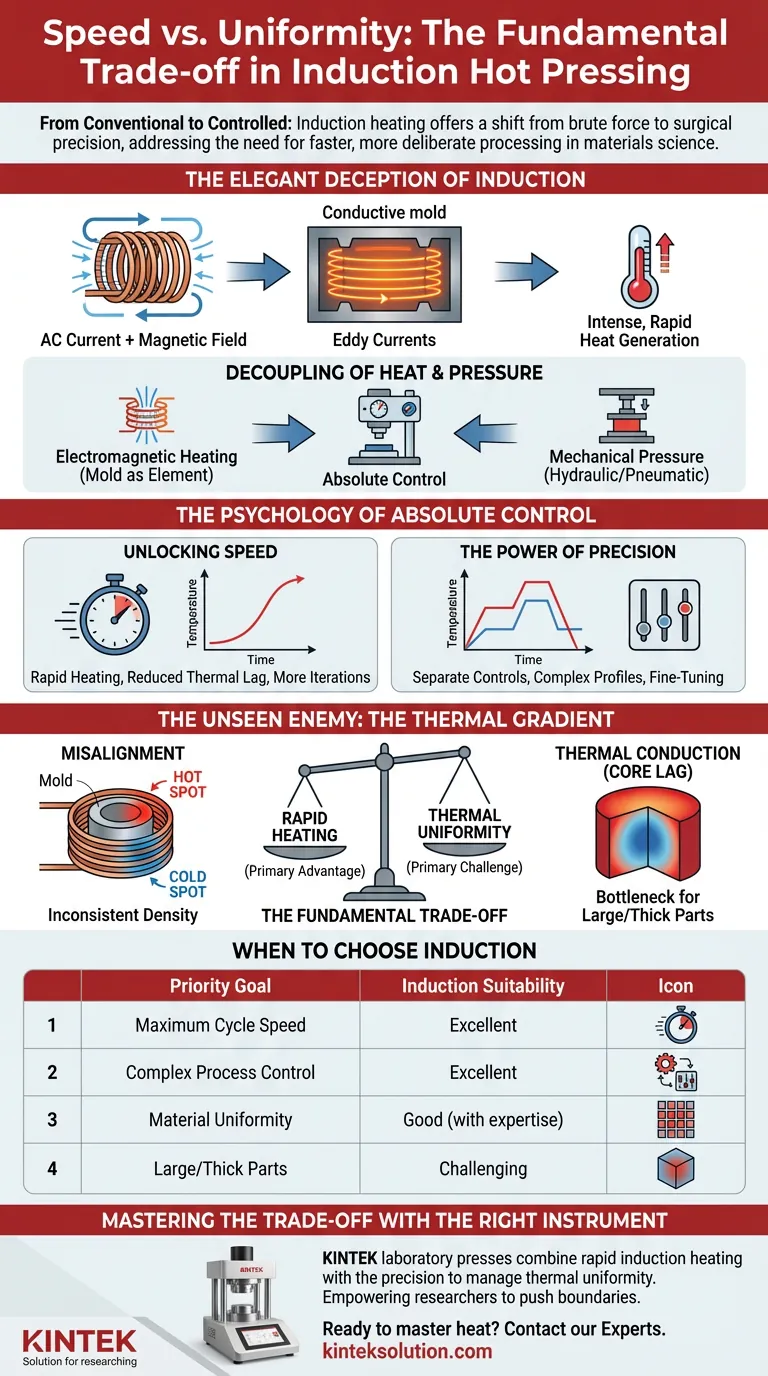
Visual Guide
Related Products
- Heated Hydraulic Press Machine with Heated Plates for Vacuum Box Laboratory Hot Press
- Automatic Heated Hydraulic Press Machine with Hot Plates for Laboratory
- Automatic High Temperature Heated Hydraulic Press Machine with Heated Plates for Lab
- Laboratory Manual Heated Hydraulic Press Machine with Hot Plates
- Heated Hydraulic Press Machine With Heated Plates For Vacuum Box Laboratory Hot Press
Related Articles
- The Architecture of Slow: Why Physical Precision Dictates Chemical Destiny
- The Architecture of Certainty: Why the Laboratory Press is the Anchor of Material Science
- The Vanishing Boundary: The Hidden Thermodynamics of LTCC Lamination
- The Alchemy of 160°C: Why Precision Pressing is the Silent Backbone of Rubber Science
- The Invisible Forge: Why the Laboratory Press is the Soul of Nano-Composites



















