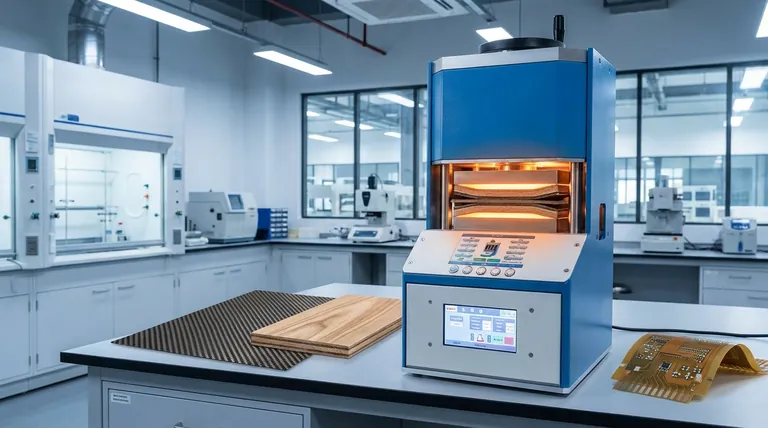
The Illusion of Simplicity
Look at a piece of high-end Scandinavian furniture. The surface is flawless, a single, unified sheet of wood veneer. Or consider a carbon fiber bicycle frame. It’s impossibly light yet stronger than steel.
These objects feel simple, almost elemental. But this simplicity is an illusion.
The raw materials—thin wood layers, sticky resin, loose carbon fibers—are fragile and disparate. Their final, heroic properties are not inherent; they are created. They are born from the precise application of two fundamental forces: immense pressure and intense heat. This transformation happens inside a hot press.
A Duet of Forces
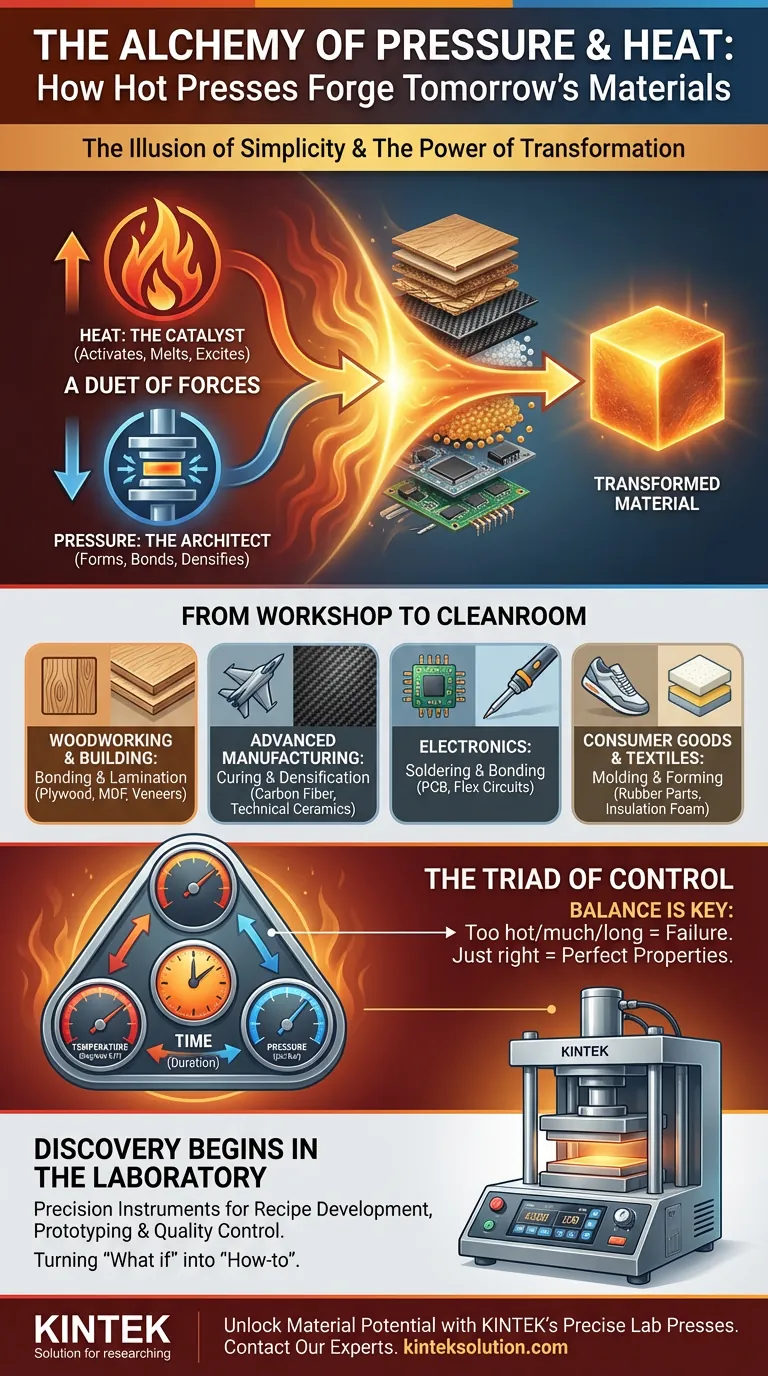
A hot press isn’t just a heater stacked on a hydraulic press. It's an instrument that orchestrates a duet between thermal energy and mechanical force. Separately, they are useful. Together, they are transformative.
Heat as the Catalyst
Heat is the agent of change. It provides the energy to activate adhesives, turning inert resins into powerful bonding agents. For plastics and polymers, it brings them to a pliable, semi-liquid state, ready to be molded. For ceramics, it excites molecules, preparing them to be fused together. Heat unlocks a material’s potential to become something new.
Pressure as the Architect
If heat unlocks potential, pressure gives it form and integrity. It forces layers into intimate contact, ensuring a bond is not just surface-level but absolute. It squeezes out air pockets and voids in composites, creating a dense, monolithic structure free of weak points. Pressure turns a collection of parts into a unified whole.
From the Workshop to the Cleanroom
The power of this duet is so fundamental that it appears across a vast spectrum of industries, solving vastly different problems.
-
The Foundation of Furnishings: In woodworking, the hot press is the backbone of modern materials. It transforms wood chips and resin into the dense, stable Medium-Density Fiberboard (MDF) and bonds delicate veneers to create the flawless surfaces of cabinets and tables.
-
The Pursuit of Strength Without Weight: The aerospace and high-performance automotive industries rely on hot presses to cure composite materials. They forge layers of carbon fiber into components that are critically strong and astonishingly light, pushing the boundaries of speed and efficiency.
-
The Micro-Scale Precision of Electronics: Even the world of microelectronics needs this macro force. Specialized hot presses perform "hot bar soldering," creating durable electromechanical bonds between flexible circuits and PCBs—a task requiring immense force and precision on an incredibly delicate scale.
-
The Texture of Everyday Life: Many objects we touch daily are products of a hot press. Rubber and plastic parts are molded, insulation foam is formed, and even the simple mouse pad—fabric bonded perfectly to a foam base—owes its existence to this process.
| Industry | Core Function | Common Applications |
|---|---|---|
| Woodworking & Building | Bonding & Lamination | Plywood, MDF, Decorative Laminates |
| Advanced Manufacturing | Curing & Densification | Carbon Fiber Panels, Technical Ceramics |
| Electronics | Soldering & Bonding | Hot Bar Soldering for PCBs, Flex Circuits |
| Consumer Goods & Textiles | Molding & Forming | Rubber Parts, Insulation Foam, Yoga Mats |
The Engineer's Dilemma: The Triad of Control
This transformative power is not a brute force affair. It’s a delicate balance. The success of any hot press operation hinges on the perfect control of three variables: Temperature, Pressure, and Time.
This is the engineer’s central challenge. A few degrees too hot can scorch the material. Too little pressure can result in delamination. A cycle time that’s too short can leave a resin under-cured and weak.
This triad is the "recipe" for a material. Getting it wrong leads to failure. Getting it right creates the perfect properties you designed for.
Discovery Begins in the Laboratory
Before a factory can produce thousands of identical parts, that perfect recipe must be discovered. The exact temperature, the precise pressure, and the ideal duration are not guessed; they are meticulously developed through experimentation.
This is the domain of the laboratory hot press.
A lab press is not just a smaller version of its industrial cousin; it is a high-precision instrument built for discovery, prototyping, and quality control. It provides the granular control needed to test new composite formulations, validate adhesive strengths, and perfect curing cycles on a small, manageable scale. It’s where the "what if" of material science becomes the "how-to" of manufacturing.
For researchers and engineers pushing the limits of material science, tools like KINTEK's automatic and heated lab presses provide the precise, repeatable control over that essential triad of forces. They are the instruments that turn theoretical recipes into tangible, high-performance realities.
The next time you admire a flawless piece of furniture or lift a feather-light piece of high-tech gear, remember the unseen forces that created it. It's a testament to the quiet, powerful alchemy of heat and pressure. To explore how this precision can advance your own material development, Contact Our Experts.
Visual Guide
Related Products
- Automatic High Temperature Heated Hydraulic Press Machine with Heated Plates for Lab
- Heated Hydraulic Press Machine with Heated Plates for Vacuum Box Laboratory Hot Press
- Automatic Heated Hydraulic Press Machine with Hot Plates for Laboratory
- Laboratory Split Manual Heated Hydraulic Press Machine with Hot Plates
- Heated Hydraulic Press Machine With Heated Plates For Vacuum Box Laboratory Hot Press
Related Articles
- The Architecture of Slow: Why Physical Precision Dictates Chemical Destiny
- The Architecture of Certainty: Why the Laboratory Press is the Anchor of Material Science
- The Vanishing Boundary: The Hidden Thermodynamics of LTCC Lamination
- The Alchemy of 160°C: Why Precision Pressing is the Silent Backbone of Rubber Science
- The Invisible Forge: Why the Laboratory Press is the Soul of Nano-Composites



















