
Hydraulic presses are the workhorses of industrial manufacturing, utilizing fluid mechanics to generate massive compressive force for shaping, fabricating, and assembling materials. They are utilized primarily for high-pressure tasks that exceed the capabilities of pneumatic systems, specifically in operations requiring deep drawing, heavy forging, and the precision molding of complex components across the automotive and aerospace sectors.
Core Takeaway While often recognized for their crushing power, the true utility of a hydraulic press lies in its versatility and control. Whether shaping turbine blades or compacting ceramic powder, these machines provide the consistent, high-tonnage force necessary to manipulate materials that resist standard mechanical deformation.
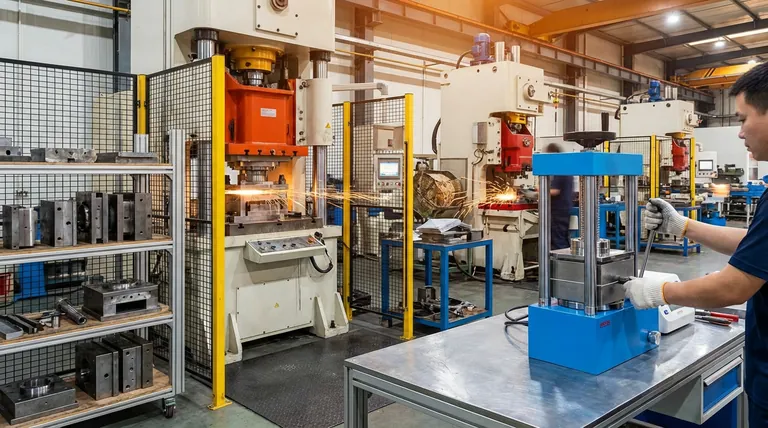
Primary Applications in Metal Forming
The most distinct advantage of hydraulic presses is their ability to apply substantial compressive force to shape metal billets and sheets.
Automotive Component Production
The automotive industry relies heavily on hydraulic presses for both structural and functional parts. They are essential for deep drawing and stamping operations used to create large car body panels.
Beyond the chassis, these presses configure smaller, intricate parts ranging from gear housings to wiper blades. They provide the force required to shape these rigid materials quickly and consistently.
Aerospace and Heavy Industry
In aerospace, manufacturers utilize hydraulic presses to form complex geometries that demand high precision, such as turbine blades.
Similarly, the construction and steel industries use them for straightening and bending heavy metal beams. The press can apply slow, controlled pressure to correct distortions in structural steel without compromising its integrity.
Forging and Sword-Making
Hydraulic presses are integral to modern forging operations. They shape heated metal into desired forms with uniform pressure. This versatility extends to specialized niche manufacturing, such as sword-making, where the press flattens and shapes steel with a consistency that manual hammering cannot achieve.
Assembly and Material Testing
Beyond shaping raw materials, hydraulic presses play a critical role in assembly lines and quality control laboratories.
Precision Assembly and Joining
Manufacturers use these presses for force-fit assemblies, such as pressing bearings, gears, or fittings into place.
They are also used for joining techniques like clinching and crimping. This allows for the assembly of components without the need for heat (welding) or additional fasteners, streamlining the manufacturing process.
Laboratory and Stress Testing
In laboratory settings, hydraulic presses are used to test material limits. They verify the tensile strength of concrete and investigate how substances react under extreme pressure.
They are also used for sample preparation, such as pressing pellets for analysis, ensuring that materials meet safety and durability standards before mass production.
Compaction and Waste Management
Hydraulic presses excel at altering the density of materials, making them vital for both creation and destruction.
Powder Compaction and Molding
Industry uses these presses to compress powdered materials into solid shapes. This is standard practice in ceramics manufacturing for producing tiles and bricks at room temperature.
This application extends to the food industry, where presses are used to extract liquids and produce solids, such as fat-free cocoa powder. It is also used in the compression molding of plastics, rubber, and composites.
Recycling and Baling
In waste management, hydraulic presses are used to crush and compact scrap material. They bale scrap metal and crush entire automobiles to facilitate easier transport and storage for recycling facilities.
Understanding the Capabilities (The "Why")
To understand why a manufacturer chooses a hydraulic press, one must look at the pressure differential.
Hydraulic vs. Pneumatic
Hydraulic systems can apply pressures in the range of 10,000 psi, whereas pneumatic systems typically operate around 100 psi.
Versatility of Force
This massive power difference means hydraulic presses are the only viable option for heavy-duty tasks. However, they are also capable of delicate operations. Through the use of specific dies and molds, the same underlying technology can crush a car or precision-mold a delicate electronic component.
Making the Right Choice for Your Goal
When determining if a hydraulic press is the right tool for your manufacturing process, consider your specific output requirements.
- If your primary focus is Heavy Metal Forming: Rely on hydraulic presses for deep drawing, stamping, and forging operations where material resistance is high (e.g., car panels, beams).
- If your primary focus is Material Density: Use these presses for powder compacting (ceramics/metallurgy) or waste baling to achieve maximum density and volume reduction.
- If your primary focus is Precision Assembly: Utilize the controllable force of a hydraulic press for clinching, crimping, and pressing bearings where consistency is critical.
Ultimately, the hydraulic press is the definitive solution for any application requiring the efficient transmission of extreme force to reshape, test, or compact solid matter.
Summary Table:
| Application Category | Key Examples | Primary Benefit |
|---|---|---|
| Metal Forming | Deep drawing car panels, forging, bending beams | Massive, controlled force for shaping rigid materials |
| Assembly & Testing | Press-fit bearings, material strength testing | Precision and consistency for quality control |
| Compaction & Molding | Powder compaction (ceramics), plastic molding, baling scrap | Alters material density efficiently and uniformly |
Ready to harness the power and precision of a hydraulic press in your laboratory?
KINTEK specializes in lab press machines, including automatic lab presses, isostatic presses, and heated lab presses, designed to meet the demanding needs of modern R&D and quality control. Whether your focus is material testing, sample preparation, or precision molding, our equipment delivers the consistent, high-tonnage force required for reliable results.
Contact us today to discuss your specific application and discover how KINTEK's solutions can enhance your manufacturing process and drive innovation.
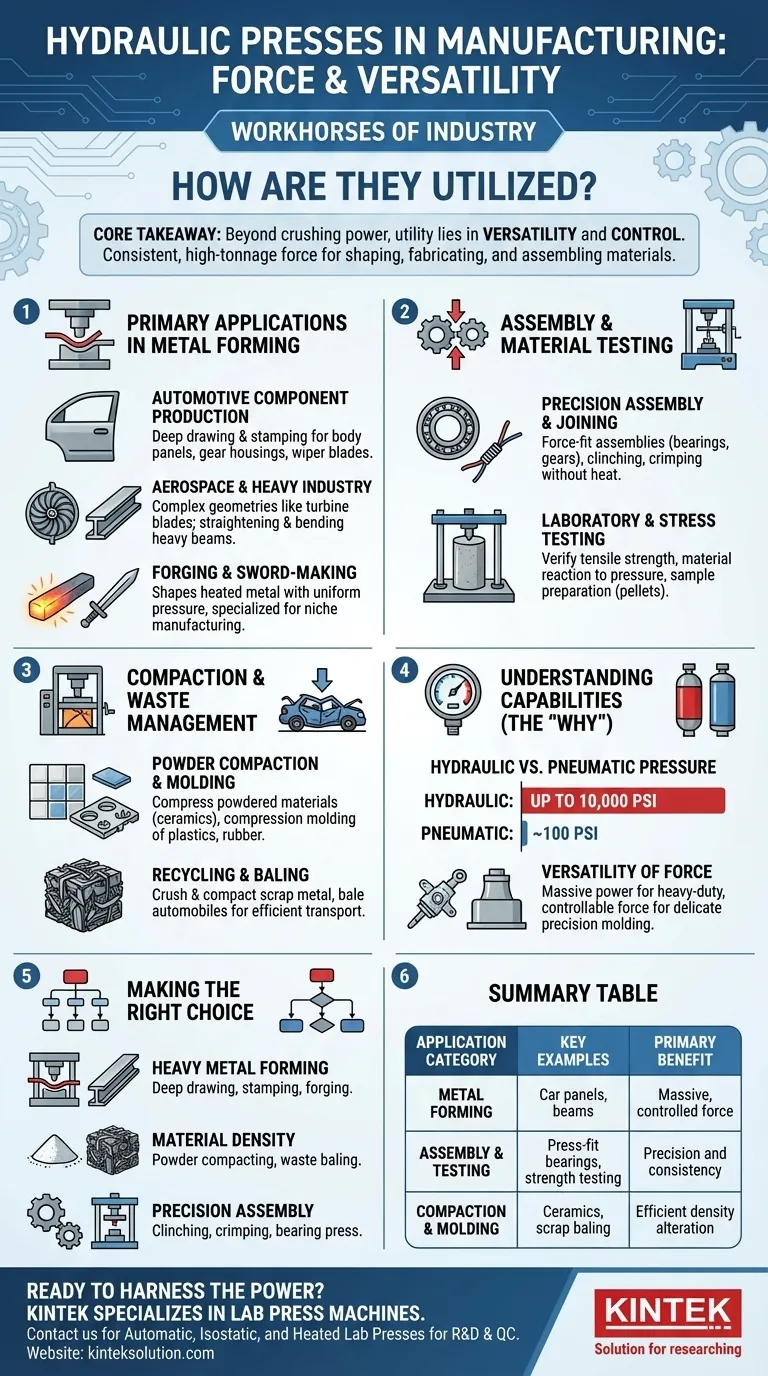
Visual Guide
Related Products
- Automatic High Temperature Heated Hydraulic Press Machine with Heated Plates for Lab
- Manual Heated Hydraulic Lab Press with Integrated Hot Plates Hydraulic Press Machine
- Heated Hydraulic Press Machine with Heated Plates for Vacuum Box Laboratory Hot Press
- Laboratory Hydraulic Press 2T Lab Pellet Press for KBR FTIR
- Laboratory Hydraulic Press Lab Pellet Press Machine for Glove Box
People Also Ask
- Function of a Laboratory Hydraulic Press with Heated Platens in SSE? Enhance Battery Density & Conductivity
- What are the requirements for electrode pressing with high-viscosity ionic liquids like EMIM TFSI? Optimize Performance
- How does a laboratory heated hydraulic press facilitate PBN sample prep for WAXS? Achieve Precise X-Ray Scattering
- What are the industrial applications of heated hydraulic presses? Master Heat & Force for Precision Manufacturing
- Why is a laboratory hydraulic press with heating plates required for PLA/TEC films? Achieve Precise Sample Integrity



















