
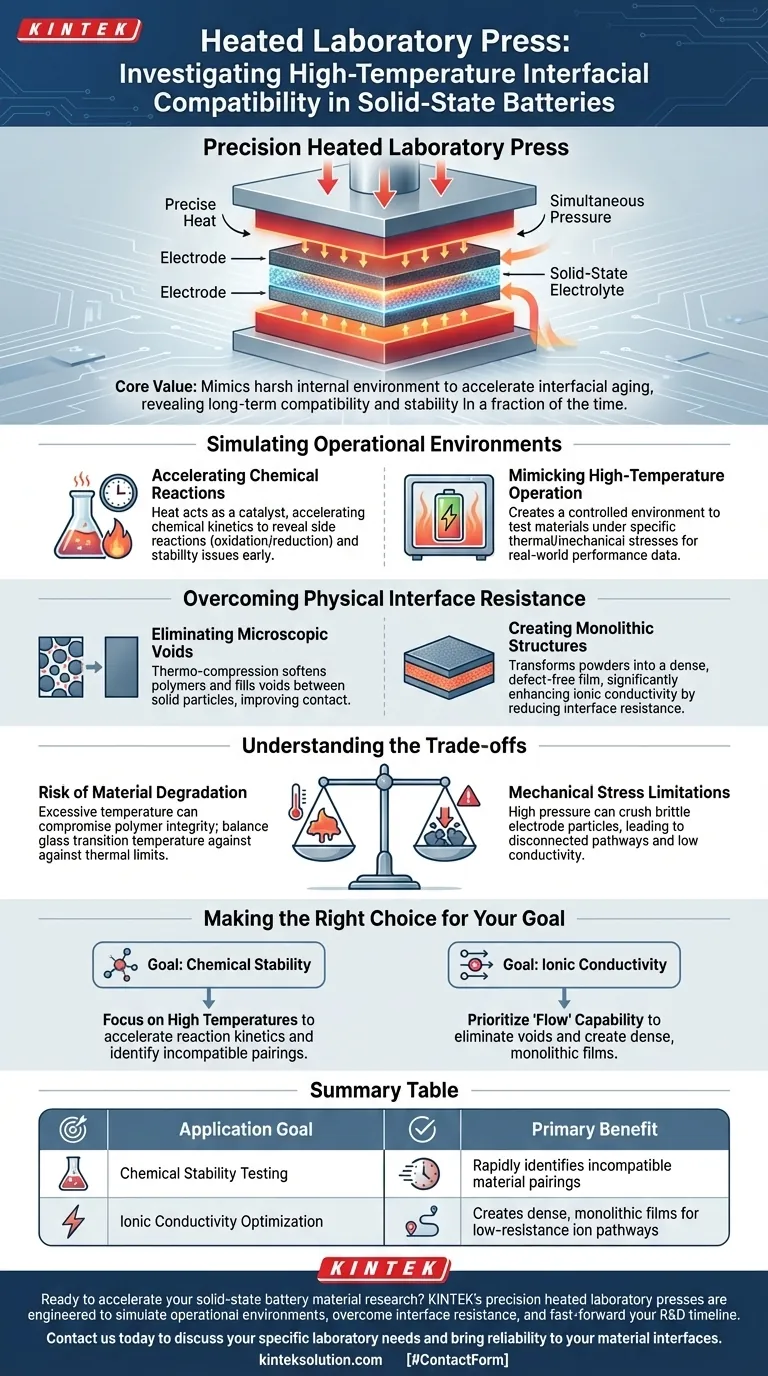
A heated laboratory press serves as a critical accelerator for evaluating solid-state battery interfaces. By applying simultaneous, precise heat and pressure to a co-pressed mixture of electrolyte and electrode powders, the device mimics the harsh internal environment of a battery in operation. This process forces intimate material contact and speeds up potential chemical reactions, allowing researchers to determine long-term compatibility and stability in a fraction of the standard testing time.
The core value of the heated press lies in its ability to artificially accelerate interfacial aging; by forcing solids together under thermal stress, it exposes chemical incompatibilities and physical voids that would otherwise degrade performance over months of usage.
Simulating Operational Environments
Accelerating Chemical Reactions
To test compatibility, researchers co-press electrolyte and electrode powders at elevated temperatures. Heat acts as a catalyst, accelerating chemical kinetics at the interface between the two materials.
This allows you to observe potential side reactions, such as oxidation or reduction, much faster than they would occur at room temperature. It effectively "fast-forwards" the aging process to reveal stability issues early.
Mimicking High-Temperature Operation
Solid-state batteries often operate at higher temperatures to improve conductivity. The heated press creates a controlled simulation environment that replicates these exact conditions.
By testing materials under these specific thermal and mechanical stresses, you generate data that is directly applicable to real-world battery performance limits.
Overcoming Physical Interface Resistance
Eliminating Microscopic Voids
One of the primary challenges in solid-state batteries is the high resistance caused by poor contact between solid particles. A heated press addresses this by simultaneously softening and compressing the materials.
In systems using thermoplastic polymers, the heat melts or softens the polymer matrix. The applied pressure then forces this viscous material to flow into and fill the microscopic voids between solid particles.
Creating Monolithic Structures
The result of this thermo-compression is a dense, homogenous, and defect-free film. This process transforms separate powders into a unified, monolithic structure.
This intimate contact is vital for reducing solid-solid interface resistance. It creates a continuous pathway for ions, significantly enhancing the overall ionic conductivity of the system.
Understanding the Trade-offs
The Risk of Material Degradation
While heat improves contact, excessive temperature can compromise the structural integrity of polymer-based electrolytes. It is critical to balance the glass transition temperature against the thermal limits of the active materials.
Overheating during the pressing phase can degrade the polymer chains or alter the crystallography of the electrode, rendering the test results invalid.
Mechanical Stress Limitations
Applying high pressure is necessary to densify the material, but it carries the risk of mechanically damaging brittle electrode particles.
If the pressure exceeds the material's compressive strength, you risk crushing the active material rather than just bonding it. This can lead to disconnected pathways and falsely low conductivity readings.
Making the Right Choice for Your Goal
To maximize the utility of a heated laboratory press for your specific research objectives:
- If your primary focus is Chemical Stability: Utilize high temperatures to accelerate reaction kinetics at the interface to rapidly identify incompatible material pairings.
- If your primary focus is Ionic Conductivity: Prioritize the "flow" capability of the press to eliminate voids and create a dense, defect-free monolithic film.
The heated press is not just a manufacturing tool; it is a time machine that reveals the future reliability of your material interfaces.
Summary Table:
| Application Goal | Key Function of Heated Press | Primary Benefit |
|---|---|---|
| Chemical Stability Testing | Accelerates interfacial reaction kinetics with heat | Rapidly identifies incompatible material pairings |
| Ionic Conductivity Optimization | Eliminates microscopic voids via thermo-compression | Creates dense, monolithic films for low-resistance ion pathways |
Ready to accelerate your solid-state battery material research?
KINTEK's precision heated laboratory presses are engineered to help you simulate operational environments, overcome interface resistance, and fast-forward your R&D timeline. Our automatic lab presses, isostatic presses, and heated lab presses provide the precise control you need to test chemical stability and optimize ionic conductivity effectively.
Contact us today using the form below to discuss how our lab press machines can serve your specific laboratory needs and bring reliability to your material interfaces.
Visual Guide
Related Products
- 24T 30T 60T Heated Hydraulic Lab Press Machine with Hot Plates for Laboratory
- Heated Hydraulic Press Machine with Heated Plates for Vacuum Box Laboratory Hot Press
- Laboratory Split Manual Heated Hydraulic Press Machine with Hot Plates
- Automatic Heated Hydraulic Press Machine with Hot Plates for Laboratory
- Automatic Heated Hydraulic Press Machine with Heated Plates for Laboratory
People Also Ask
- Function of a Laboratory Hydraulic Press with Heated Platens in SSE? Enhance Battery Density & Conductivity
- Why is a laboratory hydraulic press with heating plates required for PLA/TEC films? Achieve Precise Sample Integrity
- What role does a laboratory heated hydraulic press play in LTCC? Essential for High-Density Ceramic Lamination
- What is the primary function of a laboratory heated hydraulic press? Mastering Thermoplastic Carbon Fiber Composites
- What is the critical role of a laboratory heated hydraulic press? Mastering PVC Sample Prep for Testing



















