
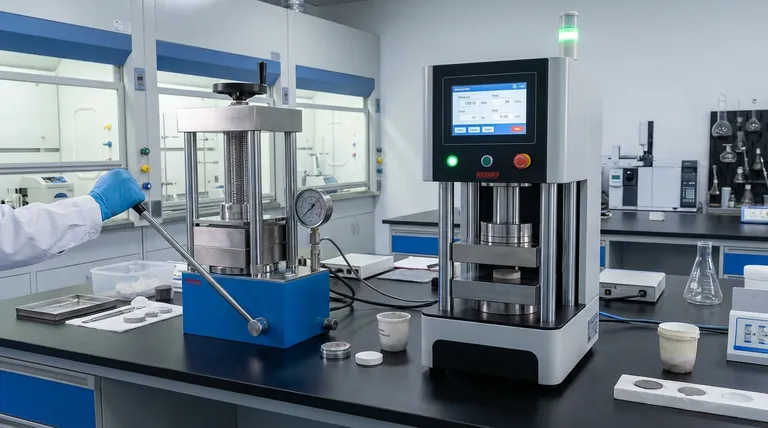
The fundamental difference lies in the drive mechanism: Automatic hydraulic presses utilize an electric motor and programmable controls to generate and regulate force, whereas manual presses rely on the physical effort of an operator pumping a lever. While manual presses are cost-effective and simple for low-volume tasks, automatic presses are essential for removing human error and ensuring precise repeatability across high-throughput workflows.
While manual presses offer an economical entry point for infrequent use, automatic presses decouple the quality of the sample from the physical strength and skill of the operator. The investment in automation is primarily an investment in data consistency and workflow efficiency.
Mechanisms of Action and Control
The Power Source
Manual hydraulic presses are purely mechanical. The operator builds pressure by physically pumping a handle. While these units can generate significant force (often up to 25 tons), reaching the higher end of this range can be physically demanding and tiring for the user.
Automatic hydraulic presses replace physical labor with an electric motor. This motor drives the pump and utilizes electric switches to control relief valves. The machine handles the exertion, ensuring that the full tonnage can be reached effortlessly every time.
Consistency and Human Error
In a manual press, the consistency of the pressure application depends entirely on the operator's technique. Slight variations in how the lever is pumped or when the pressure is released can lead to inconsistencies between samples.
Automatic presses eliminate this variable. Because they operate based on programmed settings, they apply the exact same pressure profile to every sample. This automation minimizes the risk of human error, resulting in highly reliable outcomes critical for sensitive analyses like XRF or FTIR.
Impact on Laboratory Workflow
Autonomy and Efficiency
A major advantage of automatic presses is autonomous operation. Once the technician programs the desired load and dwell time, the press performs the cycle without further intervention.
This allows laboratory personnel to attend to other tasks while the sample is being prepared, significantly increasing overall lab efficiency. Conversely, a manual press requires the operator's full attention and physical presence throughout the entire pressing cycle.
Throughput Capabilities
Manual presses are generally best suited for infrequent use. Their simpler design makes them cost-effective for labs that only need to press a few samples a week.
Automatic presses are designed for high-throughput environments. In busy laboratories where dozens of samples must be prepared daily, the speed and lack of physical fatigue associated with automatic systems become a necessity rather than a luxury.
Understanding the Trade-offs
Cost vs. Complexity
Manual presses are the lowest cost option. They are mechanically simpler, which often translates to a lower purchase price and fewer electronic components that could require maintenance.
Automatic presses represent a higher upfront capital cost. They are complex machines involving motors and electronic logic, aimed at facilities where the cost is justified by the volume of work and the need for data precision.
Footprint and Portability
If space is a critical constraint, manual presses often have the advantage. They can be found in compact, full-size benchtop models or even handheld configurations.
Automatic presses typically require a dedicated bench space and a power source. While manual presses offer high customization and quality comparable to larger units, their primary advantage in this category is their ability to fit into facilities with limited room.
Making the Right Choice for Your Laboratory
To select the correct equipment, you must weigh your budget against your need for sample throughput and reproducibility.
- If your primary focus is budget and low volume: A manual press is the most cost-effective solution for pressing samples infrequently where speed is not critical.
- If your primary focus is data consistency and precision: An automatic press is required to ensure that every sample is subjected to identical force, removing operator variability.
- If your primary focus is workflow efficiency: An automatic press is the best choice, as it allows technicians to multitask while the equipment operates autonomously.
Ultimately, the right press is the one that matches your laboratory's volume requirements while delivering the level of precision your specific analysis demands.
Summary Table:
| Feature | Manual Press | Automatic Press |
|---|---|---|
| Power Source | Operator's physical effort | Electric motor |
| Control | Manual lever pumping | Programmable settings |
| Consistency | Dependent on operator skill | Highly repeatable, minimal error |
| Best For | Low volume, budget-focused labs | High-throughput, precision-critical workflows |
| Operator Role | Active throughout cycle | Set program, multitask during cycle |
Struggling with sample prep inconsistencies or low throughput? KINTEK's automatic lab presses are engineered to eliminate human error and maximize your laboratory's efficiency. Our hydraulic presses (including automatic, isostatic, and heated models) deliver the precise, repeatable performance that sensitive analyses demand. Let us help you achieve superior data quality and workflow autonomy. Contact our experts today to find the perfect press for your lab's specific needs!
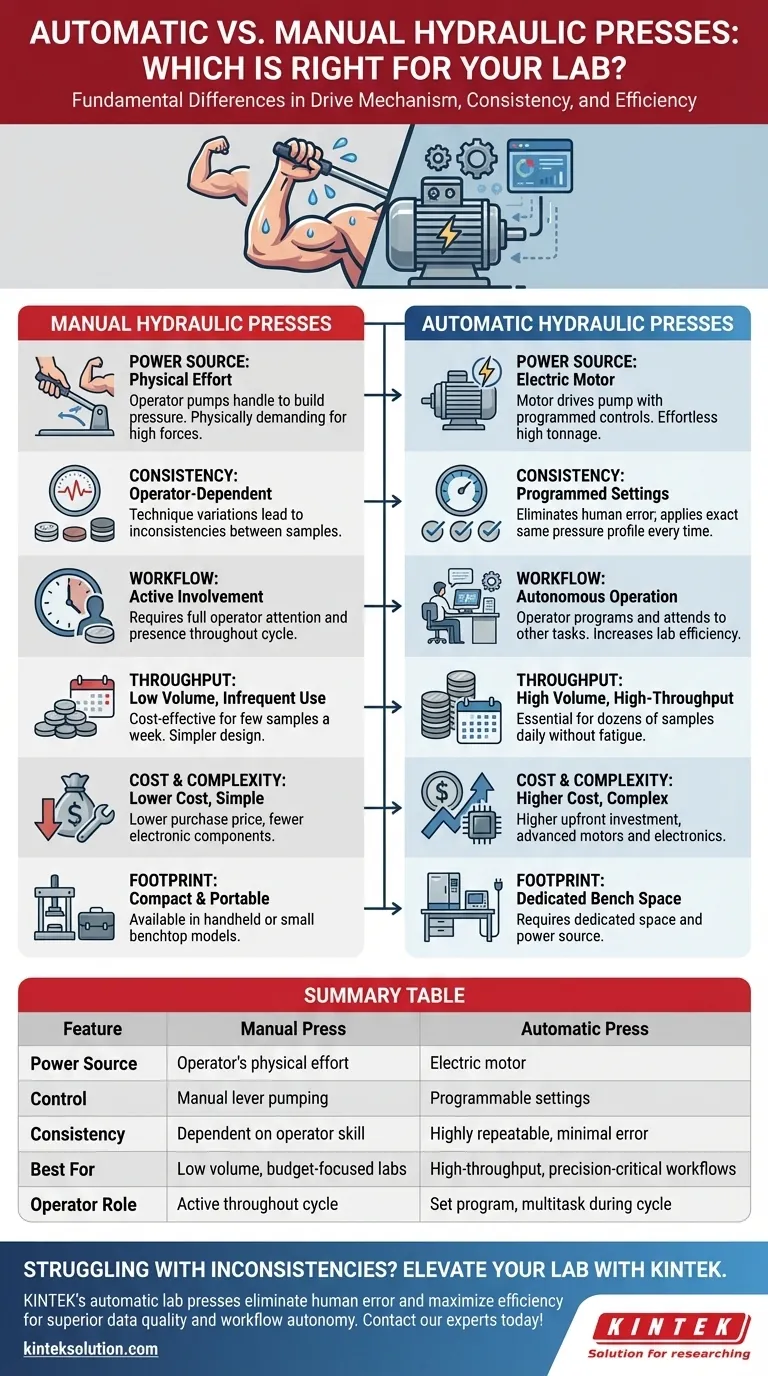
Visual Guide
Related Products
- Automatic Laboratory Hydraulic Press Lab Pellet Press Machine
- Automatic Heated Hydraulic Press Machine with Hot Plates for Laboratory
- Automatic Heated Hydraulic Press Machine with Heated Plates for Laboratory
- Automatic Laboratory Hydraulic Press for XRF and KBR Pellet Pressing
- Automatic High Temperature Heated Hydraulic Press Machine with Heated Plates for Lab
People Also Ask
- What is the primary purpose of a manual lab hydraulic pellet press? Ensure Accurate Sample Prep for XRF and FTIR
- What is the primary purpose of manual lab hydraulic pellet presses? Achieve High-Precision Sample Preparation for Spectroscopy
- How does an automatic laboratory hydraulic press improve KBr pellet preparation? Achieve Precision IR Spectroscopy
- What are the advantages of using an automatic laboratory hydraulic press? Enhance Precision in Sample Preparation
- What are the technical advantages of an automatic laboratory hydraulic press for biomimetic surfaces?



















