
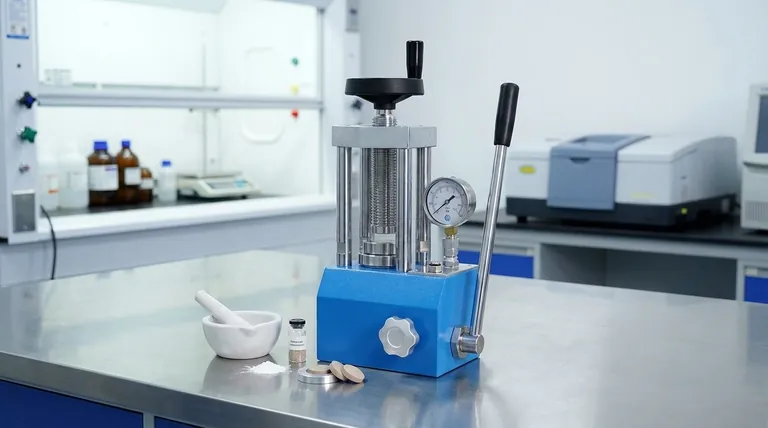
Manual hydraulic presses operate via a hand-actuated lever system that drives a piston into a cylinder filled with hydraulic fluid. By mechanically pumping the lever, the operator generates significant compressive force on a sample without the application of heat. While these devices are a standard, cost-effective solution for creating pellets for FTIR or XRF analysis, they are inherently limited by the physical exertion required for operation and the potential for inconsistency caused by human variance.
While manual presses provide an economical and space-saving entry point for laboratory sample preparation, they introduce a "human variable" into the workflow. The reliance on operator technique often results in slight pressure variations that can impact the repeatability of analytical results.
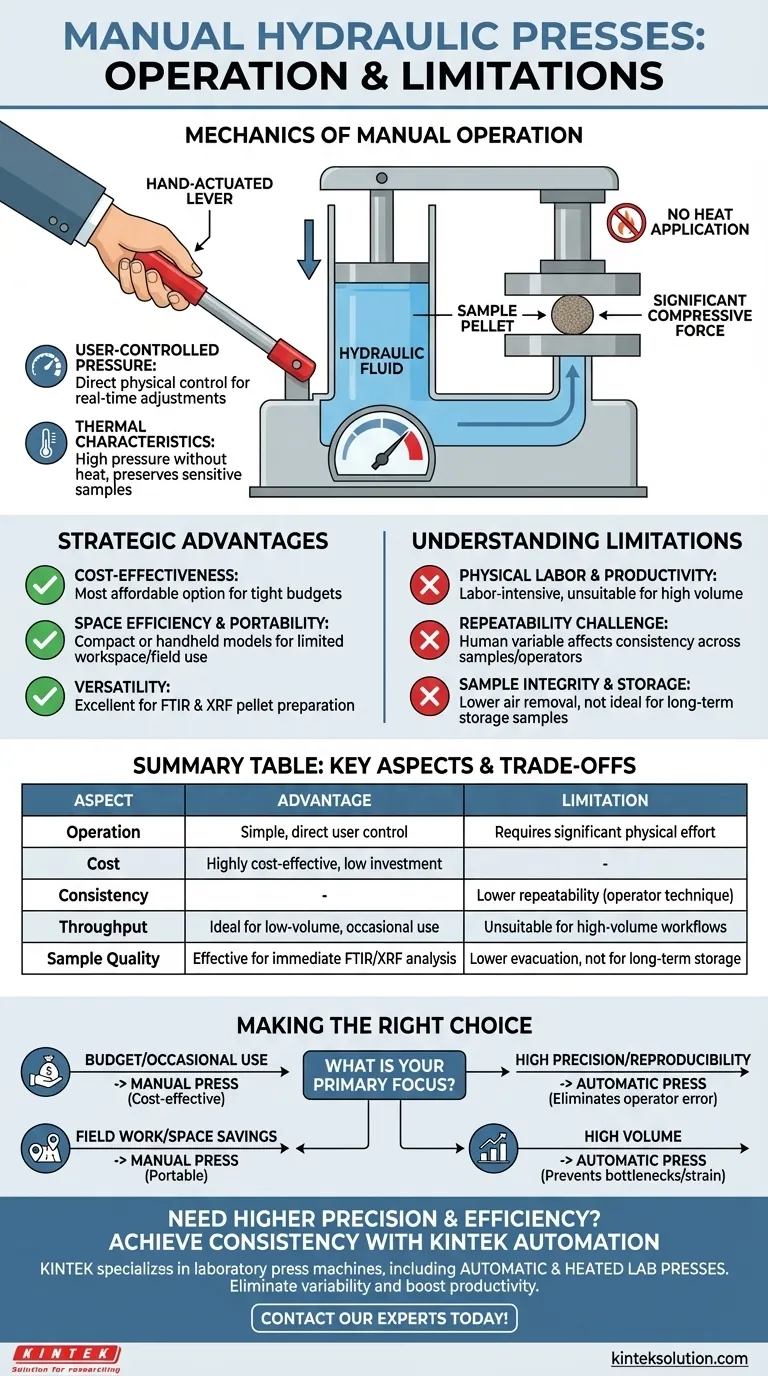
The Mechanics of Manual Operation
The Hydraulic Principle
At its core, the machine utilizes a fluid-filled cylinder. When the user pumps the hand lever, it moves a piston, displacing hydraulic oil to generate force.
User-Controlled Pressure
Unlike automatic systems that utilize electric motors, the operator has total physical control over the pressure load. This allows for real-time adjustments but requires constant manual input to maintain the desired force.
Thermal Characteristics
These presses are designed to exert high pressure—often for pelletizing powder samples—without introducing additional heat. This preserves the chemical integrity of heat-sensitive samples during preparation.
Strategic Advantages in the Laboratory
Cost-Effectiveness
Manual presses are generally the most affordable option for hydraulic compression. They are the ideal choice for laboratories with strict budget constraints where the high cost of automation cannot be justified.
Space Efficiency and Portability
These units are available in full-size benchtop models or compact handheld versions. Their small footprint makes them suitable for facilities with limited workspace or for field applications where portability is required.
Versatility for Analytical Techniques
Despite their simplicity, manual presses offer high customization and quality comparable to larger units. They are specifically recognized for their ability to produce effective pellets for FTIR (Fourier Transform Infrared Spectroscopy) and XRF (X-Ray Fluorescence) analysis.
Understanding the Limitations and Trade-offs
Physical Labor and Productivity
The most significant drawback is the physical effort required. Creating samples is labor-intensive, making these presses unsuitable for high-volume workflows where operator fatigue could become a safety or productivity issue.
The Repeatability Challenge
Because pressure application depends on the operator's physical technique, the load can vary slightly between samples. This lack of absolute consistency can affect the reproducibility of data, especially when different technicians operate the same machine.
Sample Integrity and Storage
Manual presses generally have lower "evacuation efficiency" compared to advanced hydraulic systems. This means they are less effective at removing air from the sample, making them unsuitable for creating samples intended for long-term storage.
Making the Right Choice for Your Goal
To determine if a manual hydraulic press is the correct tool for your laboratory, consider your volume of work and your tolerance for variability.
- If your primary focus is Budget or Occasional Use: A manual press is the most cost-effective solution for low-throughput labs where samples are prepared infrequently.
- If your primary focus is Field Work or Space Savings: The handheld or compact footprint of a manual press offers necessary portability that automatic units cannot match.
- If your primary focus is High Precision and Reproducibility: You should consider an automatic press to eliminate operator error and ensure identical pressure application for every sample.
- If your primary focus is High Volume: Avoid manual presses to prevent productivity bottlenecks and physical strain on laboratory staff.
For general analytical needs where throughput is low and budgets are tight, the manual hydraulic press remains a reliable workhorse.
Summary Table:
| Aspect | Advantage | Limitation |
|---|---|---|
| Operation | Simple, direct user control | Requires significant physical effort |
| Cost | Highly cost-effective, low initial investment | - |
| Consistency | - | Lower repeatability due to operator technique |
| Throughput | Ideal for low-volume, occasional use | Unsuitable for high-volume workflows |
| Sample Quality | Effective for immediate FTIR/XRF analysis | Lower evacuation efficiency, not for long-term storage |
Need a more consistent and efficient solution for your lab?
While manual presses are a great entry point, achieving high precision and reproducibility often requires automation. KINTEK specializes in laboratory press machines, including automatic lab presses and heated lab presses, designed to eliminate operator variability and boost your productivity.
Let us help you enhance your sample preparation workflow. Contact our experts today to find the perfect press for your specific needs!
Visual Guide
Related Products
- Manual Heated Hydraulic Lab Press with Integrated Hot Plates Hydraulic Press Machine
- Manual Laboratory Hydraulic Press Lab Pellet Press
- Laboratory Manual Heated Hydraulic Press Machine with Hot Plates
- Manual Laboratory Hydraulic Pellet Press Lab Hydraulic Press
- Laboratory Split Manual Heated Hydraulic Press Machine with Hot Plates
People Also Ask
- Why is a laboratory hydraulic press with heating plates required for PLA/TEC films? Achieve Precise Sample Integrity
- Why is a manual hydraulic heated lab press essential for compleximer materials? Unlock Advanced Material Synthesis
- Function of a Laboratory Hydraulic Press with Heated Platens in SSE? Enhance Battery Density & Conductivity
- What role does a lab manual hydraulic press play in Li9B19S33 ionic conductivity? Optimize Pellet Characterization
- What are the main benefits of performing proper maintenance on a heated lab press? Ensure Accuracy & Safety



















