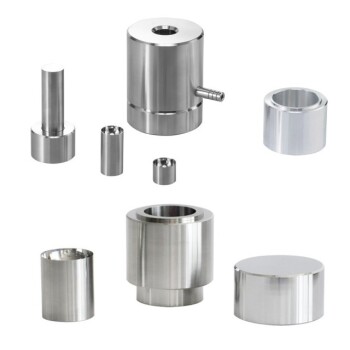
The punches of a lab press serve as the primary drivers of mechanical force during the molding process. By applying high-magnitude axial pressure to metal powder confined within a rigid die, the punches force the particles to undergo significant plastic deformation. This physical alteration is the catalyst for cold welding, creating a cohesive solid without the application of external heat.
The core mechanism of cold welding relies on the mechanical rupture of oxide layers, not temperature. The punches supply the compressive force necessary to strip away these surface impurities, allowing fresh, reactive metal surfaces to make contact and bond instantly.
The Mechanics of Particle Interaction
The Role of Axial Pressure
The punches are responsible for delivering a controlled mechanical load to the powder.
This force is applied unidirectionally along the axis of the die.
By compressing the powder, the punches initiate the rearrangement of particles, reducing the volume of internal voids and increasing the density of the material.
Inducing Plastic Deformation
Mere compression is not enough to bond metal; the particles must change shape.
The pressure exerted by the punches causes the metal particles to undergo plastic deformation.
This irreversible change in shape maximizes the contact area between individual granules, moving them beyond simple packing into a state of structural interlocking.
Breaking the Oxide Barrier
The Surface Problem
Most metal powder particles are naturally coated with a thin, brittle oxide layer.
This layer acts as a barrier, preventing the underlying metal from bonding with neighboring particles.
Without breaching this "skin," the powder would remain loose regardless of how tightly it is packed.
Rupturing the Layer
The deformation caused by the punches is critical for breaking this barrier.
As the particles deform under pressure, the brittle oxide layers fracture and rupture.
This process exposes the "fresh" or virgin metal underneath, which has not yet been passivated by oxygen.
The Cold Welding Effect
When these distinct, fresh metal surfaces are forced into contact, a cold welding effect occurs.
This results in atomic-level bonding between the particles.
This bonding is what transforms loose powder into a unified solid, known in the industry as a "green body."
Understanding the Trade-offs
The Necessity of "Sufficient" Force
The pressure applied by the punches cannot be arbitrary; it must meet a specific threshold.
The mechanical force must be sufficient to rupture the oxide layers.
If the pressure is too low, particles may pack together, but they will not cold weld, resulting in a compact with zero structural integrity.
Green Strength vs. Final Strength
It is important to distinguish between the strength achieved here and the final material properties.
The cold welding provides green strength, which is merely sufficient for the part to maintain its geometric stability during handling.
This is a foundational step; the green compact typically requires subsequent processes, such as sintering or hot pressing, to achieve its final mechanical potential.
Making the Right Choice for Your Goal
To optimize your pressing process, consider the specific requirements of your material and end-application.
- If your primary focus is Handling Strength: Ensure your press applies enough pressure to induce plastic deformation, as this is the only way to achieve the cold welding required for geometric stability.
- If your primary focus is Material Purity: Recognize that the rupture of oxide layers is a physical cleaning process, allowing for high-quality metal-to-metal contact without chemical additives.
The punches do not simply pack powder; they mechanically activate the material to create a self-sustaining structure.
Summary Table:
| Stage | Action of Punches | Physical Result |
|---|---|---|
| Compression | Apply high-magnitude axial force | Particle rearrangement and void reduction |
| Deformation | Induce plastic shape change | Maximize surface contact and interlocking |
| Activation | Rupture brittle oxide layers | Exposure of fresh, reactive virgin metal |
| Bonding | Force metal-to-metal contact | Cold welding and creation of a 'green body' |
Elevate Your Powder Metallurgy Research with KINTEK
Precise control over mechanical force is the difference between a fragile compact and a high-integrity green body. KINTEK specializes in comprehensive laboratory pressing solutions, offering manual, automatic, heated, multifunctional, and glovebox-compatible models, alongside advanced cold and warm isostatic presses designed for the rigors of battery research and material science.
Our equipment ensures you deliver the exact pressure needed to rupture oxide layers and achieve superior cold welding. Contact us today to find the perfect pressing solution for your lab's unique requirements!
References
- Raphael Basílio Pires Nonato, Thomaz Augusto Guisard Restivo. HYBRID UNCERTAINTY QUANTIFICATION IN METAL ALLOY POWDER COMPACTION. DOI: 10.29327/xxiiconemi.572539
This article is also based on technical information from Kintek Solution Knowledge Base .
Related Products
- XRF KBR Steel Ring Lab Powder Pellet Pressing Mold for FTIR
- Lab Polygon Press Mold
- Lab Round Bidirectional Press Mold
- Square Lab Press Mold for Laboratory Use
- Square Bidirectional Pressure Mold for Lab
People Also Ask
- What considerations are important regarding the die size of an XRF pellet press? Optimize for Your XRF Spectrometer and Sample
- Why are pellets used in XRF analysis, and what is their limitation? Boost Accuracy and Speed in Your Lab
- What is the general process for preparing a sample pellet for XRF? Master Consistency for Accurate Analysis
- What are the differences between manual and automatic XRF pellet presses? Choose the Right Press for Your Lab's Needs
- What are the different types of XRF pellet preparation methods available? Manual, Hydraulic, and Automated Presses Explained