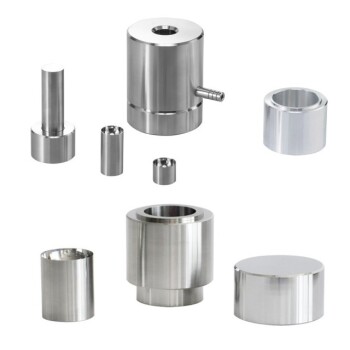
A laboratory mechanical lab press functions as the critical first step in material consolidation. It applies high-intensity uniaxial pressure to loose thermoelectric powders, compressing them into cohesive, solid forms known as "green bodies." This process creates a physical prototype with defined dimensions and sufficient structural strength to withstand immediate handling, effectively converting a difficult-to-manage powder into a stable, workable solid.
While the ultimate goal is high material density, the mechanical press focuses on the essential "pre-shaping" phase. By expelling air and establishing a preliminary particle bond, it ensures the material has the structural integrity required for subsequent, high-pressure densification processes.
The Mechanics of Powder Consolidation
Applying Uniaxial Pressure
The press exerts significant vertical force—often amounting to several tons—directly onto the mixed powders contained within a mold.
This high-intensity uniaxial pressure forces the loose particles to rearrange mechanically.
Expelling Trapped Air
In their raw state, powders contain significant voids filled with air.
The compression process forces this air out of the matrix. This increases the initial densification of the sample before any thermal processing begins.
Establishing Particle Bonds
As particles are forced closer together, they establish a preliminary tight bond.
This rearrangement transforms the material from a loose collection of granules into a unified structure.
Creating a Stable "Green Body"
Defining Physical Geometry
The primary output of this process is a green body—a solid, compressed part that is not yet fully sintered.
This step provides the physical prototype, establishing the precise dimensional control needed for the final component.
Preventing Fragmentation
Raw powders are impossible to move or process without a container.
The mechanical press imparts enough structural strength to prevent fragmentation. This allows the sample to be removed from the mold and transferred to a furnace or sintering device without crumbling.
Understanding the Trade-offs
Mechanical vs. Final Density
It is crucial to understand that mechanical pressing is generally a preparatory step, not the final densification method.
While it increases density significantly compared to loose powder, it creates a foundation for subsequent processes rather than a fully dense final product.
Directional Limitations
Because the pressure is uniaxial (applied from the top/bottom), density gradients can occur in taller samples.
The friction between the powder and the mold walls can sometimes result in uneven compression compared to isostatic pressing methods.
Making the Right Choice for Your Goal
To maximize the utility of a mechanical lab press in your thermoelectric research, consider your specific processing requirements:
- If your primary focus is handling efficiency: Ensure you apply sufficient pressure to maximize green strength, which prevents sample breakage during transfer to sintering equipment.
- If your primary focus is dimensional accuracy: Utilize the mechanical press to establish strict geometric parameters, creating a consistent baseline for the final shrinkage that occurs during sintering.
The mechanical lab press bridges the gap between raw potential and a workable solid, laying the structural groundwork for high-performance thermoelectric materials.
Summary Table:
| Stage of Process | Core Function | Primary Outcome |
|---|---|---|
| Uniaxial Pressure | Mechanical rearrangement of loose particles | High-intensity compression |
| Air Expulsion | Removal of voids within the powder matrix | Increased initial density |
| Particle Bonding | Establishing tight mechanical connections | Formation of a unified structure |
| Green Body Creation | Defining physical dimensions and geometry | Structural integrity for handling |
Elevate Your Battery and Material Research with KINTEK
Precision in the initial shaping phase is critical for the performance of your final thermoelectric materials. KINTEK specializes in comprehensive laboratory pressing solutions designed to meet the rigorous demands of modern research. Whether you require manual, automatic, heated, or multifunctional models, or are looking for advanced cold and warm isostatic presses, our equipment ensures consistent green body density and structural integrity.
Ready to optimize your powder consolidation process? Contact us today to discover how KINTEK’s expert solutions can enhance your lab's efficiency and research outcomes.
References
- Md. Ferdous Rahman. Fabrication of Thermoelectric Module from Efficient Earth Abundant Thermoelectric Materials. DOI: 10.37502/ijsmr.2022.5701
This article is also based on technical information from Kintek Solution Knowledge Base .
Related Products
- Lab Round Bidirectional Press Mold
- Special Shape Lab Press Mold for Laboratory Applications
- Lab Polygon Press Mold
- XRF KBR Plastic Ring Lab Powder Pellet Pressing Mold for FTIR
- Cylindrical Lab Electric Heating Press Mold for Laboratory Use
People Also Ask
- What is the purpose of incorporating cartridge heaters into a lab press mold for MLCC block compression? Optimize Results
- Why is precise cooling management of the lab press mold necessary? Protect Core Integrity in Thermoforming
- What is the function of a pressing tool in thermoplastic panels? Master Precision Shaping & Fusion Bonding
- Why is a high-performance laboratory molding press critical for in-situ electrolyte formation? Unlock Battery Success
- How do the design and geometric precision of pressing molds and mandrels affect the quality of PTFE composite samples?