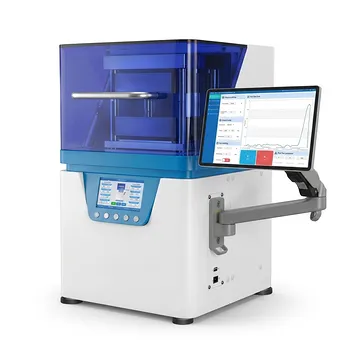
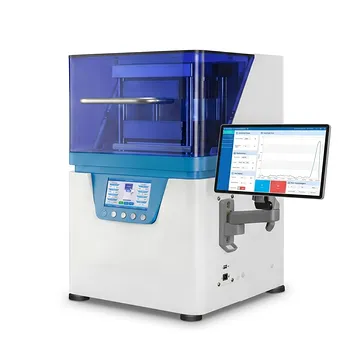
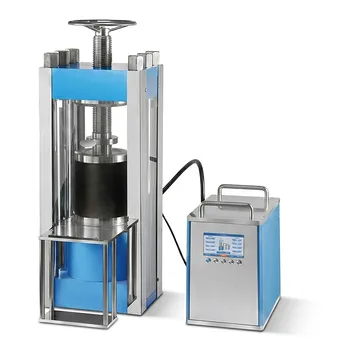
Induction heating in hot pressing functions by generating heat directly within a conductive mold using a high-frequency electromagnetic field. Rather than applying heat from an external element, an induction coil surrounds a graphite or steel mold, causing it to generate internal heat while cylinders simultaneously apply mechanical pressure to the powder inside.
The core advantage of this method is the complete independence of thermal energy and mechanical pressure. While this allows for precise processing of complex materials, it requires careful management of heat-up rates and coil alignment to prevent mold failure.
The Mechanics of the Process
Generating the Electromagnetic Field
The process begins with an induction coil powered by a high-frequency generator.
When activated, this coil creates a powerful, fluctuating electromagnetic field. This field is the engine of the heating process, but it does not touch the mold physically.
Internal Heat Production
The mold, typically made of graphite or steel, is placed inside the coil.
When subjected to the electromagnetic field, heat is produced directly within the material of the mold itself. This internal generation of heat is rapid and efficient, transferring thermal energy to the powder contained within the mold.
Simultaneous Pressure Application
While the mold heats up, the hot pressing system applies mechanical force.
One or two hydraulic cylinders drive punches into the mold. This compresses the heated powder, consolidating it into a solid mass.
Operational Advantages
Decoupling Power and Pressure
A distinct benefit of induction heating is the complete independence of the inductive power (heat) and the applied pressure.
Operators can adjust the temperature profile without affecting the mechanical pressure, and vice versa. This flexibility is critical for tailoring the process to specific material requirements.
Suitability for Liquid Phases
This method is particularly effective for processing powders that involve a liquid phase during sintering.
Because the process allows for precise thermal control, it can manage the transition states of materials better than some alternative heating methods.
Low-Pressure Operation
Induction hot pressing is capable of effective operation even at low pressures.
This versatility allows it to accommodate delicate materials or specific densification strategies that do not require immense mechanical force.
Understanding the Trade-offs
Limited Magnetic Penetration
The magnetic field generated by the coil has a shallow penetration depth, typically reaching only 0.5mm to 3mm into the mold.
Because the field does not penetrate the entire thickness of the mold, the process relies heavily on the thermal conductivity of the mold material to transfer heat to the core.
Risk of Thermal Shock
If the heat-up rate is too aggressive, significant temperature differences can develop between the mold's surface (where heat is generated) and its core.
These thermal gradients can create structural stress. In extreme cases, this can lead to the destruction of the mold.
Complexity and Cost
The system relies on good inductive coupling and precise alignment.
If the mold is not aligned correctly within the coil, heat distribution will be uneven. Furthermore, the high-frequency generator required to drive the system represents a significant capital expense compared to simpler heating methods.
Making the Right Choice for Your Project
To determine if induction hot pressing is the correct solution for your application, consider your specific constraints:
- If your primary focus is processing complex powders: The ability to handle liquid phases and decouple pressure from heat makes this an excellent choice.
- If your primary focus is equipment budget: Be aware that the high-frequency generator adds significant expense compared to resistance heating options.
- If your primary focus is process speed: You must balance the desire for fast cycle times against the risk of destroying molds due to thermal gradients; rapid heating requires highly conductive mold materials.
Induction heating offers superior control and versatility, provided you can manage the technical demands of coil alignment and thermal distribution.
Summary Table:
| Feature | Induction Hot Pressing Detail |
|---|---|
| Heating Source | High-frequency electromagnetic field |
| Mold Materials | Graphite or Steel (Conductive) |
| Heat Generation | Internal (Induced within mold walls) |
| Key Advantage | Independent control of heat and pressure |
| Best Used For | Liquid phase sintering & complex powder processing |
| Penetration Depth | 0.5mm to 3mm (Surface-focused) |
Elevate Your Material Research with KINTEK Precision
Are you looking to optimize your sintering process with precise thermal control? KINTEK specializes in comprehensive laboratory pressing solutions, offering manual, automatic, heated, multifunctional, and glovebox-compatible models, as well as cold and warm isostatic presses widely applied in battery research.
Our expert team can help you navigate the complexities of induction heating, ensuring perfect coil alignment and thermal management for your specific applications. Discover the KINTEK advantage and enhance your lab's efficiency today.
Contact KINTEK for Expert Guidance
Related Products
- Automatic Heated Hydraulic Press Machine with Hot Plates for Laboratory
- Heated Hydraulic Press Machine with Heated Plates for Vacuum Box Laboratory Hot Press
- Automatic High Temperature Heated Hydraulic Press Machine with Heated Plates for Lab
- Automatic Hydraulic Heat Press Machine with Multi Stage Programmable Control and Integrated Water Cooling Plate Size 180x180mm
- Heated Hydraulic Press Machine With Heated Plates For Vacuum Box Laboratory Hot Press
People Also Ask
- Function of a Laboratory Hydraulic Press with Heated Platens in SSE? Enhance Battery Density & Conductivity
- Why is a laboratory hydraulic press with heating plates required for PLA/TEC films? Achieve Precise Sample Integrity
- How does a laboratory heated hydraulic press facilitate PBN sample prep for WAXS? Achieve Precise X-Ray Scattering
- What are the requirements for electrode pressing with high-viscosity ionic liquids like EMIM TFSI? Optimize Performance
- What are the industrial applications of heated hydraulic presses? Master Heat & Force for Precision Manufacturing