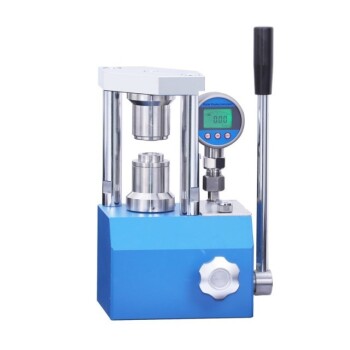
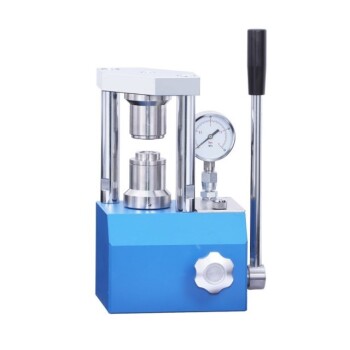
The operation of a battery crimper directly dictates the validity of your electrochemical data by establishing the internal mechanical environment of the cell. By applying precise and uniform sealing force, the crimper compresses internal components—such as the cathode, solid electrolyte, and anode—to create a stable solid-to-solid interface. This mechanical consistency is the prerequisite for minimizing interfacial resistance and preventing external contamination.
The crimper does more than merely close a case; it standardizes the internal contact pressure required to reduce interfacial resistance, ensuring that test results reflect the true chemistry of your materials rather than assembly defects.
The Role of Mechanical Pressure in Data Quality
Optimizing Solid-to-Solid Contact
The primary function of the crimper is to apply precise and uniform mechanical sealing force.
This force determines the compression of the cell's internal stack, including the current collectors, electrodes, and separators.
Proper compression establishes a tight solid-to-solid physical contact interface, which is essential for facilitating ion transport.
Reducing Interfacial Resistance
When components are compressed correctly, the impedance between layers drops significantly.
The primary reference notes that this reduction in interfacial resistance is critical for maintaining electrochemical stability.
This is particularly vital during high current density testing, where even minor resistance can cause significant voltage drops and heat generation.
Ensuring Data Repeatability
A laboratory crimper provides controlled pressure that manual assembly cannot match.
This ensures that every coin cell in a batch experiences the exact same internal conditions.
Without this mechanical consistency, variations in test data may be attributed to assembly inconsistencies rather than material performance.
Chemical Isolation and Long-Term Stability
Preventing Impurity Ingress
A high-quality seal isolates the sensitive internal chemistry from the external environment.
Proper crimping prevents the ingress of external air and moisture, which can react with lithium or sodium anodes and degrade performance.
This isolation is a fundamental requirement for obtaining credible electrochemical data.
Eliminating Electrolyte Leakage
The crimper must tightly bond the battery case with the sealing gasket.
This prevents the evaporation or leakage of liquid electrolytes during operation.
Leakage prevention is critical for safety and for observing long-term cycling stability, as electrolyte loss leads to premature capacity fade.
Understanding the Trade-offs: Precision vs. Variable Results
The Impact of Insufficient Pressure
If the crimper applies insufficient or uneven pressure, the internal components will lack the necessary physical contact.
This results in artificially high impedance, which can mask the true performance of high-conductive materials.
The Risk of Seal Degradation
Inadequate sealing acts as a ticking clock on your experiment.
While a cell might perform well in the first few cycles, a poor seal will eventually allow atmospheric contamination.
This invalidates long-term studies, such as those observing self-healing mechanisms, by introducing external variables that mimic degradation.
Making the Right Choice for Your Goal
To ensure your data is publication-ready, align your assembly process with your specific testing metrics:
- If your primary focus is High-Rate Performance: Prioritize a crimper that delivers high, uniform compression to minimize interfacial resistance and handle high current densities.
- If your primary focus is Long-Term Cycling: Ensure your crimping process creates a hermetic, leak-proof seal to prevent electrolyte loss and environmental contamination over weeks of testing.
Ultimately, the reliability of your electrochemical insights is limited by the mechanical precision of your cell assembly.
Summary Table:
| Factor | Impact on Testing Results | Importance for Data Quality |
|---|---|---|
| Mechanical Pressure | Lowers interfacial resistance & improves ion transport | Essential for high current density accuracy |
| Seal Hermeticity | Prevents moisture ingress & electrolyte evaporation | Critical for long-term cycling & chemical stability |
| Consistency | Standardizes internal contact pressure | Eliminates assembly-induced data variability |
| Interface Quality | Establishes stable solid-to-solid contact | Ensures performance reflects material chemistry |
Elevate Your Battery Research with KINTEK Precision
Don't let assembly defects mask your material innovations. KINTEK specializes in comprehensive laboratory pressing solutions designed to deliver the mechanical consistency your electrochemical testing demands. Whether you need manual, automatic, heated, multifunctional, or glovebox-compatible models, our equipment ensures a perfect hermetic seal every time.
From standard coin cells to advanced cold and warm isostatic presses for solid-state battery research, we provide the tools necessary to minimize resistance and maximize data repeatability.
Ready to standardize your cell assembly? Contact our laboratory experts today to find the perfect pressing solution for your research goals.
References
- Xilong Wang, Jia‐Qi Huang. A Robust Dual‐Layered Solid Electrolyte Interphase Enabled by Cation Specific Adsorption‐Induced Built‐In Electrostatic Field for Long‐Cycling Solid‐State Lithium Metal Batteries. DOI: 10.1002/anie.202421101
This article is also based on technical information from Kintek Solution Knowledge Base .
Related Products
- Button Battery Sealing Machine for Button Batteries
- Manual Button Battery Sealing Machine for Battery Sealing
- Button Battery Sealing Press Machine for Lab
- Laboratory Hydraulic Press Lab Pellet Press Button Battery Press
- Warm Isostatic Press for Solid State Battery Research Warm Isostatic Press
People Also Ask
- Why is a laboratory hydraulic press or battery sealing machine essential? Ensure Coin Cell Data Integrity
- What role does a laboratory press perform for CR2032 coin cell assembly? Ensure Precision in Battery Research
- Why is a high-pressure manual or automatic coin cell crimper required? Optimize Solid-State Battery Performance
- How does a high-precision lab press or coin cell crimper affect the performance of assembled lithium-metal batteries?
- How does the mechanical pressure provided by a laboratory crimper affect the performance of assembled 2032-type coin cells?