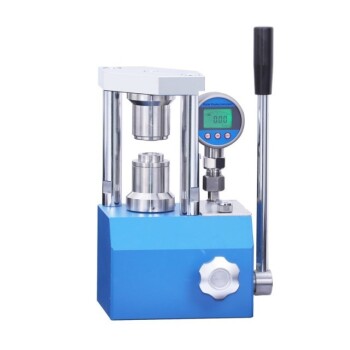
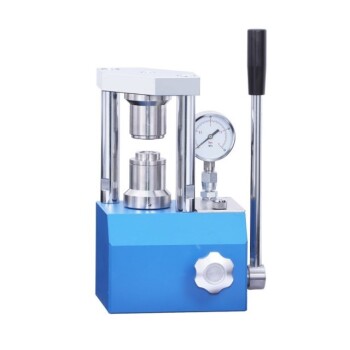
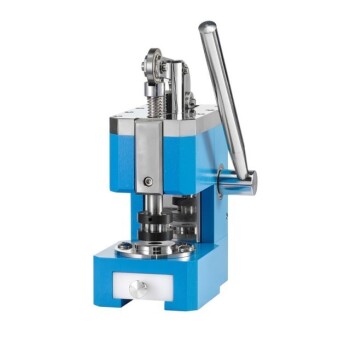
The operation of a coin cell crimper serves as the fundamental variable in determining the validity of your TPQB battery data. By applying precise mechanical pressure, the crimper creates a hermetic seal around the cathode, separator, anode, and electrolyte, ensuring that the internal environment remains stable and isolated from external variables.
Core Takeaway The crimper is not just an assembly tool; it is a calibration instrument for your data. Its primary function is to enforce precise mechanical pressure that minimizes internal contact resistance and prevents environmental contamination, ensuring that test results reflect the battery's true chemistry rather than assembly defects.
The Role of Mechanical Pressure
Establishing Internal Continuity
The crimper applies mechanical pressure to force the battery case, spring, gasket, and electrode components together.
This pressure ensures optimal physical contact between the active materials, separator, and anode. Without this tight junction, the internal components may shift or separate, leading to unreliable connectivity.
Minimizing Contact Resistance
Proper crimper operation directly influences electrochemical impedance.
By creating a uniform interface between components, the crimper significantly reduces interface contact resistance. This is critical for obtaining accurate data during Electrochemical Impedance Spectroscopy (EIS), as loose components introduce noise and artificial resistance into the results.
Sealing Integrity and Environmental Protection
Blocking Contaminants
A precise crimp creates a barrier against the external atmosphere.
The sealing pressure prevents moisture and oxygen from entering the stainless steel shell. In TPQB assemblies, ingress of these elements can cause immediate chemical failure or degradation, rendering test data useless.
Preventing Electrolyte Loss
The crimper ensures the gasket is compressed correctly to contain the electrolyte.
This prevents the leakage or evaporation of the electrolyte (whether aqueous or volatile). Maintaining the correct electrolyte volume is essential for ensuring the battery functions at its full potential throughout the testing period.
Impact on Long-Term Data Consistency
Stability Over High Cycle Counts
For long-term studies, such as those lasting up to 6,000 cycles, the initial crimp quality is the deciding factor for success.
Consistent sealing pressure ensures that the physical contact remains stable over time. If the crimp is weak, the internal structure may relax or degrade over thousands of cycles, leading to data drift that is unrelated to the actual battery chemistry.
Ensuring Repeatability
A high-precision hydraulic crimper eliminates variables between different test cells.
By applying consistent radial and axial pressure, the crimper ensures that every TPQB assembly is mechanically identical. This allows researchers to attribute performance differences to the battery materials rather than fluctuations in packaging pressure.
Common Pitfalls to Avoid
The Cost of Uneven Pressure
If the crimper applies pressure unevenly, it can warp the casing or pinch the gasket incorrectly.
This leads to fluctuations in internal resistance, creating "noisy" charge-discharge curves. Inconsistent pressure often masks the true performance characteristics of the battery materials.
The Risk of "Soft" Crimps
Failing to apply sufficient pressure results in a "soft" crimp, where the seal appears visually correct but fails chemically.
This allows for slow evaporation of the electrolyte or gradual oxidation of the anode. The result is often a battery that performs well initially but fails prematurely during long-term cycling tests.
Making the Right Choice for Your Goal
To ensure your TPQB battery testing yields valid, publishable results, align your crimping process with your specific analytical goals:
- If your primary focus is Long-Term Cycling (e.g., 6,000+ cycles): Prioritize seal integrity to prevent moisture ingress and electrolyte evaporation over extended periods.
- If your primary focus is Electrochemical Impedance Spectroscopy (EIS): Prioritize high-precision, uniform pressure application to minimize and stabilize interface contact resistance.
- If your primary focus is Material Comparison: Ensure your crimper settings are locked and consistent to eliminate packaging pressure as a variable between different samples.
The quality of your data can never exceed the quality of your seal.
Summary Table:
| Impact Factor | Role in TPQB Battery Assembly | Effect on Data Accuracy |
|---|---|---|
| Mechanical Pressure | Establishes physical contact between components | Minimizes contact resistance; improves EIS clarity |
| Sealing Integrity | Compresses gasket to isolate internal environment | Prevents moisture ingress and electrolyte evaporation |
| Structural Stability | Maintains component alignment over time | Ensures consistency during long-term cycling (6,000+ cycles) |
| Uniformity | Applies consistent radial and axial force | Eliminates packaging variables for reliable material comparison |
Elevate Your Battery Research with KINTEK Precision
Don't let assembly variables compromise your research data. KINTEK specializes in comprehensive laboratory pressing solutions designed to provide the repeatability and precision your battery studies demand. Whether you are conducting long-term cycling or sensitive EIS analysis, our range of equipment ensures a perfect seal every time:
- Manual & Automatic Crimpers: High-precision pressure control for consistent cell assembly.
- Heated & Multifunctional Models: Specialized solutions for advanced material testing.
- Glovebox-Compatible Designs: Seamlessly integrate your crimping process into inert environments.
- Cold & Warm Isostatic Presses: Professional-grade tools widely applied in high-performance battery research.
Ready to achieve superior data consistency? Contact KINTEK today to find the ideal pressing solution for your laboratory.
References
- Susu Li, Yuesheng Li. Molecular Engineering Empowers Phenanthraquinone Organic Cathodes with Exceptional Cycling Stability for Lithium‐ and Aqueous Zinc‐Ion Batteries. DOI: 10.1002/advs.202506749
This article is also based on technical information from Kintek Solution Knowledge Base .
Related Products
- Lab Button Battery Disassembly and Sealing Mold
- Button Battery Sealing Machine for Button Batteries
- Manual Button Battery Sealing Machine for Battery Sealing
- Lab Button Battery Tablet Press Sealing Mold
- Button Battery Sealing Press Machine for Lab
People Also Ask
- How does a sealed battery mold facilitate the assembly and testing of asymmetric supercapacitors using VO2?
- What is the function of specialized battery molds and sealing consumables? Optimize Your In-situ XRD Testing Today
- How does the geometry of laboratory molds influence mycelium-based composites? Optimize Density and Strength
- Why are specialized battery test molds used? Ensure Peak Performance for All-Solid-State Sodium Batteries (ASSIBs)
- What role do battery testing molds play in electrolyte performance? Exploring Pressure vs. Viscoelasticity