
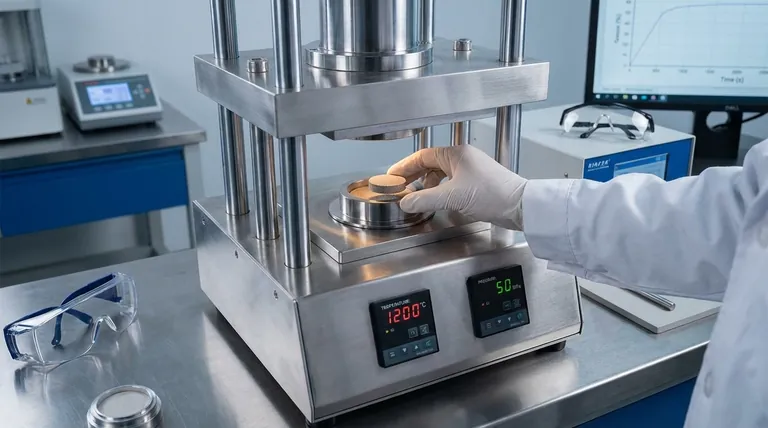
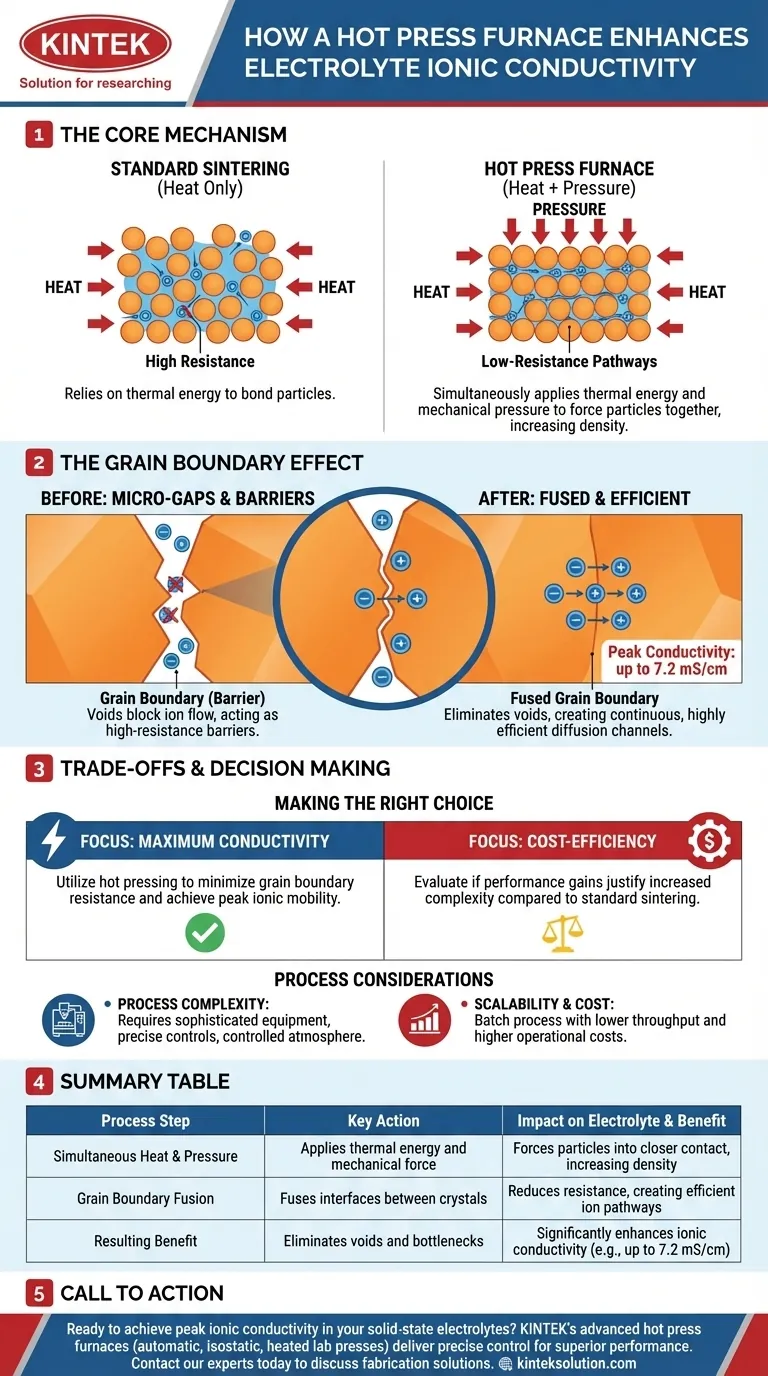
Hot press furnaces enhance ionic conductivity by simultaneously applying thermal energy and mechanical pressure to the electrolyte material. This dual-action process forces the material particles into closer proximity, significantly improving the physical contact and bonding at the grain boundaries. By eliminating voids and reducing resistance between grains, the process creates highly efficient pathways for ion diffusion.
By structurally reinforcing the grain boundaries, hot pressing removes the primary bottlenecks to ion movement. This can substantially increase room-temperature ionic conductivity, in some cases elevating it to values as high as 7.2 mS/cm.
The Mechanism of Enhancement
Simultaneous Heat and Pressure
Standard sintering relies solely on heat to bond particles. A hot press furnace introduces mechanical pressure during the heating phase.
Forcing Particle Contact
This external pressure physically forces the material grains together. It overcomes the natural resistance particles have to packing tightly, leading to a much denser final product.
The Grain Boundary Effect
Bridging Microscopic Gaps
The most critical impact of this process occurs at the grain boundaries—the interfaces where individual crystals meet. In loosely packed materials, these boundaries act as barriers that block the flow of ions.
Creating Diffusion Pathways
Hot pressing fuses these boundaries more effectively than heat alone. This creates continuous, low-resistance channels throughout the material.
Unlocking High Conductivity
With the structural barriers removed, ions can move freely. This efficiency is what allows certain electrolytes to reach high conductivity benchmarks, such as 7.2 mS/cm.
Understanding the Trade-offs
Process Complexity
Achieving these results requires sophisticated equipment. The furnace must maintain precise temperature and pressure controls, often within a vacuum or inert atmosphere to prevent contamination.
Scalability and Cost
Hot pressing is typically a batch process rather than a continuous one. While it yields superior material properties, it generally has lower throughput and higher operational costs compared to pressureless sintering methods.
Making the Right Choice for Your Goal
If you are evaluating fabrication methods for solid-state electrolytes, consider your specific performance requirements.
- If your primary focus is maximum conductivity: Utilize hot pressing to minimize grain boundary resistance and achieve peak ionic mobility.
- If your primary focus is cost-efficiency: Evaluate if the performance gains of hot pressing justify the increased complexity compared to standard sintering.
The superior contact at the grain boundaries ultimately transforms the physical density of the material into electrochemical efficiency.
Summary Table:
| Process Step | Key Action | Impact on Electrolyte |
|---|---|---|
| Simultaneous Heat & Pressure | Applies thermal energy and mechanical force | Forces particles into closer contact, increasing density |
| Grain Boundary Fusion | Fuses interfaces between crystals | Reduces resistance, creating efficient ion pathways |
| Resulting Benefit | Eliminates voids and bottlenecks | Significantly enhances ionic conductivity (e.g., up to 7.2 mS/cm) |
Ready to achieve peak ionic conductivity in your solid-state electrolytes?
KINTEK's advanced hot press furnaces (including automatic, isostatic, and heated lab presses) are engineered to deliver the precise heat and pressure control required to minimize grain boundary resistance and unlock superior material performance for your laboratory.
Contact our experts today to discuss how our specialized lab press machines can help you fabricate high-conductivity electrolytes efficiently.
Visual Guide
Related Products
- Automatic High Temperature Heated Hydraulic Press Machine with Heated Plates for Lab
- Heated Hydraulic Press Machine with Heated Plates for Vacuum Box Laboratory Hot Press
- Laboratory Manual Heated Hydraulic Press Machine with Hot Plates
- Heated Hydraulic Press Machine With Heated Plates For Vacuum Box Laboratory Hot Press
- Automatic Heated Hydraulic Press Machine with Hot Plates for Laboratory
People Also Ask
- Function of a Laboratory Hydraulic Press with Heated Platens in SSE? Enhance Battery Density & Conductivity
- How does a laboratory heated hydraulic press facilitate PBN sample prep for WAXS? Achieve Precise X-Ray Scattering
- What are the requirements for electrode pressing with high-viscosity ionic liquids like EMIM TFSI? Optimize Performance
- What are the industrial applications of heated hydraulic presses? Master Heat & Force for Precision Manufacturing
- Why is a laboratory hydraulic press with heating plates required for PLA/TEC films? Achieve Precise Sample Integrity



















