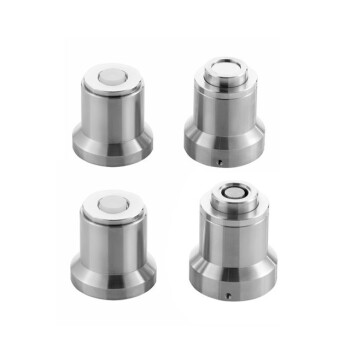
The sealing quality of your coin cell is a fundamental determinant of data validity, not just a packaging step. A laboratory crimper or sealing press applies precise, uniform radial pressure to achieve two non-negotiable outcomes: a hermetic seal that prevents chemical contamination and physical compression that establishes electrical continuity. If either of these fails, the resulting testing data—specifically impedance and cycle life—will reflect assembly errors rather than the true performance of your battery chemistry.
The core function of a sealing press is to simultaneously isolate the internal chemistry from the environment and minimize ohmic contact resistance. Without precise and constant sealing pressure, electrochemical test results will be skewed by variable impedance and electrolyte degradation.
The Dual Impact on Battery Performance
To understand how sealing affects testing results, you must look at the two distinct physical mechanisms controlled by the crimper: internal compression and environmental isolation.
Minimizing Ohmic Internal Resistance
The most immediate impact of the sealing process is on the cell's impedance. A crimper applies constant mechanical pressure to the battery casing.
This pressure forces the internal stack—current collectors, electrodes, separators, and spacers—into tight physical contact.
When this contact is uniform, it significantly reduces contact resistance (or ohmic internal resistance). If the sealing pressure is insufficient or uneven, you will observe artificially high impedance, which ruins rate performance data.
Ensuring Electrolyte Stability
The second mechanism is the creation of a hermetic seal. The crimper bonds the battery case to the sealing gasket to create an airtight enclosure.
This prevents the volatilization of the internal electrolyte, ensuring it remains liquid and functional throughout long-term testing.
It also blocks the ingress of external air and moisture. Moisture is particularly detrimental, as it causes parasitic side reactions that degrade the cell's chemistry and distort cycle life measurements.
Implications for Test Data Accuracy
The quality of the seal directly dictates the reliability of specific data points gathered during battery testing.
Cycle Life and Stability
For long-term charge-discharge cycling, the internal environment must remain chemically stable.
If the seal allows even microscopic leakage or evaporation, the electrolyte volume will decrease over time. This leads to a false indication of capacity fade, suggesting the active material is failing when, in reality, the cell is simply drying out.
High-Voltage Performance (LNMO)
Sealing precision is even more critical for high-voltage systems, such as LiNi0.5Mn1.5O4 (LNMO) batteries operating above 4.7 V.
In these scenarios, precise pressure control ensures the integrity required to withstand higher energy states. Accurate sealing guarantees that the rate performance data reflects the material's intrinsic properties rather than assembly defects.
Repeatability of Results
Scientific validity relies on reproducibility. A hydraulic sealing machine ensures that the pressure applied is standardized across every cell you build.
This uniformity eliminates the "assembly variable." It ensures that differences in test data are due to changes in your material formulation, not inconsistent contact pressure between the lithium foil and the separator.
Common Pitfalls and Trade-offs
While the goal is a perfect seal, it is important to understand the risks associated with improper pressure application.
The Consequence of Insufficient Pressure
If the crimper fails to apply enough radial pressure, the physical contact between layers will be loose.
This results in poor electrolyte wetting of the porous framework and high internal resistance. Your data will show poor specific capacity and sluggish reaction kinetics, masking the true potential of your active material.
The Risk of Inconsistent Mechanics
Using a manual or poorly calibrated crimper can lead to non-uniform pressure distribution.
This causes variability between coin cells in the same batch. If one cell has low resistance and another has high resistance solely due to crimping differences, your statistical analysis of the battery chemistry becomes impossible.
Making the Right Choice for Your Goal
The selection and operation of your sealing press should align with the specific performance metrics you are trying to capture.
- If your primary focus is Rate Performance: Prioritize a crimper with high-precision pressure control to ensure maximum contact between layers and minimize ohmic resistance.
- If your primary focus is Long-Term Cycle Life: Focus on the crimper's ability to form a rigorous, airtight bond to prevent electrolyte volatilization and moisture ingress over weeks of testing.
Ultimately, the crimper is not a passive tool; it acts as the gatekeeper for the accuracy, repeatability, and validity of your electrochemical research.
Summary Table:
| Impact Factor | Mechanism of Action | Effect on Testing Results |
|---|---|---|
| Contact Resistance | Mechanical compression of internal stack | Lowers ohmic resistance; improves rate performance data. |
| Hermetic Sealing | Gasket bonding to prevent leakage | Prevents electrolyte evaporation and moisture-driven side reactions. |
| Pressure Uniformity | Standardized hydraulic application | Ensures result repeatability and eliminates assembly variables. |
| High-Voltage Integrity | Precise pressure control (LNMO) | Maintains cell stability at high energy states (>4.7 V). |
Optimize Your Battery Research with KINTEK Precision
Don't let poor sealing compromise your electrochemical data. KINTEK specializes in comprehensive laboratory pressing solutions designed for the rigorous demands of battery research. From manual and automatic crimpers to specialized heated and glovebox-compatible models, our equipment ensures the hermetic integrity and uniform contact pressure your research requires.
Our value to you:
- Unmatched Consistency: Eliminate assembly variables with standardized pressure control.
- Versatile Solutions: Offering everything from isostatic presses to specialized coin cell sealers.
- Expert Support: Specialized equipment tailored for lithium-ion and high-voltage battery development.
Ready to elevate your lab's testing accuracy?
Contact KINTEK today to find the perfect sealing solution!
References
- Ndenga, Barack, Himanshi, sharma. Microcapsule-Enabled Self-Healing Silicon Anodes for Next-Generation Lithium-Ion Batteries: A Conceptual Design, Materials Framework, and Technical Feasibility Study. DOI: 10.5281/zenodo.17981741
This article is also based on technical information from Kintek Solution Knowledge Base .
Related Products
- Button Battery Sealing Press Machine for Lab
- Lab Button Battery Tablet Press Sealing Mold
- Lab Button Battery Disassembly and Sealing Mold
- Assemble Lab Cylindrical Press Mold for Laboratory Use
People Also Ask
- Why use standardized CR2032 components & high-precision presses? Ensure reliability in lithium metal battery research.
- Why is a laboratory battery sealing press essential for desolvation energy testing? Ensure Reliable Kinetic Data
- Why is a laboratory hydraulic press or battery sealing machine essential? Ensure Coin Cell Data Integrity
- How do laboratory battery sealing machines ensure performance consistency? Master Your Lithium and LFP Battery Assembly
- What role does a laboratory sealing press play in thermal analysis of solid dispersion films? Ensure Data Integrity