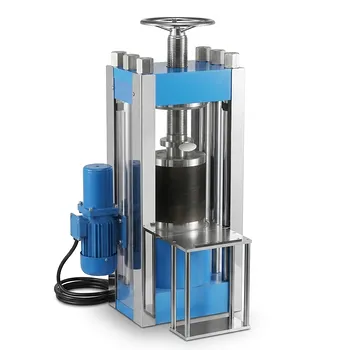
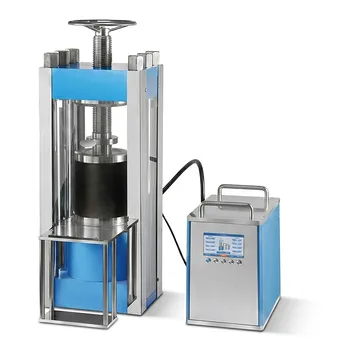
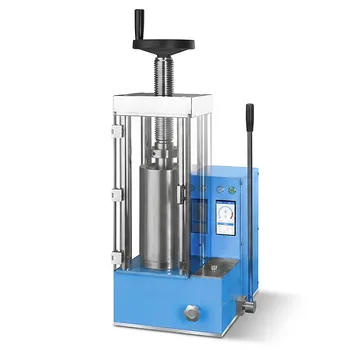
In Warm Isostatic Pressing (WIP), hydraulic pressure functions as the physical transmission vehicle that simultaneously delivers force and thermal energy to the powder material. Unlike mechanical pressing, this process utilizes a heated liquid medium—typically warm water—which is continuously injected into a sealed cylinder by a booster source to create a uniform, densifying force.
The core advantage of using hydraulic pressure in WIP is the ability to apply omnidirectional force while maintaining precise temperature control. By utilizing a liquid medium within a 0-240 MPa range, the process ensures consistent material density and minimizes the internal friction often found in solid-die compaction.
The Mechanics of Pressure Application
The Liquid Medium
In the WIP process, the pressure is not applied by a solid ram or gas, but by a liquid medium. This is typically warm water or a similar fluid engineered to remain stable at the operating temperatures.
Continuous Injection and Boosting
To build the necessary pressure, the liquid is not static; it is continuously injected into the sealed pressing cylinder. A booster source drives this injection, ramping up the pressure to the required levels to compress the powder.
Integrated Thermal Control
The hydraulic system serves a dual purpose: force transmission and temperature regulation. The liquid is heated prior to injection, and the pressing cylinder itself is equipped with a heat generator. This ensures the medium maintains an accurate, specific temperature throughout the consolidation process.
Achieving Material Consolidation
Omnidirectional Force Distribution
Because the medium is a fluid, it applies pressure equally from all directions against the flexible membrane or hermetic container holding the powder. This eliminates the density gradients (uneven packing) that frequently occur in unidirectional pressing.
The Pressure Range
The working static pressure for WIP typically falls within the range of 0 to 240 MPa. This specific range is sufficient to uniformly mold the powder into a high-quality product without requiring the extreme ultra-high pressures of Cold Isostatic Pressing (CIP).
Friction Reduction
The use of a hydraulic medium helps minimize friction between the powder and the forming die walls. This reduction in friction is critical for achieving improved product performance and structural integrity in the final molded shape.
Understanding the Trade-offs
Pressure Limits vs. Cold Isostatic Pressing (CIP)
While WIP offers temperature benefits, its hydraulic pressure limit (approx. 240 MPa) is significantly lower than CIP. CIP systems utilize hydraulic pressure multipliers to achieve pressures up to 600 MPa (6000 bar), making them superior for materials requiring extreme compaction force without heat.
Temperature Limits vs. Hot Isostatic Pressing (HIP)
The reliance on a liquid medium (hydraulic) rather than gas (pneumatic) limits the maximum operating temperature. Because liquids like water will boil or degrade at high temperatures, WIP is restricted to "warm" processing. For sintering or bonding requiring high heat, gas-based HIP is the necessary alternative.
Making the Right Choice for Your Goal
To select the correct isostatic pressing method, you must weigh the need for thermal assistance against the need for raw pressure.
- If your primary focus is uniform density with moderate thermal assistance: Choose WIP to leverage the heated hydraulic medium for consistent kinetics and reduced friction.
- If your primary focus is maximum green strength and density: Opt for Cold Isostatic Pressing (CIP) to utilize higher hydraulic pressures (up to 600 MPa) without thermal complications.
- If your primary focus is diffusion bonding or eliminating internal porosity: Select Hot Isostatic Pressing (HIP), which uses gas to achieve temperatures and pressures beyond liquid limits.
Success in isostatic pressing relies on matching the medium—liquid or gas—to the specific thermal and barometric thresholds of your material.
Summary Table:
| Feature | Warm Isostatic Pressing (WIP) | Cold Isostatic Pressing (CIP) |
|---|---|---|
| Pressure Medium | Heated Liquid (Warm Water) | Room Temp Liquid (Water/Oil) |
| Pressure Range | 0 - 240 MPa | Up to 600 MPa |
| Thermal Aid | Integrated Heat (0 - 100°C+) | None (Ambient) |
| Key Benefit | Reduced friction & uniform kinetics | Maximum green strength & density |
| Force Direction | Omnidirectional (Isostatic) | Omnidirectional (Isostatic) |
Elevate Your Lab Research with KINTEK Pressing Solutions
Are you looking to eliminate density gradients and enhance your material performance? KINTEK specializes in comprehensive laboratory pressing solutions tailored for precision research. From manual and automatic models to specialized warm and cold isostatic presses, our equipment is engineered to provide the consistent, omnidirectional force required for advanced material development.
Why choose KINTEK?
- Versatility: Solutions ranging from heated and multifunctional presses to glovebox-compatible designs.
- Expertise: Our systems are widely applied in cutting-edge battery research and advanced ceramics.
- Precision: Achieve accurate temperature and pressure control up to 600 MPa.
Don't let internal friction or uneven packing compromise your results. Contact our technical specialists today to find the ideal isostatic press for your application!
Related Products
- Warm Isostatic Press for Solid State Battery Research Warm Isostatic Press
- Split Warm Isostatic Lab Press 200 Ton Powder Compaction Chamber for Battery Research and Material Science
- Split Hot Isostatic Pressing Machine 150 Ton Laboratory Heated Isostatic Press
- Electric Isostatic Pressing Machine 40 Tons Automatic Laboratory Powder Compacting Press
- Electric Lab Cold Isostatic Press CIP Machine
People Also Ask
- Why must composite cathodes be sealed in vacuum lamination bags for WIP? Ensure Battery Stability and Density
- How do sacrificial volume materials (SVM) maintain microchannels in isostatic pressing? Ensure Structural Integrity
- What is the function of elastic molds in warm isostatic pressing? Achieve Uniform Density in Composite Particles
- How does Warm Isostatic Pressing differ from traditional pressing methods? Unlock Uniform Density for Complex Parts
- What are the advantages of using a Warm Isostatic Press (WIP) for batteries? Achieve Superior Interface Contact