
In a laboratory press, temperature is controlled through a closed-loop system involving electrically heated platens, precision sensors, and a digital controller. The platens, which can reach up to 500°C, transfer heat directly to the sample. The controller constantly compares the actual platen temperature, measured by sensors, to the user's desired setpoint, adjusting electrical power to maintain precise thermal conditions. Many systems also feature integrated cooling channels to rapidly and uniformly lower the temperature.
Precise temperature management in a laboratory press is not just about reaching a target temperature. It is a dynamic, three-part process—heating, holding, and cooling—where each stage is actively managed to achieve specific material structures and properties.
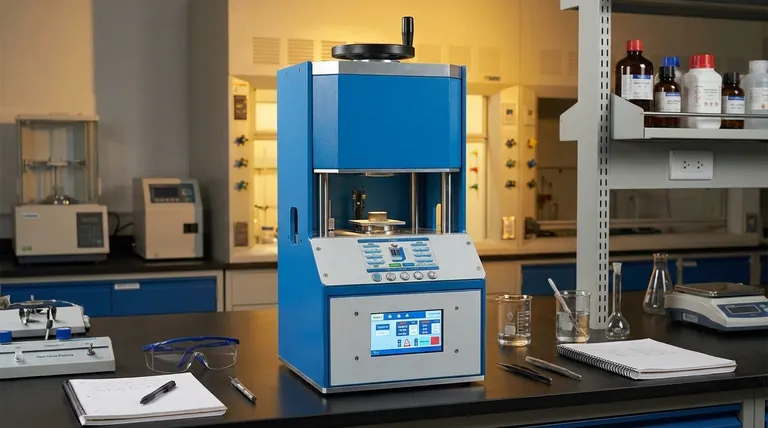
The Core Components of Thermal Control
To understand how a press manages temperature, you must first understand the key components working in concert. Each part plays a distinct and critical role in the thermal cycle.
The Heated Platens
The platens are the heavy steel plates that press the sample. They are the primary source of heat, typically containing embedded electric resistance heating cartridges. These cartridges convert electrical energy into thermal energy, heating the entire mass of the platen uniformly.
Temperature Sensors (Thermocouples)
These sensors are the "eyes" of the control system. A thermocouple is typically embedded within each platen, as close to the pressing surface as possible. It provides real-time temperature feedback directly to the central controller, ensuring the system knows the exact thermal state at all times.
The Digital Controller
The controller is the "brain" of the operation. The user inputs the desired temperature profile—including ramp rates, hold times, and final temperature—into this unit. The controller's software then executes a control algorithm (like PID control) to precisely manage the power sent to the heating cartridges, minimizing deviation from the setpoint.
Integrated Cooling Systems
For many material science applications, controlled cooling is as important as heating. Presses often have channels machined into the platens through which a coolant, typically water, can be circulated. This allows for rapid temperature reduction to "freeze" a material's structure or simply to shorten the cycle time before the next experiment.
The Temperature Control Cycle in Practice
The process described in manuals is a direct result of these components working together. A typical operational cycle follows a distinct, programmable path.
Setting the Target (Setpoint)
The process begins with the operator programming the desired temperature profile into the digital controller. This isn't just a single temperature but often a multi-stage recipe involving different temperatures and durations.
Ramping and Heating
Once initiated, the controller supplies full power to the heating elements to "ramp up" to the first setpoint. The rate of this temperature increase can often be controlled to prevent thermal shock to sensitive samples.
Isothermal Holding (Dwelling)
Upon reaching the setpoint, the controller modulates power to the heaters to maintain a stable temperature. This isothermal holding period is critical for processes like polymer curing or material annealing, where time at temperature dictates the final properties.
Controlled Cooling
After the holding phase, the heating elements are switched off. If the press is equipped with a cooling system, the controller opens valves to circulate coolant through the platens. This ensures a rapid and repeatable cooling rate, which is essential for achieving consistent results in materials like thermoplastics.
Understanding the Trade-offs and Limitations
While modern presses offer remarkable control, there are inherent physical limitations and trade-offs to consider for any application.
Temperature Uniformity
Achieving perfect temperature uniformity across the entire platen surface is a significant engineering challenge. Minor variations or "hot spots" can exist, potentially leading to inconsistent results in larger samples. High-end presses employ multiple heating zones and sensors to mitigate this.
Ramp Rate vs. Overshoot
Programming a very fast ramp rate can cause the platen temperature to overshoot the setpoint before the controller can compensate. For thermally sensitive materials, a slower, more controlled ramp is safer and ensures the sample is never exposed to excessive temperatures.
Maximum Temperature
The stated maximum of 500°C is suitable for the vast majority of polymers, composites, and organic materials. However, it is insufficient for processing most ceramics or metals, which require specialized high-temperature furnaces or presses.
Making the Right Choice for Your Application
The level of temperature control you require is dictated entirely by your material and your experimental goal.
- If your primary focus is basic sample formation (e.g., FTIR pellets): A simple press with basic heating and manual or passive air cooling is often sufficient.
- If your primary focus is polymer curing or composite lamination: A press with a programmable controller for precise ramp, hold (dwell), and cooling cycles is non-negotiable.
- If your primary focus is high-throughput material testing: An integrated, fast-response water cooling system is essential to minimize the cycle time between individual samples.
Understanding these control mechanisms empowers you to select the right tool and precisely manipulate your materials to achieve the desired outcome.
Summary Table:
| Component | Function |
|---|---|
| Heated Platens | Provide uniform heat up to 500°C via electric resistance |
| Temperature Sensors | Monitor real-time platen temperature for feedback |
| Digital Controller | Executes PID algorithms to maintain setpoints |
| Cooling Systems | Enable rapid temperature reduction with coolant circulation |
Need precise temperature control for your lab processes? KINTEK specializes in lab press machines, including automatic, isostatic, and heated models, designed to deliver accurate thermal management for materials like polymers and composites. Enhance your lab's efficiency and achieve consistent results—contact us today to discuss your needs!
Visual Guide

Related Products
- 24T 30T 60T Heated Hydraulic Lab Press Machine with Hot Plates for Laboratory
- Heated Hydraulic Press Machine with Heated Plates for Vacuum Box Laboratory Hot Press
- Laboratory Split Manual Heated Hydraulic Press Machine with Hot Plates
- Automatic Heated Hydraulic Press Machine with Hot Plates for Laboratory
- Automatic High Temperature Heated Hydraulic Press Machine with Heated Plates for Lab
People Also Ask
- Function of a Laboratory Hydraulic Press with Heated Platens in SSE? Enhance Battery Density & Conductivity
- Why is a laboratory hydraulic press with heating plates required for PLA/TEC films? Achieve Precise Sample Integrity
- What role does a laboratory heated hydraulic press play in LTCC? Essential for High-Density Ceramic Lamination
- Why reduce load when applying composite strengthening tabs? Protect Specimen Integrity and Data Accuracy
- Why is a laboratory heated hydraulic press required? Ensure Precise Vulcanization for NBR/EPDM Nanocomposites



















