
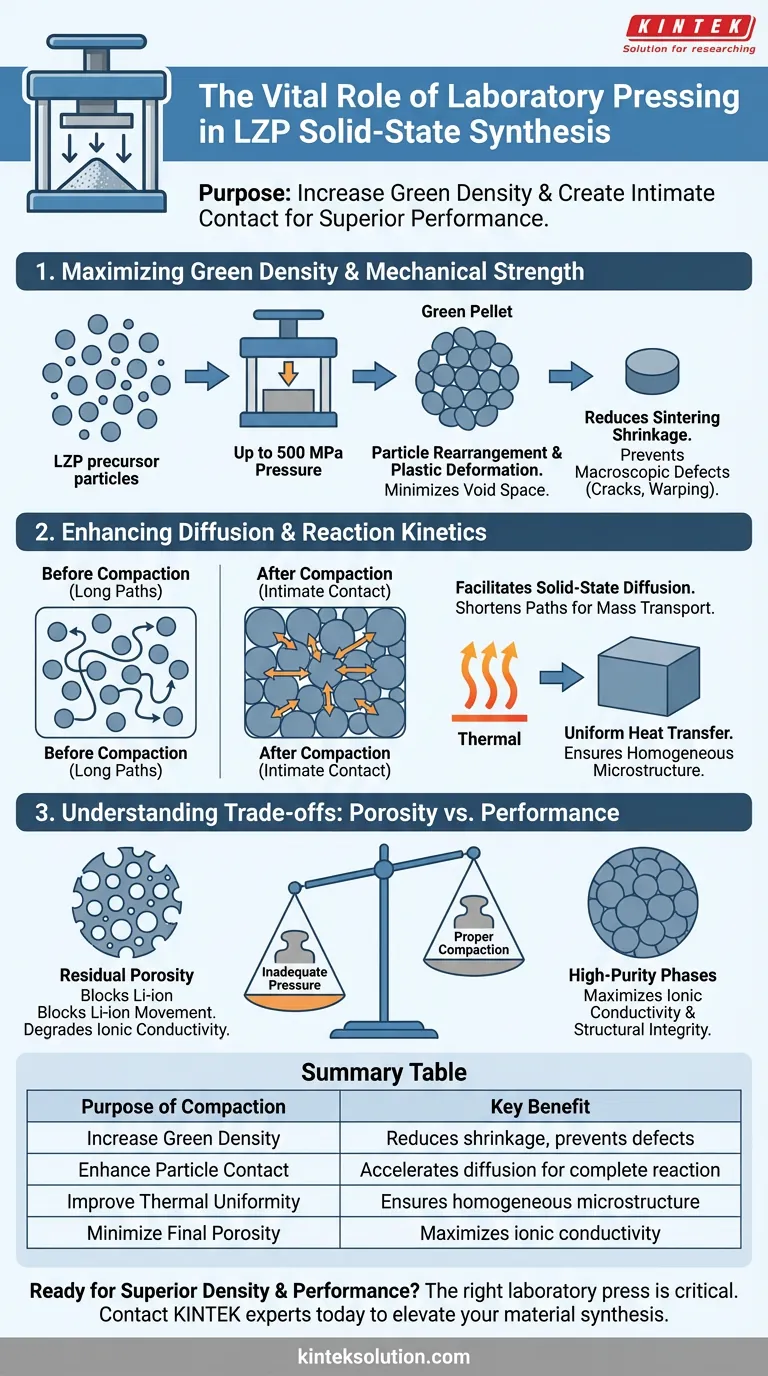
The primary purpose of compacting LiZr₂(PO₄)₃ (LZP) precursor powder using a laboratory press is to significantly increase the green density of the material prior to sintering.
By applying high uniaxial pressure, you force the powder particles into intimate contact, reducing the distance atoms must travel during heat treatment. This pre-treatment is not merely for handling; it is the fundamental enabler of solid-state diffusion, ensuring the final ceramic electrolyte is dense, low-porosity, and highly conductive.
Core Insight: The laboratory press acts as a kinetic accelerator for the sintering process. By mechanically forcing particle proximity through plastic deformation and rearrangement, you lower the energy barrier for mass transport, directly dictating the final ionic conductivity and structural integrity of the LZP electrolyte.
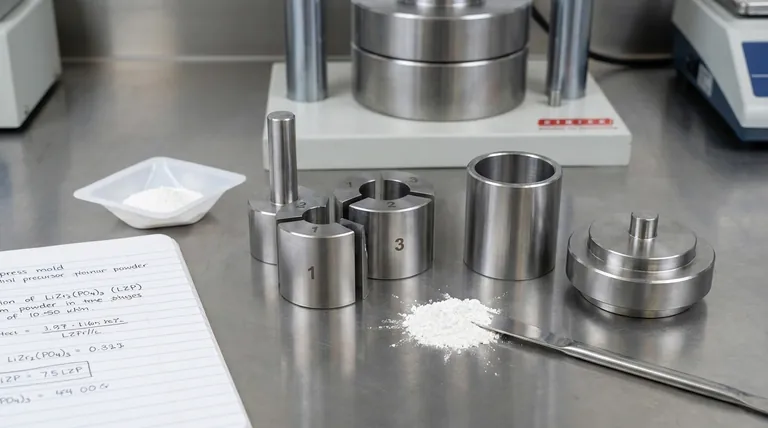
Maximizing Green Density and Mechanical Strength
The immediate physical goal of the pressing stage is to transform a loose sol-gel powder into a cohesive solid, known as a green pellet.
Particle Rearrangement and Deformation
According to technical specifications for LZP synthesis, a laboratory hydraulic press often applies pressures up to 500 MPa.
This intense pressure forces the individual powder particles to rearrange and pack tightly together. Under this stress, the particles undergo plastic deformation, effectively interlocking to minimize void space.
Reducing Sintering Shrinkage
Creating a highly dense green pellet is essential for controlling dimension changes during the subsequent high-temperature phase.
If the initial packing density is low, the material will undergo excessive shrinkage as it sinters. A well-compacted pellet minimizes this volume change, which is critical for preventing the formation of macroscopic defects such as cracks or warping in the final electrolyte.
Enhancing Diffusion and Reaction Kinetics
While the physical shape is important, the chemical implications of pressing are even more critical for NASICON-type materials.
Facilitating Solid-State Diffusion
Sintering is fundamentally a diffusion-based process where atoms move across particle boundaries to fuse the material.
Compacting the powder ensures intimate contact between reactant particles. This proximity significantly facilitates mass transport, allowing the chemical reaction to proceed efficiently and completely. Without this contact, diffusion paths are too long, leading to incomplete sintering.
Ensuring Uniform Heat Transfer
A dense pellet has higher thermal conductivity than loose powder.
The pressing process increases the contact area between particles, which promotes uniform heat conduction throughout the sample. This ensures that the entire pellet experiences the same thermal history, leading to a homogeneous microstructure rather than a material with uneven phases.
Understanding the Trade-offs: Porosity vs. Performance
While the goal is a dense material, it is vital to understand the inverse relationship between compaction and the resulting ceramic structure.
The Risk of Residual Porosity
The central pitfall in solid-state synthesis is porosity. Pores act as insulators that block the movement of Lithium ions.
If the precursor is not sufficiently compacted, the final ceramic will retain a porous microstructure. This directly degrades ionic conductivity, rendering the LZP ineffective as a solid electrolyte.
Defect Management
There is a direct trade-off between the quality of the green body and the integrity of the sintered product.
Inadequate pressure leads to weak green pellets that are prone to creating macroscopic defects. Conversely, proper compaction is the primary defense against these structural failures, ensuring the synthesis of high-purity phases with the desired electrochemical properties.
Making the Right Choice for Your Goal
To optimize your LiZr₂(PO₄)₃ synthesis, align your pressing parameters with your specific performance targets.
- If your primary focus is High Ionic Conductivity: Maximize the applied pressure (within tooling limits) to eliminate porosity and shorten diffusion paths for Lithium ions.
- If your primary focus is Structural Integrity: Ensure uniform pressure distribution to create a homogeneous green density that prevents cracking and warping during shrinkage.
Compacting your precursor is not just a shaping step; it is the defining moment that sets the ceiling for your electrolyte's performance.
Summary Table:
| Purpose of Compaction | Key Benefit |
|---|---|
| Increase Green Density | Reduces sintering shrinkage and prevents defects |
| Enhance Particle Contact | Accelerates solid-state diffusion for complete reaction |
| Improve Thermal Uniformity | Ensures homogeneous microstructure |
| Minimize Final Porosity | Maximizes ionic conductivity of the electrolyte |
Ready to achieve superior density and performance in your solid-state synthesis? The right laboratory press is critical for compacting precursor powders like LZP to eliminate porosity and maximize ionic conductivity. KINTEK specializes in automatic lab presses, isostatic presses, and heated lab presses designed to deliver the precise, high-pressure compaction your research demands. Contact our experts today to find the perfect press for your laboratory's needs and elevate your material synthesis.
Visual Guide
Related Products
- Laboratory Split Manual Heated Hydraulic Press Machine with Hot Plates
- 24T 30T 60T Heated Hydraulic Lab Press Machine with Hot Plates for Laboratory
- Laboratory Hydraulic Press Lab Pellet Press Machine for Glove Box
- Automatic Laboratory Hydraulic Press Lab Pellet Press Machine
- Automatic Heated Hydraulic Press Machine with Hot Plates for Laboratory
People Also Ask
- Why is a laboratory hydraulic press with heating plates required for PLA/TEC films? Achieve Precise Sample Integrity
- Why reduce load when applying composite strengthening tabs? Protect Specimen Integrity and Data Accuracy
- What role does a laboratory heated hydraulic press play in LTCC? Essential for High-Density Ceramic Lamination
- Why is a laboratory heated hydraulic press required? Ensure Precise Vulcanization for NBR/EPDM Nanocomposites
- Why is a laboratory heated hydraulic press utilized during the lamination stage of NASICON green tapes?



















