
Manual hydraulic pellet presses are fundamentally relied upon for preparing solid samples in spectroscopy, most notably for X-ray Fluorescence (XRF) and Fourier Transform Infrared Spectroscopy (FTIR). By utilizing high pressure to compress powders into stable, homogeneous discs, these devices create the necessary physical conditions for accurate elemental and molecular analysis.
Core Insight: The primary value of a manual hydraulic press in a laboratory is its ability to densify materials into a flat, durable form without applying external heat. This "cold pressing" technique preserves the chemical integrity of sensitive samples, ensuring that the resulting spectral data reflects the material's true composition rather than thermal degradation.
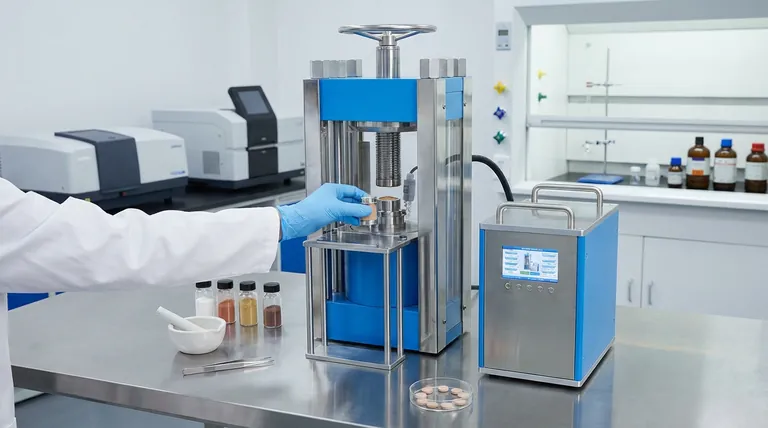
Primary Analytical Applications
Spectroscopy Sample Preparation
The most common application for these presses is the creation of pellets—often called briquettes—for spectral analysis.
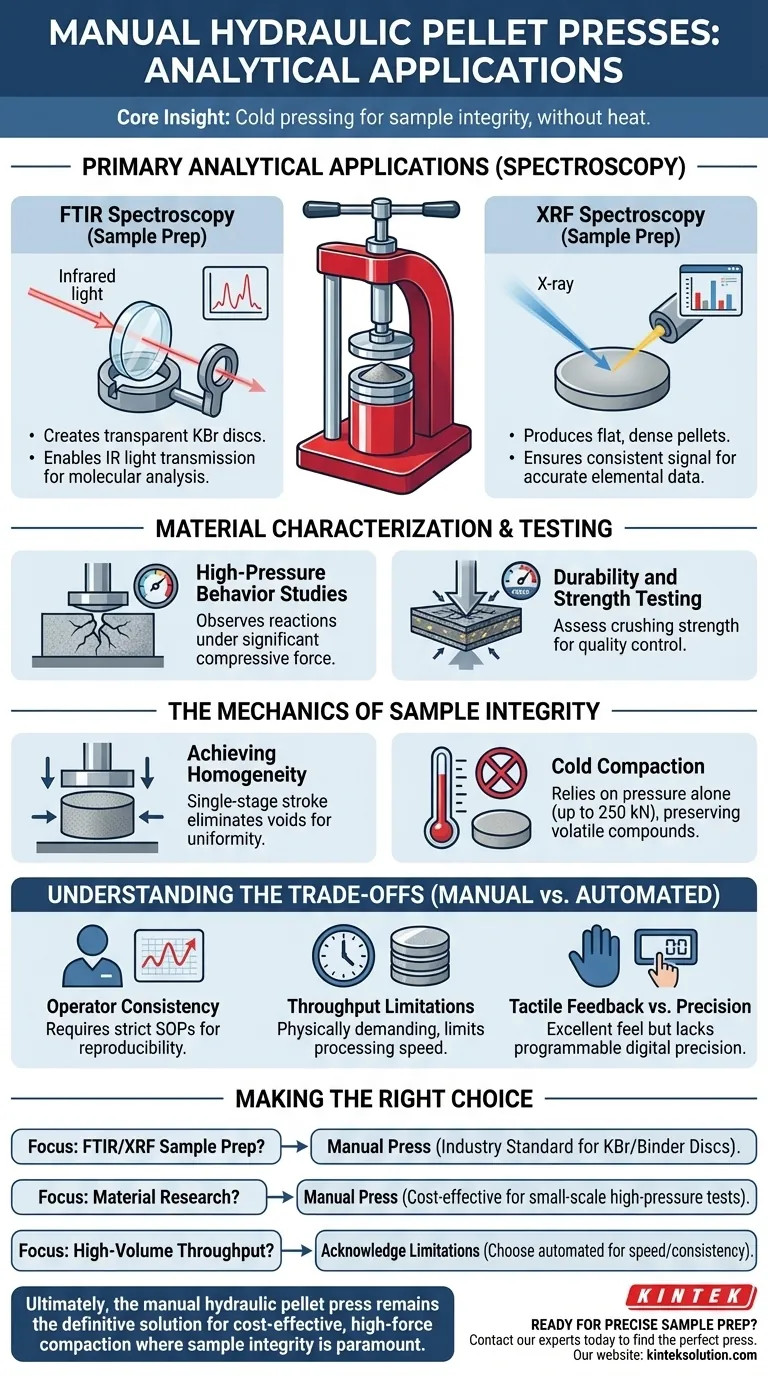
Fourier Transform Infrared Spectroscopy (FTIR) In FTIR analysis, samples must be optically transparent to infrared light. A manual press is used to compress a mixture of the sample and potassium bromide (KBr) into a thin, transparent disc. This transparency is critical for allowing infrared radiation to pass through the sample for detection.
X-ray Fluorescence (XRF) XRF requires a sample with a perfectly flat and smooth surface to minimize scattering errors. The press compacts loose powder (often mixed with a binder) into a dense, solid pellet. The resulting homogeneity ensures that the X-ray detector receives a consistent signal, leading to reproducible elemental data.
Material Characterization and Testing
Beyond spectroscopy, these presses are utilized to investigate the physical properties of materials.
High-Pressure Behavior Studies Researchers use these presses to observe how materials react under significant compressive force. This allows for the study of phase transitions or structural changes that occur only under high-pressure conditions.
Durability and Strength Testing In quality control settings, the press can act as a testing rig. It is used to assess the crushing strength of composite materials, ceramics, or hardened metals to ensure they meet manufacturing specifications.
The Mechanics of Sample Integrity
Achieving Homogeneity
Analytical accuracy depends on the sample being uniform throughout. The single-stage piston stroke of these presses ensures consistent pressure application, eliminating voids and air pockets within the pellet.
Cold Compaction
Unlike industrial molding which often uses heat, analytical pelletizing relies on pressure alone (up to 250 kN). This is vital for analyzing volatile or thermally unstable compounds that would decompose if heated.
Understanding the Trade-offs
While manual hydraulic presses are essential for low-to-medium volume laboratories, they possess inherent limitations compared to automated systems.
Operator Consistency
Because the pressure is generated manually, there can be slight variations in the force applied or the duration of the hold time between different operators. This requires strict standard operating procedures (SOPs) to ensure reproducibility between batches.
Throughput Limitations
Manual pumping is physically demanding and time-consuming. For laboratories processing hundreds of samples daily, a manual press creates a significant bottleneck compared to automated electric presses.
Tactile Feedback vs. Precision
A manual press offers excellent tactile feedback, allowing the user to "feel" the compaction. However, it lacks the programmable precision of automated systems that can ramp up pressure at exact, digital rates.
Making the Right Choice for Your Goal
When deciding if a manual hydraulic pellet press is the correct tool for your analytical workflow, consider your specific constraints regarding volume and material sensitivity.
- If your primary focus is FTIR or XRF Sample Prep: The manual press is the industry standard for creating the KBr pellets and binder discs required for high-resolution spectral data.
- If your primary focus is Material Research: This tool provides a cost-effective method for conducting small-scale high-pressure experiments and durability tests without complex automation.
- If your primary focus is High-Volume Throughput: You should acknowledge that manual operation will limit your processing speed and may introduce user fatigue errors over long shifts.
Ultimately, the manual hydraulic pellet press remains the definitive solution for laboratories requiring cost-effective, high-force compaction where sample integrity must be preserved without thermal interference.
Summary Table:
| Application | Key Use Case | Primary Benefit |
|---|---|---|
| FTIR Spectroscopy | Creating transparent KBr pellets | Enables infrared light transmission for molecular analysis |
| XRF Spectroscopy | Producing flat, dense powder pellets | Ensures consistent signal for accurate elemental data |
| Material Research | High-pressure behavior & strength testing | Cost-effective method for studying material properties |
Ready to achieve precise and reliable sample preparation?
KINTEK's manual hydraulic lab presses, including our automatic and heated lab press models, are engineered to deliver the consistent, high-pressure compaction your laboratory needs for flawless XRF and FTIR analysis. Preserve sample integrity and improve your analytical results.
Contact our experts today to find the perfect press for your specific application and workflow!
Visual Guide
Related Products
- Manual Laboratory Hydraulic Pellet Press Lab Hydraulic Press
- Manual Laboratory Hydraulic Press Lab Pellet Press
- Automatic Laboratory Hydraulic Press Lab Pellet Press Machine
- Automatic Laboratory Hydraulic Press for XRF and KBR Pellet Pressing
- Laboratory Hydraulic Pellet Press for XRF KBR FTIR Lab Press
People Also Ask
- What is the primary purpose of a manual lab hydraulic pellet press? Ensure Accurate Sample Prep for XRF and FTIR
- What is the primary purpose of manual lab hydraulic pellet presses? Achieve High-Precision Sample Preparation for Spectroscopy
- What role does a lab hydraulic press play in researching squishy granular matter? Expert Insights into Material Physics
- What is the primary function of a laboratory hydraulic press in evaluating the ionic conductivity of Li6PS5X (LMSX)?
- What is the purpose of initial axial molding using a lab hydraulic press? Optimizing Electrolyte Green Bodies



















