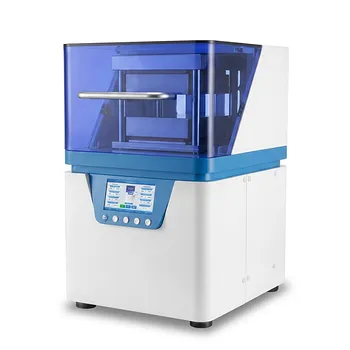
Hydraulic mini presses are primarily utilized in scientific and industrial laboratory settings for precise sample preparation. Specifically, they are the standard tool in pharmaceutical, polymer, and undergraduate chemistry laboratories for preparing samples for spectroscopic analysis, such as Fourier Transform Infrared Spectroscopy (FTIR) and X-ray Fluorescence (XRF).
Core Takeaway While standard hydraulic presses are used for heavy industrial manufacturing, mini presses are specialized for mobility and precision in laboratories. Their defining application is creating small, compressed discs (pellets) for chemical analysis where space is limited and portability is required.
The Primary Use Case: Laboratory Sample Preparation
Spectroscopy Analysis (FTIR and XRF)
The most critical application of the hydraulic mini press is preparing solid samples for FTIR (Fourier Transform Infrared Spectroscopy).
To analyze a powder via FTIR, it must often be compressed into a thin, transparent disc. Mini presses are specifically engineered to produce 7 mm diameter KBr (potassium bromide) discs used in this process.
They are also widely used for XRF (X-ray Fluorescence) sample preparation, where materials must be compacted into stable pellets for elemental analysis.
Pharmaceutical and Polymer Testing
In pharmaceutical labs, researchers use these presses to compress powder formulations into tablets or pellets for drug testing and development.
Polymer testing labs utilize them to compress polymer beads or fragments into uniform films or discs. This allows for consistent testing of physical properties and chemical composition without the need for large, stationary machinery.
Educational Applications
Due to their compact nature, hydraulic mini presses are a staple in undergraduate chemistry laboratories.
They allow students to learn essential sample preparation techniques safely. Their handheld design and lower cost make them far more accessible for teaching institutions than full-sized industrial presses.
The Mechanics Behind the Application
Portability and Space Efficiency
Unlike their industrial counterparts, hydraulic mini presses are designed to be handheld and portable.
They operate using a pump to move an oil-filled plunger, regulating pressure through system valves. This makes them ideal for labs with limited bench space or field operations where mobility is required.
Force Generation
Despite their small footprint, these devices can generate substantial force, typically up to 2 tons.
This pressure is sufficient for compressing powders and chemicals but is delivered in a controlled, manual format suitable for delicate analytical work.
Understanding the Limitations
Force Capacity vs. Industrial Needs
It is critical not to confuse a mini press with a standard hydraulic press.
Mini presses top out at approximately 2 tons of force. They are not suitable for metal forming, heavy stamping, or automotive part manufacturing, which require the massive tonnage of stationary industrial presses.
Throughput Volume
Mini presses are generally manual and designed for individual sample creation.
They are not efficient for high-volume production or manufacturing environments. If your application requires rapid, automated pressing of thousands of units, a mini press will be a bottleneck.
Making the Right Choice for Your Goal
To determine if a hydraulic mini press fits your application, consider your specific constraints regarding force and location.
- If your primary focus is Spectroscopic Analysis: A mini press is ideal for creating high-quality 7 mm KBr pellets for FTIR or XRF without wasting bench space.
- If your primary focus is Field Work or Education: The handheld, portable nature of the mini press makes it the best option for mobile testing or crowded teaching labs.
- If your primary focus is Metal Forming or Manufacturing: You require a standard industrial hydraulic press; a mini press lacks the tonnage and surface area for these tasks.
Select the tool that matches the scale of your pressure requirements, not just the mechanism of operation.
Summary Table:
| Application Category | Primary Use | Key Benefit |
|---|---|---|
| Spectroscopy | Creating 7mm KBr pellets for FTIR & XRF | High-quality transparency and uniform discs |
| Pharmaceuticals | Compressing powder formulations for drug testing | Precision and consistency in tablet creation |
| Polymer Testing | Forming beads or fragments into uniform films | Reliable physical and chemical property analysis |
| Education | Teaching sample prep in chemistry labs | Safe, portable, and cost-effective learning |
| Field Work | On-site material testing and analysis | Lightweight, handheld portability |
Optimize Your Lab Research with KINTEK Pressing Solutions
Are you looking to enhance your sample preparation precision? KINTEK specializes in comprehensive laboratory pressing solutions tailored for high-accuracy research. Whether you need the portability of a manual mini press, the efficiency of an automatic or heated model, or the specialized capabilities of isostatic and glovebox-compatible presses, we have the perfect fit for your workflow.
From advanced battery research to routine FTIR spectroscopy, our equipment ensures consistent results and durability. Let our experts help you select the ideal press to drive your innovation forward.
Contact KINTEK Today to Find Your Perfect Lab Press
Related Products
- Automatic Hydraulic Hot Press with Large Plate and Precision Temperature Control for Advanced Material Sample Preparation and Industrial Research
- Automatic Laboratory Hydraulic Press Lab Pellet Press Machine
- Laboratory Hydraulic Press Lab Pellet Press Machine for Glove Box
- Automatic Hydraulic Heat Press Machine with Multi Stage Programmable Control and Integrated Water Cooling Plate Size 180x180mm
- Laboratory Hydraulic Press Lab Pellet Press Button Battery Press
People Also Ask
- What are the specific features and applications of hydraulic hot press machines? Precision Solutions for Modern Labs
- How does an automatic hydraulic press operate? Achieve Precision and Consistency in Lab Pelleting
- What are the advantages and common applications of an automatic hydraulic press? Elevate Your Lab's Precision
- What is the technical significance of setting a precise dwell time? Achieve Peak Material Density and Stability
- When is an automatic hydraulic press more suitable than a manual press? Scale Your Lab with Precision & Speed