
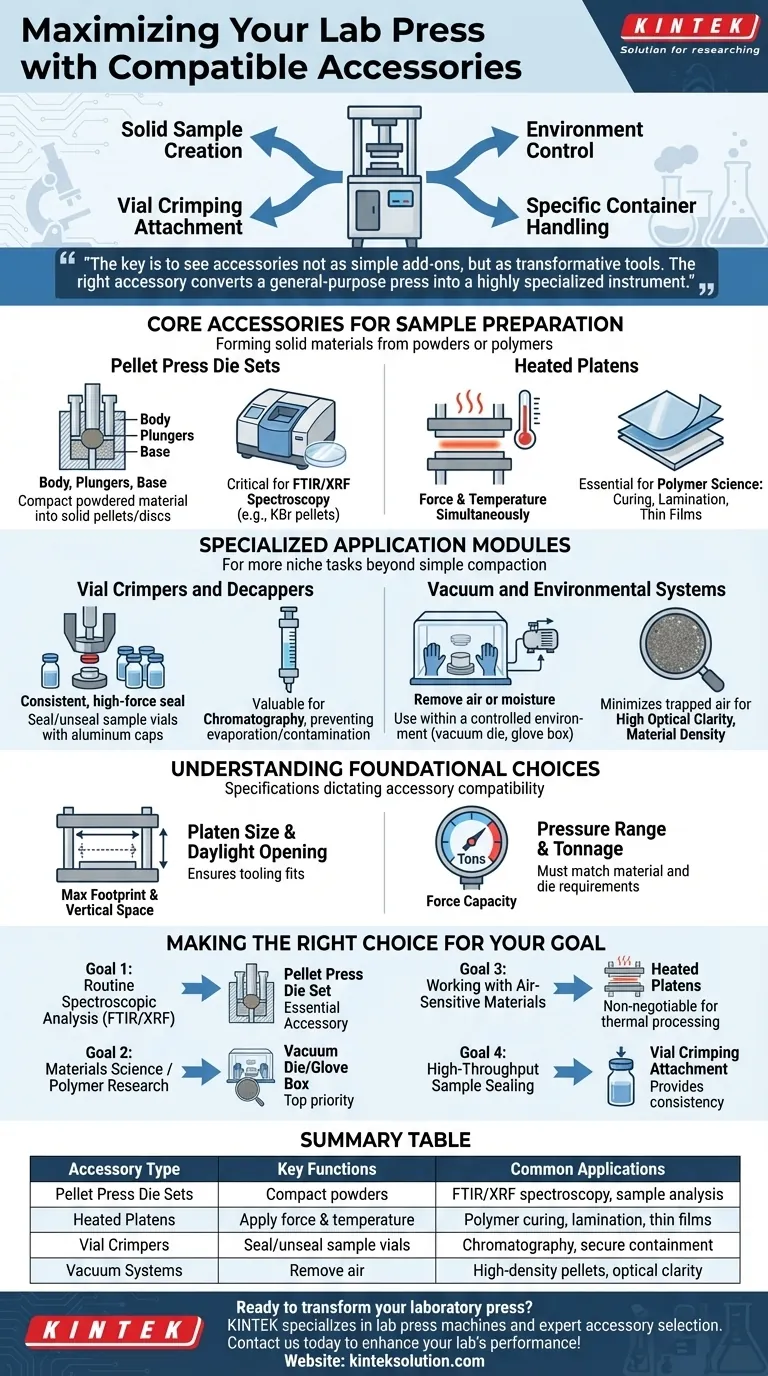
At its core, a laboratory press is compatible with accessories that enable three primary functions: creating solid samples, controlling the pressing environment, and handling specific sample containers. Common accessories include pellet press die sets for forming discs, heated platens for thermal applications, and specialized modules like vial crimpers or vacuum systems.
The key is to see accessories not as simple add-ons, but as transformative tools. The right accessory converts a general-purpose press into a highly specialized instrument tailored to solve a specific analytical or material processing challenge.
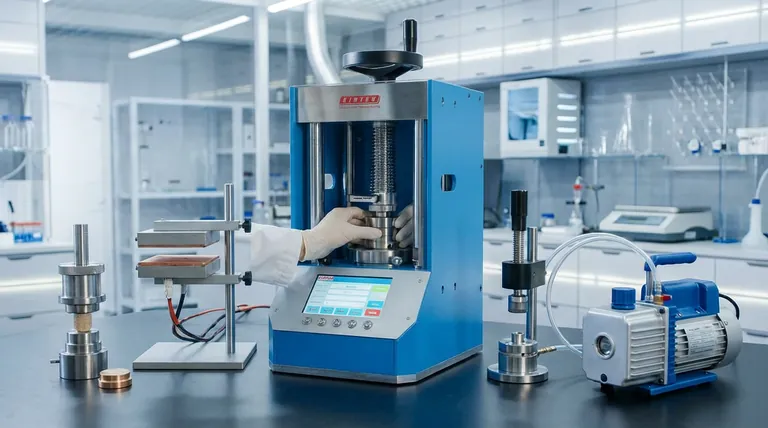
From Force to Function: Choosing the Right Accessory
A laboratory press applies controlled force. Accessories are what give that force a purpose, shaping materials, enabling reactions, or preparing samples for further analysis. The accessory you need is defined entirely by your end goal.
Core Accessories for Sample Preparation
These accessories are fundamental for users who need to form solid materials from powders or polymers.
Pellet Press Die Sets
A die set is the most common press accessory. It is essentially a high-strength mold, consisting of a body, plungers, and a base, used to compact powdered material into a solid pellet or disc.
These are critical for applications like FTIR/XRF spectroscopy, where a powdered sample (often mixed with KBr) must be pressed into a transparent or homogenous disc for analysis. Dies come in various diameters to produce pellets of a specific size.
Heated Platens
Heated platens are integrated heating systems that replace or sit on top of the standard press anvils. They allow you to apply both force and temperature simultaneously.
This capability is essential for work in polymer science and materials research, including applications like curing, lamination, and creating thin films from thermoplastic materials.
Specialized Application Modules
For more niche tasks, a press can be outfitted with modules that perform a function other than simple compaction.
Vial Crimpers and Decappers
These specialized attachments allow the press to be used for sealing and unsealing sample vials with aluminum caps. This provides a consistent, high-force seal that is difficult to achieve manually.
This is valuable in chromatography and other fields where secure, repeatable sample containment is critical to prevent evaporation or contamination.
Vacuum and Environmental Systems
For materials that are sensitive to air or moisture, a press can be used within a controlled environment. This is often achieved with a vacuum die or by placing the entire press inside a glove box.
A vacuum die includes a port to connect a vacuum pump, allowing you to remove air from the powder before and during compaction. This minimizes trapped air in the final pellet, which is crucial for achieving high optical clarity or material density.
Understanding the Foundational Choices
Some "features" are not add-on accessories but fundamental specifications of the press itself. These choices dictate which accessories you can use and what processes are possible.
Platen Size and Daylight Opening
The platen size determines the maximum footprint of your die set or workpiece. The daylight opening is the maximum vertical space available, which limits the height of your tooling.
An oversized die set simply will not fit on a small press. Always ensure your press specifications can accommodate the tooling required for your application.
Pressure Range and Tonnage
The force capacity of the press, measured in tons, must be sufficient for your material and die set. Harder materials require significantly more force to compact.
Using a die set rated for 10 tons on a 25-ton press without careful pressure control risks catastrophic failure of the die. Always match the pressure requirements of your process to the capabilities of both the press and the accessory.
Making the Right Choice for Your Goal
Your choice should be driven by your specific scientific or production objective.
- If your primary focus is routine spectroscopic analysis (FTIR/XRF): A standard pellet press die set in your desired diameter is your essential accessory.
- If your primary focus is materials science or polymer research: Heated platens are non-negotiable for thermal processing, often paired with a film maker kit.
- If your primary focus is working with air-sensitive materials: A vacuum die or compatibility with a glove box environment is your top priority.
- If your primary focus is high-throughput sample sealing: A dedicated vial crimping attachment will provide the consistency you need.
Ultimately, viewing your press as a modular system, where accessories adapt it to new tasks, is the most effective approach to maximizing its value in the lab.
Summary Table:
| Accessory Type | Key Functions | Common Applications |
|---|---|---|
| Pellet Press Die Sets | Compact powders into solid pellets | FTIR/XRF spectroscopy, sample analysis |
| Heated Platens | Apply force and temperature simultaneously | Polymer curing, lamination, thin films |
| Vial Crimpers/Decappers | Seal and unseal sample vials | Chromatography, secure sample containment |
| Vacuum Systems | Remove air for sensitive materials | High-density pellets, optical clarity |
Ready to transform your laboratory press with the perfect accessories? KINTEK specializes in lab press machines, including automatic lab presses, isostatic presses, and heated lab presses, tailored to meet your specific needs in spectroscopy, materials science, and more. Our expert team can help you select compatible accessories to boost efficiency and precision. Contact us today to discuss how we can enhance your lab's performance!
Visual Guide
Related Products
- Laboratory Hydraulic Press Lab Pellet Press Button Battery Press
- Laboratory Hydraulic Press 2T Lab Pellet Press for KBR FTIR
- Laboratory Hydraulic Press Lab Pellet Press Machine for Glove Box
- Laboratory Split Manual Heated Hydraulic Press Machine with Hot Plates
- Laboratory Hydraulic Pellet Press for XRF KBR FTIR Lab Press
People Also Ask
- How is a laboratory hydraulic press used for HAP composite gels? Master Mineral Substrate Standardization
- What role does a laboratory hydraulic press play in reaction pellets? Optimizing Lunar Soil and Metal Fuel Density
- What role does a laboratory hydraulic press play in the preparation of piezoelectric ceramic discs for DC-PG? | KINTEK
- Why is a laboratory hydraulic press required for PBAT and PLA sample preparation? Achieve Flawless Characterization
- What role does a laboratory hydraulic press play in the assembly of all-solid-state battery test cells? Expert Guide



















