
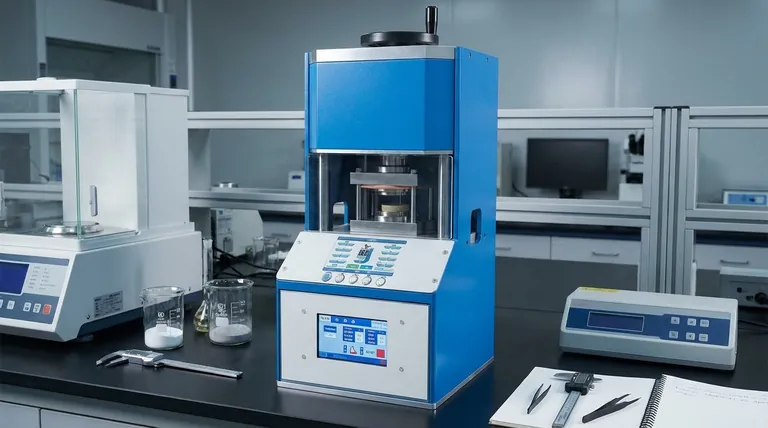
A laboratory heated press is the definitive tool for overcoming the physical limitations inherent in mixing solid polymers and inorganic fillers. By applying simultaneous thermal energy and mechanical force, it transforms loose, porous mixtures into dense, cohesive membranes. This process is essential for eliminating the micro-defects that otherwise impede ionic conductivity in solid-state batteries.
Core Takeaway The heated press solves the "solid-solid interface" problem by reducing polymer viscosity and collapsing voids simultaneously. Its primary value is the creation of a dense, monolithic structure where the polymer matrix perfectly wets the inorganic filler, establishing the continuous pathways required for efficient ion transport.
Achieving Microstructural Integrity
Eliminating Porosity and Voids
The primary adversary in solid-state electrolyte fabrication is air pockets or solvent-induced voids. These defects act as insulators, blocking ion movement.
A heated press applies high pressure (often up to 240 MPa) to mechanically collapse these voids. This densification is critical for maximizing the volume of active material available for charge transport.
Enhancing Polymer Flow and Wetting
Pressure alone is often insufficient for composite materials. The heating function reduces the viscosity of the polymer matrix, such as PEO or PVDF.
This induced flowability allows the polymer to tightly "wet" the surface of the ceramic fillers (like LLZTO). This ensures that no physical gaps remain between the organic and inorganic phases.
Uniform Filler Distribution
Achieving a homogenous mixture is vital for consistent performance across the entire membrane.
The combination of heat and pressure promotes the uniform dispersion of inorganic fillers throughout the matrix. This prevents particle agglomeration, which can otherwise lead to localized "hot spots" or mechanical failure points.
Optimizing Electrochemical Performance
Creating Continuous Ion Transport Channels
Ionic conductivity relies on a connected network. By densifying the material, the press ensures intimate contact between particles.
This process facilitates neck formation and creates continuous channels for ions to move freely. Refined contact conditions directly correlate to higher overall conductivity.
Reducing Interfacial Resistance
The interface between the electrolyte and the electrode is a major bottleneck in solid-state batteries.
Using a heated press for lamination bonds the electrolyte layer securely to the electrodes. This seamless physical contact significantly minimizes interfacial resistance, improving both rate performance and cycling stability.
Enabling Solvent-Free Processing
Heated pressing unlocks "one-step" fabrication methods.
For systems like PEO-based electrolytes, the press allows for solvent-free preparation by melting the matrix to achieve molecular-level dispersion. This eliminates the need for drying steps and prevents defects associated with solvent evaporation.
Understanding the Trade-offs
While a heated press is essential for densification, it requires precise parameter control to avoid damaging the composite.
Thermal Degradation Risks
Excessive heat can degrade the polymer matrix before the composite is fully formed. The temperature must be high enough to induce flow but strictly below the polymer's degradation point.
Mechanical Over-Stress
Applying extreme pressure to a composite with high ceramic loading can fracture the brittle inorganic fillers. This disrupts the conductive pathways you are trying to create. Balancing pressure against the filler's structural limits is a critical operational constraint.
Making the Right Choice for Your Goal
To maximize the utility of a heated press, tailor your parameters to your specific performance metric:
- If your primary focus is Ionic Conductivity: Prioritize temperature control to ensure the polymer viscosity drops sufficiently to fully wet the ceramic particles, maximizing active surface area.
- If your primary focus is Mechanical Strength: Prioritize high-pressure densification to eliminate all internal porosity, creating a robust, monolithic membrane that resists dendrite penetration.
- If your primary focus is Full Cell Assembly: Focus on thermo-compression lamination to minimize contact resistance between the electrolyte and the anode/cathode layers.
The heated press is not just a shaping tool; it is an active processing instrument that dictates the final electrochemical identity of your composite material.
Summary Table:
| Advantage | Key Benefit | Impact on Electrolyte |
|---|---|---|
| Eliminates Porosity | Collapses voids under high pressure (up to 240 MPa) | Creates a dense, monolithic structure for uninterrupted ion flow |
| Enhances Polymer Wetting | Heats polymer to reduce viscosity and improve filler contact | Ensures perfect organic/inorganic interface, reducing resistance |
| Uniform Filler Distribution | Promotes homogeneous dispersion of ceramic particles | Prevents agglomeration and ensures consistent performance |
| Enables Solvent-Free Processing | Melts polymer matrix for one-step fabrication | Eliminates solvent evaporation defects and simplifies production |
Ready to Fabricate Superior Solid-State Electrolytes?
KINTEK's laboratory presses are engineered to meet the precise demands of battery research. Whether you are developing polymer/ceramic composites for higher ionic conductivity or need robust membranes for mechanical strength, our automatic lab presses, isostatic presses, and heated lab presses deliver the controlled heat and pressure essential for your success.
We serve laboratories and research institutions focused on next-generation energy storage. Let us help you optimize your process parameters and achieve breakthrough results.
Contact KINTEK today to discuss your specific application and discover the perfect press for your lab!
Visual Guide

References
- Zehui Zhao, Peng Tan. Quasi/All Solid‐State Electrolytes for Lithium–Carbon Dioxide Batteries. DOI: 10.1002/cnl2.70026
This article is also based on technical information from Kintek Solution Knowledge Base .
Related Products
- 24T 30T 60T Heated Hydraulic Lab Press Machine with Hot Plates for Laboratory
- Heated Hydraulic Press Machine with Heated Plates for Vacuum Box Laboratory Hot Press
- Laboratory Split Manual Heated Hydraulic Press Machine with Hot Plates
- Automatic Heated Hydraulic Press Machine with Hot Plates for Laboratory
- Automatic High Temperature Heated Hydraulic Press Machine with Heated Plates for Lab
People Also Ask
- Function of a Laboratory Hydraulic Press with Heated Platens in SSE? Enhance Battery Density & Conductivity
- Why is a laboratory hydraulic press with heating plates required for PLA/TEC films? Achieve Precise Sample Integrity
- What role does a laboratory heated hydraulic press play in LTCC? Essential for High-Density Ceramic Lamination
- What is the primary function of a laboratory heated hydraulic press? Mastering Thermoplastic Carbon Fiber Composites
- What is the critical role of a laboratory heated hydraulic press? Mastering PVC Sample Prep for Testing



















