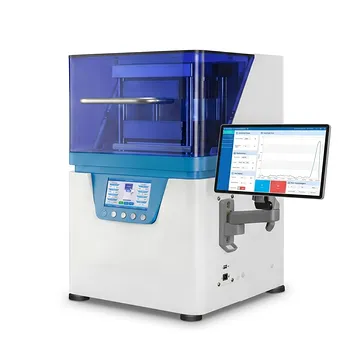
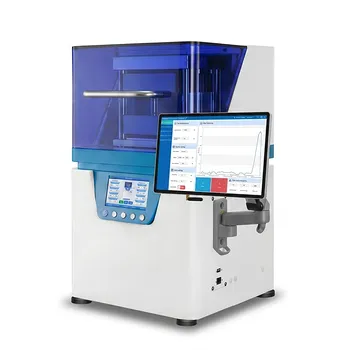
Using a precision laboratory press is essential for the successful encapsulation of anode-free solid-state batteries. It provides the stable, high-pressure environment required to maintain tight solid-solid interfacial contact, manage volume expansion during lithium plating, and inhibit the growth of destructive lithium dendrites. This precise mechanical control directly translates to lower interfacial resistance and a significantly extended battery cycle life.
Core Takeaway: A precision laboratory press transforms a collection of powdered layers into a functional electrochemical system by ensuring seamless physical contact and mitigating the mechanical stresses inherent in anode-free architectures.
Maintaining Interfacial Integrity in Solid-State Systems
Establishing Tight Solid-Solid Contact
Unlike traditional batteries with liquid electrolytes, solid-state batteries rely on physical pressure to force the electrolyte and electrodes together. A precision press ensures intimate contact between brittle solid electrolytes and the active materials, which is the fundamental requirement for ionic transport.
Reducing Interfacial Resistance
By applying consistent pressure, the laboratory press eliminates internal voids and pores between material layers. This reduction in "dead space" lowers interfacial impedance and grain boundary resistance, allowing ions to move freely across the battery's internal boundaries.
Managing Volume Expansion Stresses
In anode-free configurations, lithium metal is plated directly onto the current collector during charging, causing significant volume changes. The press provides a stable mechanical constraint that manages these stresses, preventing the layers from delaminating or losing contact during cycling.
Inhibiting Degradation and Enhancing Safety
Suppressing Lithium Dendrite Growth
Precision pressure control is a primary defense against lithium dendrites, which can penetrate solid electrolytes and cause short circuits. The press maintains a uniform stress field that discourages the non-uniform deposition of lithium, thereby preserving the integrity of the electrolyte layer.
Preventing Contact Failure During Cycling
During the stripping and plating processes of battery operation, material can physically shift or shrink. A high-precision press maintains continuous mechanical pressure, ensuring that the electrolyte and current collector remain bonded even as the lithium reservoir changes size.
Eliminating Assembly Interference
Using an automated or high-precision press provides a repeatable baseline for testing. This eliminates variables caused by manual assembly errors, ensuring that the performance data gathered during in-situ monitoring is a result of the battery chemistry, not inconsistent assembly.
Optimization of Material Density and Performance
Increasing Compaction Density
High-pressure encapsulation forces the cathode and electrolyte particles into a denser arrangement. This high compaction density maximizes the amount of active material in a given volume, directly enhancing the battery's volumetric energy density.
Improving Rate Performance
By minimizing the gaps between particles, the press creates efficient lithium-ion transport pathways. These seamless pathways allow the battery to handle higher current densities, which is critical for fast-charging applications and high-power output.
Uniformity Across Brittle Materials
Many solid electrolytes, such as sulfides or oxides, are brittle and prone to micro-cracking. A precision press applies extremely uniform normal pressure, which compacts these materials without creating the localized stress concentrations that lead to structural failure.
Understanding the Trade-offs and Limitations
Risk of Mechanical Fracturing
While high pressure is necessary, exceeding the mechanical limits of brittle ceramic electrolytes like LLZO can cause macroscopic cracking. This destroys the electrolyte's ability to act as a separator and leads to immediate cell failure.
Pressure-Induced Shorting
In some cases, excessive pressure can actually promote dendrite penetration if the electrolyte has pre-existing sub-micron flaws. Balancing the optimal pressure setpoint is critical, as the "more is better" approach does not always apply to delicate solid-state interfaces.
Complexity of In-Situ Monitoring
Maintaining high pressure during testing requires specialized, bulky housing. This can complicate in-situ characterization (like X-ray or microscopy), as the physical press and its components may obstruct the signals needed to observe internal battery dynamics.
How to Apply This to Your Battery Project
To maximize the performance of your solid-state cells, you must tailor your pressing strategy to your specific material set.
- If your primary focus is maximizing energy density: Use a high-precision automatic press to reach the maximum safe compaction limit of your cathode sheets, reducing void space to near zero.
- If your primary focus is preventing dendrite-related shorts: Prioritize a press that offers constant pressure maintenance (active compensation) to ensure the interface remains stable throughout the entire expansion/contraction cycle.
- If your primary focus is material characterization: Utilize a manual or automatic press that allows for precise, repeatable pressure settings to ensure that your experimental results are not skewed by assembly variations.
Precise mechanical pressure is the physical foundation upon which the electrochemical success of anode-free solid-state batteries is built.
Summary Table:
| Key Advantage | Impact on Battery Performance |
|---|---|
| Interfacial Contact | Ensures seamless ionic transport by forcing electrolytes and electrodes together. |
| Resistance Reduction | Eliminates internal voids to lower interfacial impedance and grain boundary resistance. |
| Strain Management | Provides mechanical constraints to manage volume expansion during lithium plating. |
| Dendrite Suppression | Maintains a uniform stress field to prevent short circuits and electrolyte penetration. |
| Density Optimization | Increases compaction for higher volumetric energy density and better rate performance. |
| Testing Consistency | Offers a repeatable baseline that removes manual assembly variables from research results. |
Optimize Your Battery Research with KINTEK Precision Presses
Achieving the perfect solid-solid interface is critical for the next generation of energy storage. KINTEK specializes in comprehensive laboratory pressing solutions designed specifically for the rigorous demands of battery research.
Whether you need manual, automatic, heated, multifunctional, or glovebox-compatible models, our equipment provides the stable, high-pressure environment required to inhibit dendrites and extend cycle life. We also offer cold and warm isostatic presses for applications requiring extreme material uniformity.
Ready to enhance your lab's efficiency and cell performance?
Contact KINTEK experts today to find your ideal pressing solution.
References
- Wang, Yijia, Zhao, Yang. Revealing the Neglected Role of Passivation Layers of Current Collectors for Solid‐State Anode‐Free Batteries. DOI: 10.34734/fzj-2025-04486
This article is also based on technical information from Kintek Solution Knowledge Base .
Related Products
- Automatic Heated Hydraulic Lab Press with Programmable Touch Screen Controls and Precision Temperature Regulation
- Automatic Hydraulic Hot Press with Large Plate and Precision Temperature Control for Advanced Material Sample Preparation and Industrial Research
- Laboratory Hydraulic Press 2T Lab Pellet Press for KBR FTIR
- Special Shape Lab Press Mold for Laboratory Applications
- 24T 30T 60T Heated Hydraulic Lab Press Machine with Hot Plates for Laboratory
People Also Ask
- Why is a laboratory heated hydraulic press required? Ensure Precise Vulcanization for NBR/EPDM Nanocomposites
- What are the industrial applications of heated hydraulic presses? Master Heat & Force for Precision Manufacturing
- Why is an automatic heated lab press preferred for PEEK & CNT laminates? Achieve Precise Crystallization Control
- What is the necessity of a laboratory hydraulic press with heating functions? Master Rubber Vulcanization Precision
- How does a heated laboratory hydraulic press contribute to the formation of dense mycelium-based materials? Expert Tips