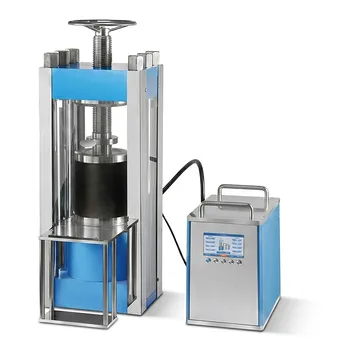
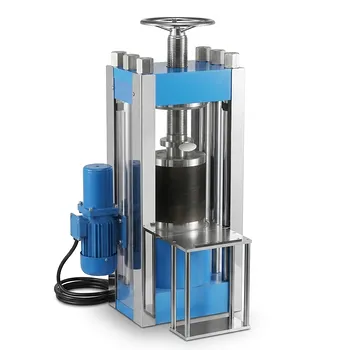
A typical laboratory hot press functions through the integration of four primary subsystems: a heating system, a pressing system, a sophisticated control system, and a rigid structural frame. While specific applications may require auxiliary features like vacuum chambers or cooling units, these four components form the essential architecture required to process materials under heat and pressure.
Core Insight: The effectiveness of a hot press is not determined by force alone, but by the precise synchronization of mechanical pressure and thermal energy. A high-quality press must maintain uniform heat distribution across the platens while simultaneously delivering stable, controlled pressure.
The Structural Foundation
The Frame and Base
The frame acts as the skeleton of the machine, designed to withstand significant mechanical stress without deforming. It anchors the baseplate, which provides a stable platform for the entire assembly.
The Ram Assembly
Housed within the frame is the ram, the movable component responsible for physically applying force. It moves vertically to close the distance between the platens and compress the sample.
The Pressing System
Hydraulic or Pneumatic Drive
The force generation system is typically hydraulic for high-pressure applications or pneumatic for lower-pressure needs. In a hydraulic setup, a plunger pushes hydraulic fluid from a reservoir through pipes and hoses to generate force.
Control Valves and Cylinders
Control valves precisely direct the flow of fluid to manage the speed and pressure of the ram. The main cylinder receives this fluid, converting hydraulic energy into the mechanical force delivered to the workpiece.
The Heating System
Heating Platens
These are the surfaces that directly contact the sample mold. They are typically machined from high-conductivity metals like tool steel or aluminum alloy. To ensure durability and prevent surface damage, they are often chrome-plated or nitrided.
Thermal Generation and Sensing
Embedded within the platens are heating elements, such as resistance wires, cartridges, or induction coils. Thermocouples serve as temperature sensors, providing real-time feedback to the controller to ensure the actual temperature matches the setpoint.
Insulation
To maximize energy efficiency and protect the rest of the machine, insulation materials are placed between the heated platens and the machine frame. This minimizes heat loss and ensures the temperature remains concentrated on the sample.
The Control Architecture
PID Logic
The brain of the operation is the Temperature Controller, which often utilizes PID (Proportional-Integral-Derivative) logic. This algorithm continuously adjusts power output to prevent temperature overshoots and ensure a stable heating rate.
Pressure and Time Management
A dedicated Pressure Controller maintains the target force, while a Timer automates the duration of the holding (dwell) phase. This ensures reproducibility across different experimental runs.
The Human-Machine Interface (HMI)
Modern presses utilize an HMI, such as a touchscreen or keypad, to input parameters. This interface allows operators to program complex multi-stage temperature profiles and view real-time data curves for monitoring the process.
Understanding the Trade-offs
Thermal Uniformity vs. Heating Speed
Rapid heating can sometimes lead to uneven temperature distribution across the platen surface. High-quality presses prioritize thermal mass and conductivity to ensure uniformity, even if it slightly reduces the initial ramp-up speed.
Hydraulic Power vs. Maintenance
While hydraulic systems offer superior force capabilities compared to pneumatic systems, they introduce complexity. They require regular maintenance of seals, hoses, and fluid levels to prevent leaks and ensure consistent pressure delivery.
Making the Right Choice for Your Goal
When evaluating a hot press, the "best" components depend entirely on your specific experimental requirements.
- If your primary focus is precise material synthesis: Prioritize a control system with PID logic and multi-stage profiling to strictly control heating rates and dwell times.
- If your primary focus is high-density compaction: Ensure the frame rigidity and hydraulic cylinder capacity are rated well above your maximum required operating pressure.
- If your primary focus is repeatability: Look for an HMI with data logging capabilities to track and verify process parameters for every cycle.
Select the machine that aligns its core strengths with the specific variables—heat, pressure, or control—that matter most to your research.
Summary Table:
| System | Key Components | Primary Function |
|---|---|---|
| Structural | Frame, Base, Ram | Provides mechanical stability and supports vertical force application. |
| Pressing | Hydraulic/Pneumatic Drive, Valves | Generates and regulates the mechanical pressure applied to the sample. |
| Heating | Platens, Elements, Thermocouples | Ensures uniform thermal distribution and precise temperature sensing. |
| Control | PID Logic, HMI, Timers | Manages temperature profiles, dwell times, and pressure synchronization. |
Elevate Your Material Research with KINTEK
Precision in heat and pressure is non-negotiable for high-performance material synthesis and battery research. KINTEK specializes in comprehensive laboratory pressing solutions, offering a versatile range of manual, automatic, heated, multifunctional, and glovebox-compatible models, alongside advanced cold and warm isostatic presses.
Whether you require sophisticated PID control for multi-stage thermal profiles or a high-rigidity frame for extreme compaction, our equipment is engineered to deliver repeatable, high-accuracy results for your lab.
Ready to optimize your pressing workflow? Contact our technical experts today to find the perfect solution for your research needs.
Related Products
- 24T 30T 60T Heated Hydraulic Lab Press Machine with Hot Plates for Laboratory
- Laboratory Split Manual Heated Hydraulic Press Machine with Hot Plates
- Heated Hydraulic Press Machine with Heated Plates for Vacuum Box Laboratory Hot Press
- Automatic Heated Hydraulic Press Machine with Hot Plates for Laboratory
- Automatic Large Format Laboratory Heated Hydraulic Press 400x400mm Plate Capacity
People Also Ask
- Function of a Laboratory Hydraulic Press with Heated Platens in SSE? Enhance Battery Density & Conductivity
- Why is a laboratory hydraulic press with heating plates required for PLA/TEC films? Achieve Precise Sample Integrity
- What role does a laboratory heated hydraulic press play in LTCC? Essential for High-Density Ceramic Lamination
- What is the primary function of a laboratory heated hydraulic press? Mastering Thermoplastic Carbon Fiber Composites
- What is the critical role of a laboratory heated hydraulic press? Mastering PVC Sample Prep for Testing