
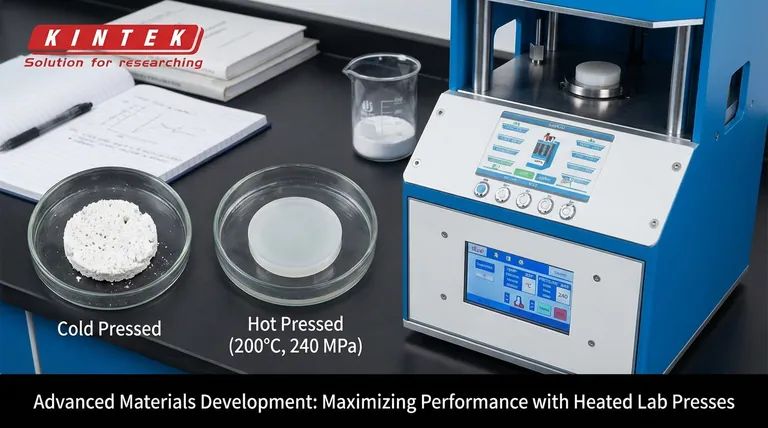
Utilizing a heated lab press at 200°C and 240 MPa transforms the fabrication of Li6PS5Cl-based electrolytes by leveraging the synergy of thermal softening and mechanical force. While cold pressing merely packs powder together, this specific combination of heat and pressure induces plastic deformation, resulting in a chemically distinct and structurally superior pellet compared to room-temperature compaction.
The simultaneous application of heat (200°C) and pressure (240 MPa) activates plastic flow in Li6PS5Cl particles, eliminating voids that cold pressing cannot reach. This results in near-theoretical density, maximized ionic conductivity, and the mechanical robustness required for high-performance solid-state batteries.
The Mechanics of Enhanced Densification
Triggering Plastic Deformation
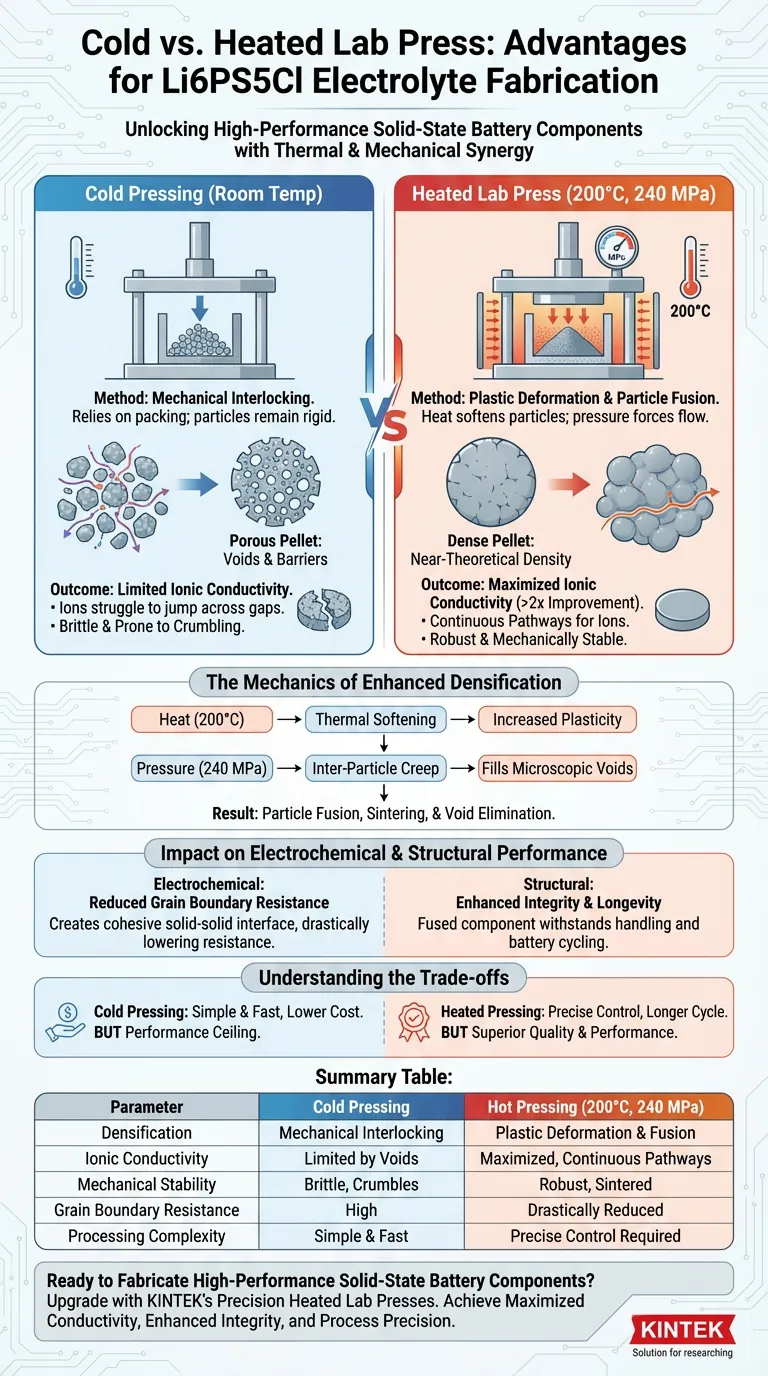
Cold pressing relies on mechanical interlocking, but it cannot overcome the inherent rigidity of the particles at room temperature. Heating the Li6PS5Cl to 200°C softens the particle surfaces.
This thermal softening increases the material's plasticity, allowing the particles to deform rather than fracture under load.
Promoting Inter-Particle Creep
When 240 MPa of pressure is applied to this softened state, it promotes inter-particle creep. The material physically flows into the microscopic voids that usually persist in cold-pressed compacts.
This process facilitates diffusion, allowing particles to fuse together rather than just touching. The result is a pellet that approaches its theoretical density, effectively eliminating the porosity issues common in cold-pressed samples.
Impact on Electrochemical Performance
Maximizing Ionic Conductivity
The primary advantage of this process is a substantial boost in ionic conductivity. In cold-pressed pellets, voids act as barriers to ion transport.
By creating a dense, void-free structure, hot pressing establishes a continuous pathway for ions. Data indicates that hot pressing can more than double conductivity compared to cold pressing (e.g., improving from ~3 mS/cm to >6 mS/cm) by optimizing the solid-solid interface.
Reducing Grain Boundary Resistance
High-performance electrolytes require intimate contact between grains. Cold pressing often leaves "grain boundary resistance," where ions struggle to jump from one particle to the next.
The simultaneous heat and pressure effectively sinter the particles, forming a cohesive solid-solid interface. This drastically lowers the resistance encountered at grain boundaries, which is a critical pathway for achieving peak performance.
Structural Integrity and Longevity
improving Mechanical Stability
Pellets fabricated via cold pressing can be brittle and prone to crumbling during handling or battery cycling.
The fusion created by hot pressing results in a mechanically integral component. This enhanced stability is vital for maintaining contact with electrodes during the volume changes associated with battery cycling.
Enhancing Polymer Matrix Distribution
If the electrolyte is a composite involving a polymer matrix, the heat (200°C) reduces the polymer's viscosity.
This improved flowability allows the polymer to wet the inorganic fillers effectively. The pressure ensures a uniform distribution, preventing the formation of internal bubbles and ensuring a homogeneous membrane.
Understanding the Trade-offs
Equipment Complexity vs. Material Quality
While cold pressing is fast and requires simpler equipment, it produces a distinct ceiling on material performance.
Hot pressing requires precise control over temperature and ramp rates. However, this complexity is the necessary "cost" for lowering the sintering temperature and duration required to achieve fine grain structures and high densities.
Processing Time
Hot pressing is generally a slower process than cold pressing due to the heating and cooling cycles.
However, it is more efficient than "pressureless sintering," as the addition of pressure significantly speeds up the densification process compared to using heat alone.
Making the Right Choice for Your Goal
To determine whether the added complexity of a heated press is necessary for your specific application, consider your performance targets.
- If your primary focus is maximizing cell efficiency: You must use hot pressing to eliminate porosity and minimize grain boundary resistance for the highest possible ionic conductivity.
- If your primary focus is mechanical durability: You need the sintering effect of the heated press to ensure the pellet survives handling and long-term cycling without delamination.
For Li6PS5Cl-based electrolytes, the transition from cold pressing to hot pressing at 200°C/240 MPa represents the shift from a theoretical powder compact to a functional, high-density battery component.
Summary Table:
| Parameter | Cold Pressing | Hot Pressing (200°C, 240 MPa) |
|---|---|---|
| Densification | Mechanical interlocking | Plastic deformation & particle fusion |
| Ionic Conductivity | Limited by voids and porosity | Maximized, continuous ion pathways |
| Mechanical Stability | Brittle, prone to crumbling | Robust, sintered structure |
| Grain Boundary Resistance | High, limits performance | Drastically reduced |
| Processing Complexity | Simple and fast | Requires precise temperature/pressure control |
Ready to Fabricate High-Performance Solid-State Battery Components?
Upgrade your lab's capabilities with KINTEK's precision heated lab presses. Our automatic lab presses, isostatic presses, and heated lab presses are engineered to deliver the exact temperature and pressure control required for superior Li6PS5Cl electrolyte pellet fabrication.
We specialize in serving laboratory needs for advanced materials development. By partnering with KINTEK, you gain:
- Maximized Ionic Conductivity: Achieve near-theoretical density and eliminate porosity.
- Enhanced Mechanical Integrity: Create robust pellets that withstand battery cycling.
- Process Precision: Reproduce optimal conditions like 200°C and 240 MPa with reliability.
Don't let cold pressing limit your battery performance. Contact our experts today to discuss how a KINTEK heated lab press can transform your research and development outcomes!
Visual Guide
Related Products
- 24T 30T 60T Heated Hydraulic Lab Press Machine with Hot Plates for Laboratory
- Manual Heated Hydraulic Lab Press with Integrated Hot Plates Hydraulic Press Machine
- Automatic High Temperature Heated Hydraulic Press Machine with Heated Plates for Lab
- Automatic Heated Hydraulic Press Machine with Hot Plates for Laboratory
- Heated Hydraulic Press Machine with Heated Plates for Vacuum Box Laboratory Hot Press
People Also Ask
- Function of a Laboratory Hydraulic Press with Heated Platens in SSE? Enhance Battery Density & Conductivity
- Why is a laboratory hydraulic press with heating plates required for PLA/TEC films? Achieve Precise Sample Integrity
- What role does a laboratory heated hydraulic press play in LTCC? Essential for High-Density Ceramic Lamination
- What is the primary function of a laboratory heated hydraulic press? Mastering Thermoplastic Carbon Fiber Composites
- Why reduce load when applying composite strengthening tabs? Protect Specimen Integrity and Data Accuracy



















