
Hot-press sintering significantly outperforms traditional preparation methods by simultaneously applying high temperature and uniaxial mechanical pressure to ceramic powders. This dual-action process facilitates the rearrangement and plastic deformation of LLZTO particles, enabling the fabrication of electrolyte pellets with relative densities exceeding 99%, a threshold that is difficult to achieve with standard pressureless sintering.
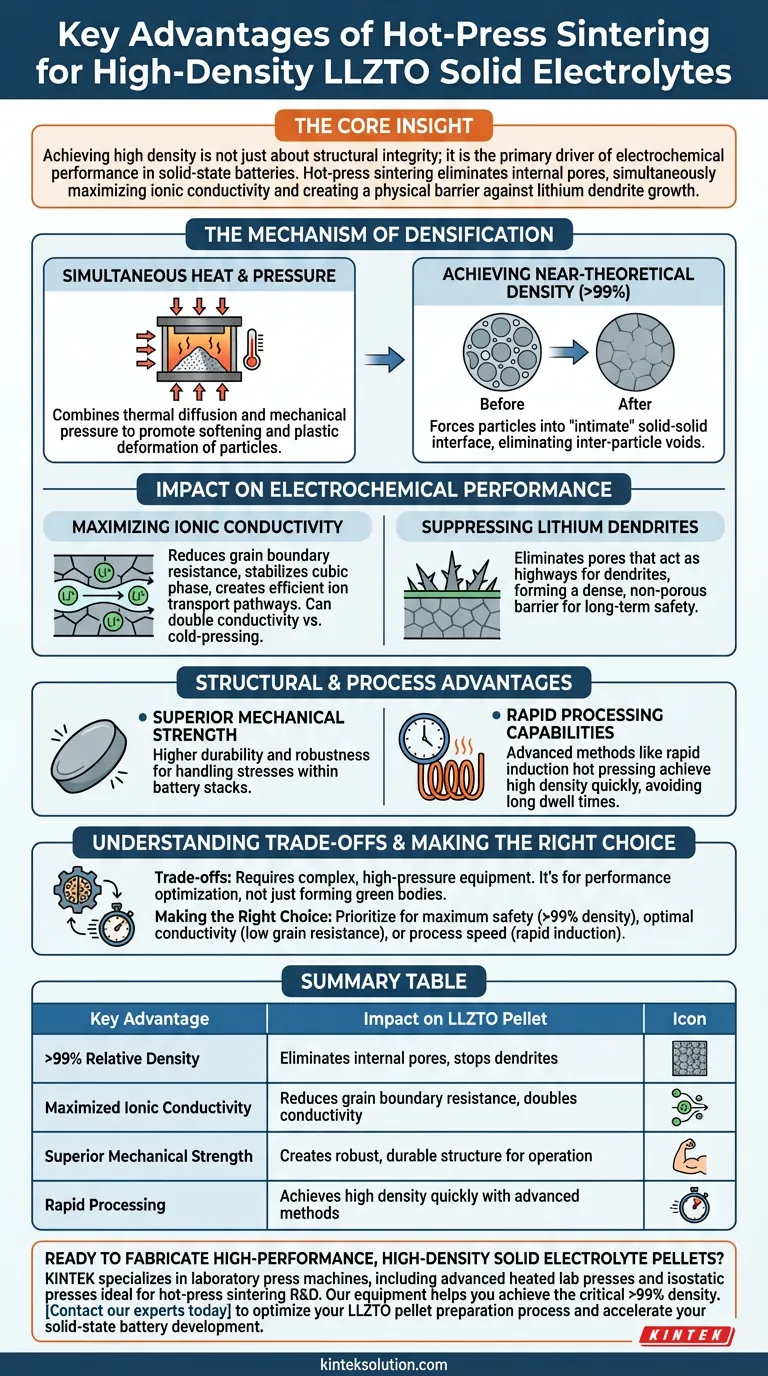
The Core Insight Achieving high density is not just about structural integrity; it is the primary driver of electrochemical performance in solid-state batteries. Hot-press sintering eliminates the internal pores that act as failure points, simultaneously maximizing ionic conductivity and creating a physical barrier against lithium dendrite growth.
The Mechanism of Densification
Simultaneous Heat and Pressure
Unlike cold pressing, which relies solely on mechanical force, or pressureless sintering, which relies solely on thermal diffusion, hot-pressing combines both. A hot press sintering furnace applies mechanical pressure while the material is at elevated temperatures. This promotes the softening and plastic deformation of the electrolyte particles, allowing them to fill voids that would otherwise remain empty.
Achieving Near-Theoretical Density
The primary advantage of this method is the ability to reach a relative density of over 99%. Standard methods often leave microscopic voids between particles. Hot-pressing forces particles into a "intimate" solid-solid interface, effectively eliminating these inter-particle voids and creating a continuous ceramic structure.
Impact on Electrochemical Performance
Maximizing Ionic Conductivity
Porosity is the enemy of conductivity. By reducing the interstitial voids, hot-pressing significantly lowers grain boundary resistance. This process stabilizes the highly conductive cubic phase of LLZTO, creating efficient, continuous pathways for lithium-ion transport. References indicate this can double ionic conductivity compared to cold-pressed samples (e.g., increasing from ~3 mS/cm to >6 mS/cm in specific contexts).
Suppressing Lithium Dendrites
Internal pores in a solid electrolyte can act as "highways" for lithium dendrites—metallic filaments that cause short circuits. By eliminating these pores, hot-pressed pellets form a dense, non-porous physical barrier. This structural density is critical for preventing dendrite penetration and ensuring the long-term safety of the battery.
Structural and Process Advantages
Superior Mechanical Strength
The elimination of voids directly correlates to physical durability. Hot-pressed ceramics possess higher mechanical strength compared to porous samples. This robustness is essential for handling the stresses within a battery stack during operation.
Rapid Processing Capabilities
Advanced variations, such as rapid induction hot pressing, can achieve high densities (over 95%) in very short timeframes. This offers a pathway to high-quality fabrication without the extended dwell times required by conventional sintering kilns.
Understanding the Trade-offs
Equipment Complexity
While pressureless sintering requires only a furnace, hot-pressing requires specialized equipment capable of applying substantial uniaxial force (e.g., 350 MPa) at high temperatures. This increases the complexity of the manufacturing setup compared to simple cold-pressing followed by sintering.
Specificity of Application
Hot-pressing is a high-energy process designed for performance optimization. It is distinct from simple cold-pressing, which is often used merely to form a "green body" (a pre-sintered shape). While cold-pressing improves contact, it cannot achieve the particle fusion and plastic deformation provided by the simultaneous heat of hot-pressing.
Making the Right Choice for Your Goal
To determine if hot-press sintering is the correct approach for your specific LLZTO application, consider your primary performance metrics:
- If your primary focus is maximum safety and longevity: Use hot-pressing to achieve >99% density, as this is the most effective way to eliminate pores that facilitate dendrite growth.
- If your primary focus is ionic conductivity: Prioritize this method to minimize grain boundary resistance and stabilize the cubic phase for optimal ion transport.
- If your primary focus is process speed: Investigate rapid induction hot pressing to combine high-density results with shorter processing times.
Ultimately, hot-press sintering is the definitive choice when the quality of the solid-solid interface and total elimination of porosity are non-negotiable requirements.
Summary Table:
| Key Advantage | Impact on LLZTO Pellet |
|---|---|
| >99% Relative Density | Eliminates internal pores that act as failure points for dendrites. |
| Maximized Ionic Conductivity | Reduces grain boundary resistance, doubling conductivity in some cases. |
| Superior Mechanical Strength | Creates a robust, durable ceramic structure for long-term battery operation. |
| Rapid Processing | Advanced methods like induction hot pressing achieve high density quickly. |
Ready to fabricate high-performance, high-density solid electrolyte pellets?
KINTEK specializes in laboratory press machines, including advanced heated lab presses and isostatic presses ideal for hot-press sintering research and development. Our equipment is designed to help you achieve the critical >99% density required for superior ionic conductivity and battery safety.
Contact our experts today to discuss how our lab press solutions can optimize your LLZTO pellet preparation process and accelerate your solid-state battery development.
Visual Guide
Related Products
- Automatic High Temperature Heated Hydraulic Press Machine with Heated Plates for Lab
- Lab Heat Press Special Mold
- Heated Hydraulic Press Machine with Heated Plates for Vacuum Box Laboratory Hot Press
- Laboratory Split Manual Heated Hydraulic Press Machine with Hot Plates
- Heated Hydraulic Press Machine With Heated Plates For Vacuum Box Laboratory Hot Press
People Also Ask
- Function of a Laboratory Hydraulic Press with Heated Platens in SSE? Enhance Battery Density & Conductivity
- What are the requirements for electrode pressing with high-viscosity ionic liquids like EMIM TFSI? Optimize Performance
- How does a laboratory heated hydraulic press facilitate PBN sample prep for WAXS? Achieve Precise X-Ray Scattering
- What are the industrial applications of heated hydraulic presses? Master Heat & Force for Precision Manufacturing
- Why is a laboratory hydraulic press with heating plates required for PLA/TEC films? Achieve Precise Sample Integrity


















