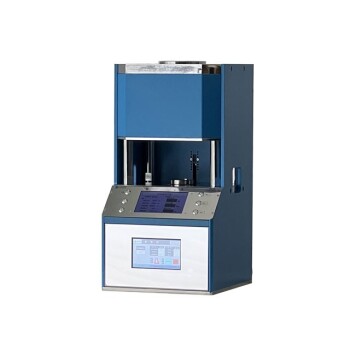
The transition from traditional Hot Pressing (HP) to Spark Plasma Sintering (SPS) represents a fundamental shift from external thermal conduction to internal, direct-current heating. This shift allows manufacturers of nickel-based alloys to achieve full densification at lower temperatures and in a fraction of the time—reducing processing cycles from hours to as little as 5 to 30 minutes.
Core Takeaway: The primary advantage of SPS is its ability to bypass the thermal "trade-off" of traditional sintering: it achieves near-theoretical density while suppressing grain growth, resulting in nickel-based alloys with ultrafine microstructures and superior mechanical strength.
The Mechanics of Direct Energy Application
The Role of Pulsed Direct Current
Unlike traditional Hot Pressing, which relies on external heating elements to radiate heat into a mold, SPS passes high-current pulses directly through the powder and the die. This process generates Joule heat and localized discharge between particles, ensuring the energy is concentrated exactly where it is needed for bonding.
Extreme Heating Rates
SPS can achieve heating rates as high as 1000°C per minute, a speed unattainable by conventional HP furnaces. This velocity allows the material to reach its optimal sintering temperature quickly, bypassing intermediate temperature zones where unwanted phase transformations or premature grain coarsening often occur.
Simultaneous Pressure and Current
By applying axial pressure at the same time as the pulsed current, SPS facilitates rapid consolidation. This synergy enables the material to achieve near-total density—often exceeding 99% of its theoretical limit—far more efficiently than pressure alone could achieve in a traditional HP environment.
Precision Control of Microstructure
Suppression of Grain Growth
The defining metallurgical benefit for nickel-based alloys is the inhibition of grain growth. Because the "isothermal time" (the time spent at high temperatures) is drastically shortened, the initial fine or nanocrystalline structure of the powder is preserved in the final solid part.
Enhanced Hardness and Wear Resistance
Maintaining an ultrafine or equiaxed nanocrystalline structure directly translates to improved mechanical performance. Nickel-based alloys produced via SPS typically exhibit higher hardness, better wear resistance, and superior tensile strength compared to those subjected to the long-term high-temperature annealing of traditional HP.
Uniform Phase Distribution
The rapid nature of SPS limits long-range atomic diffusion, which prevents the "clumping" or uneven distribution of secondary phases. In nickel-aluminum systems, for example, this ensures a uniform reinforcement phase within the matrix, leading to consistent material properties throughout the component.
Understanding the Trade-offs
Geometry and Tooling Constraints
While SPS is technically superior for material properties, it is often limited by sample geometry. Because the process requires a uniform current flow through the die, it is best suited for relatively simple shapes like discs, cylinders, or plates; complex, near-net shapes are more difficult to achieve than with some high-end HP techniques.
Tooling Longevity and Cost
The use of graphite dies is standard in SPS to facilitate electrical conductivity, but the extreme currents and rapid thermal cycling can lead to faster tool wear. Additionally, the initial capital investment for an SPS system is typically higher than that of a standard Hot Press, requiring a high-value product or high-volume throughput to justify the cost.
How to Apply SPS to Your Production Goals
Recommendations for Material Development
- If your primary focus is Grain Retention: Use SPS to maintain nanocrystalline structures that HP would otherwise destroy through prolonged heat exposure.
- If your primary focus is Production Throughput: Transition to SPS to reduce sintering windows from several hours to under 30 minutes, significantly increasing daily output.
- If your primary focus is Energy Efficiency: Opt for SPS to leverage lower sintering temperatures and shorter cycles, which significantly reduce the total energy consumed per part.
- If your primary focus is Maximum Density: Utilize the simultaneous pulsed current and axial pressure of SPS to reach near 100% density in difficult-to-sinter nickel-based composites.
By prioritizing the speed and internal heating of Spark Plasma Sintering, you can engineer nickel-based alloys that are both stronger and more efficiently produced than those made through traditional methods.
Summary Table:
| Feature | Spark Plasma Sintering (SPS) | Traditional Hot Pressing (HP) |
|---|---|---|
| Heating Method | Internal (Direct Current / Joule Heat) | External (Thermal Radiation/Conduction) |
| Heating Rate | Extremely High (Up to 1000°C/min) | Slow (Typically <50°C/min) |
| Sintering Time | 5 – 30 Minutes | Several Hours |
| Microstructure | Suppression of grain growth (Fine/Nano) | Significant grain coarsening |
| Density | Near-theoretical (>99%) | Requires longer cycles for high density |
| Energy Efficiency | High (Direct energy application) | Lower (Heat loss to environment) |
Optimize Your Advanced Material Synthesis with KINTEK
Elevate your laboratory's capabilities with KINTEK’s comprehensive laboratory pressing solutions. Whether you are working on high-performance nickel alloys or pioneering battery research, we provide the precision tools necessary to achieve superior material properties.
Our range includes:
- Versatile Lab Presses: Manual, automatic, heated, and multifunctional models.
- Specialized Environments: Glovebox-compatible designs for sensitive materials.
- Advanced Consolidation: Cold (CIP) and Warm Isostatic Presses (WIP) for maximum density.
Don't let traditional sintering limitations hold back your innovation. Contact our experts today to find the ideal pressing solution tailored to your specific research goals and achieve near-theoretical density with ease.
Related Products
People Also Ask
- Function of a Laboratory Hydraulic Press with Heated Platens in SSE? Enhance Battery Density & Conductivity
- What are the requirements for electrode pressing with high-viscosity ionic liquids like EMIM TFSI? Optimize Performance
- How does a laboratory heated hydraulic press facilitate PBN sample prep for WAXS? Achieve Precise X-Ray Scattering
- What are the industrial applications of heated hydraulic presses? Master Heat & Force for Precision Manufacturing
- Why is a laboratory hydraulic press with heating plates required for PLA/TEC films? Achieve Precise Sample Integrity