
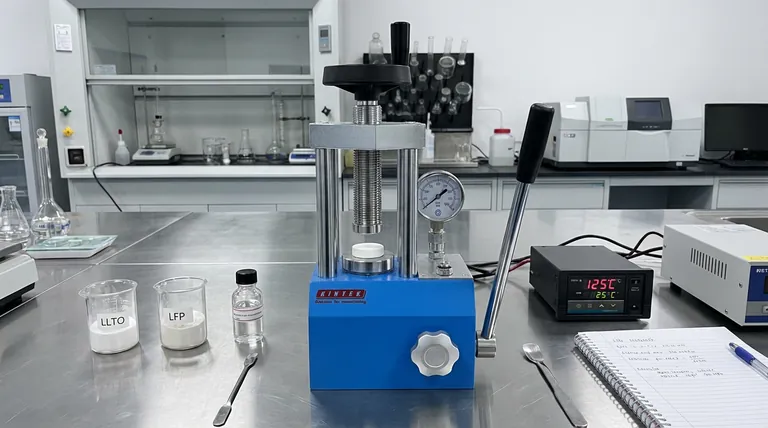
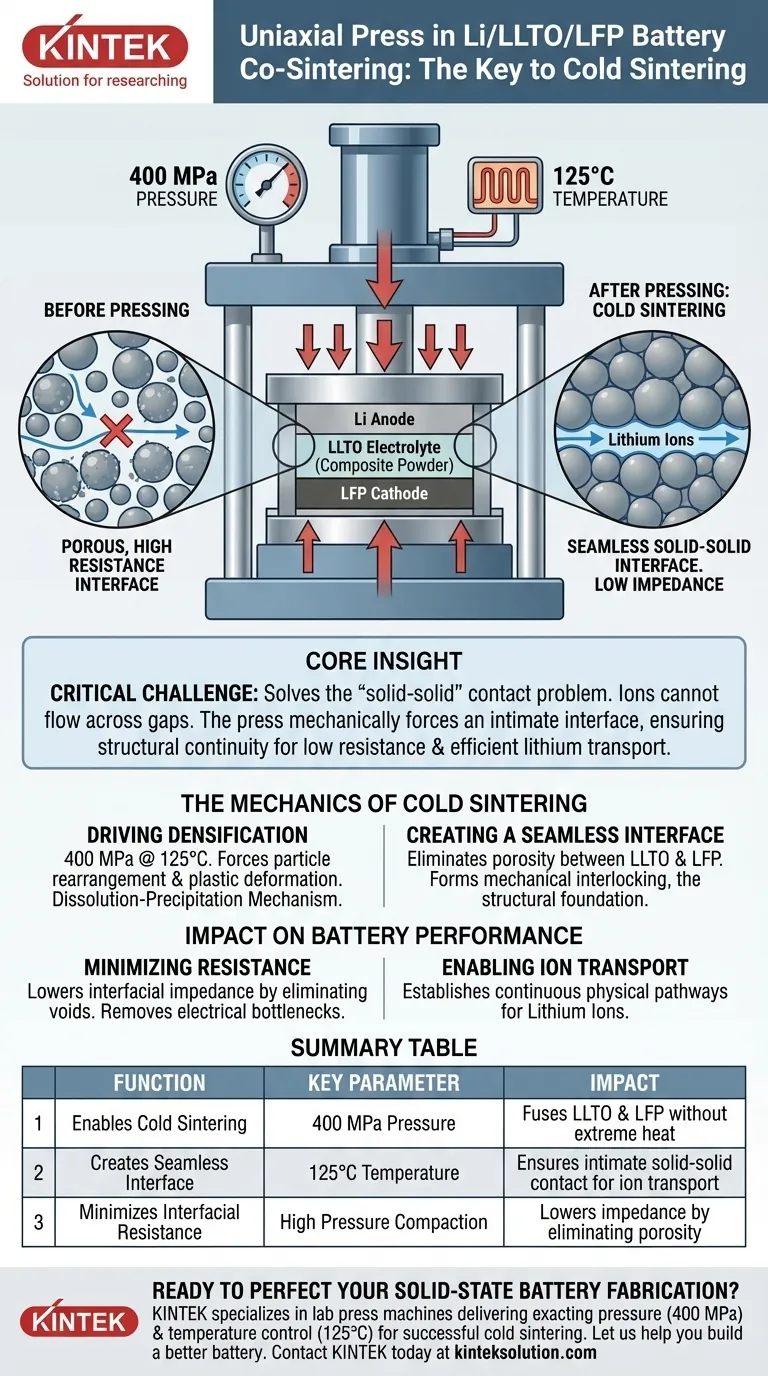
The primary function of the uniaxial press in this specific context is to enable the cold sintering process, applying high pressure (specifically 400 MPa) to fuse the LLTO electrolyte and LFP cathode. By combining this pressure with a moderate temperature of 125°C, the press forces the materials to merge into a seamless unit without requiring the extreme heat of traditional ceramics processing.
Core Insight The critical challenge in solid-state batteries is the "solid-solid" contact problem; ions cannot flow across gaps between particles. The uniaxial press solves this by mechanically forcing an intimate interface, ensuring the structural continuity required for low resistance and efficient lithium transport.
The Mechanics of Cold Sintering
Driving Low-Temperature Densification
Traditional ceramic sintering requires temperatures often exceeding 1000°C. In the Li/LLTO/LFP fabrication process, the uniaxial press utilizes cold sintering principles to achieve similar results at just 125°C.
The application of 400 MPa is not merely for compaction; it forces particle rearrangement and plastic deformation. This pressure, often in the presence of a transient solvent, drives a dissolution-precipitation mechanism, allowing the ceramic particles to densify rapidly at temperatures compatible with cathode materials.
Creating a Seamless Interface
The press physically eliminates porosity between the electrolyte (LLTO) and the cathode (LFP).
By compressing the composite powder against the cathode sheet, the machine creates a seamless, intimate solid-solid interface. This mechanical interlocking is the structural foundation of the battery, replacing the liquid electrolyte found in traditional cells.
Impact on Battery Performance
Minimizing Interfacial Resistance
A major failure point in solid-state batteries is high impedance at the junction where layers meet.
The uniaxial press ensures that the contact points between particles are maximized. By significantly increasing the density of the pellets and reducing internal voids, the process lowers the interfacial impedance, removing the electrical bottlenecks that usually degrade performance.
Enabling Ion Transport
Lithium ions require a continuous physical pathway to move between the cathode and the electrolyte.
The high-pressure compaction establishes these essential ion conduction pathways. Without the extreme densification provided by the press, the lithium ions would face physical barriers, rendering the battery inefficient or non-functional.
Understanding the Process Variables
Precision in Pressure Application
While generic pressing often ranges between 40 to 250 MPa, this specific co-sintering process demands a significantly higher pressure of 400 MPa.
Applying insufficient pressure will fail to trigger the cold sintering mechanism, resulting in a porous, highly resistive interface. Conversely, excessive pressure beyond the material's tolerance could lead to uncontrolled fracturing of the ceramic particles rather than beneficial rearrangement.
The Role of Thermal Synergy
The press does not act alone; it functions in tandem with heat.
The specific temperature of 125°C is calibrated to facilitate the dissolution-precipitation process without thermally degrading the LFP cathode. The uniaxial press must maintain pressure stability at this temperature to ensure uniform densification throughout the pellet.
Making the Right Choice for Your Goal
To optimize the fabrication of Li/LLTO/LFP batteries, consider the following based on your specific objectives:
- If your primary focus is lowering internal resistance: Prioritize maintaining the full 400 MPa pressure to maximize particle contact points and eliminate porosity at the interface.
- If your primary focus is structural integrity: Ensure the temperature is strictly maintained at 125°C during the pressing phase to activate the cold sintering mechanism without damaging the cathode material.
The uniaxial press serves as the defining tool for converting separate powder components into a unified, high-density electrochemical system.
Summary Table:
| Function | Key Parameter | Impact on Battery |
|---|---|---|
| Enables Cold Sintering | 400 MPa Pressure | Fuses LLTO electrolyte & LFP cathode without extreme heat |
| Creates Seamless Interface | 125°C Temperature | Ensures intimate solid-solid contact for ion transport |
| Minimizes Interfacial Resistance | High Pressure Compaction | Lowers impedance by eliminating porosity |
Ready to perfect your solid-state battery fabrication?
The precise application of high pressure is critical for creating the dense, low-resistance interfaces required for high-performance batteries like Li/LLTO/LFP. KINTEK specializes in lab press machines, including automatic and heated lab presses, designed to deliver the exacting pressure and temperature control your research demands.
Our expertise ensures your laboratory can reliably achieve the 400 MPa pressure and 125°C thermal synergy needed for successful cold sintering processes. Let us help you build a better battery.
Contact KINTEK today to discuss your lab press needs and enhance your development workflow.
Visual Guide
Related Products
- Lab Round Bidirectional Press Mold
- Lab Polygon Press Mold
- Lab Cylindrical Press Mold with Scale
- Split Automatic Heated Hydraulic Press Machine with Heated Plates
- Lab Cylindrical Press Mold for Laboratory Use
People Also Ask
- What is the purpose of incorporating cartridge heaters into a lab press mold for MLCC block compression? Optimize Results
- Why is precise cooling management of the lab press mold necessary? Protect Core Integrity in Thermoforming
- What is the function of a pressing tool in thermoplastic panels? Master Precision Shaping & Fusion Bonding
- Why is a high-performance laboratory molding press critical for in-situ electrolyte formation? Unlock Battery Success
- How do the design and geometric precision of pressing molds and mandrels affect the quality of PTFE composite samples?



















