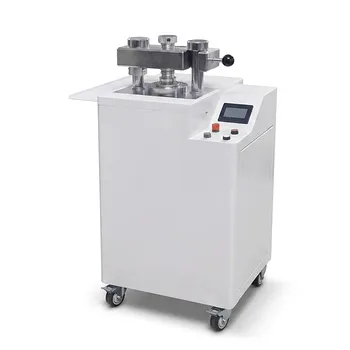
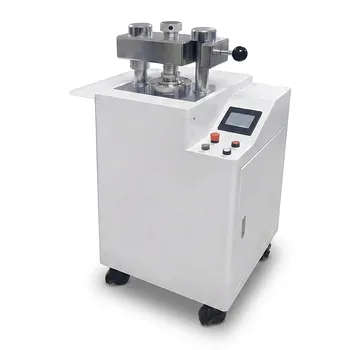
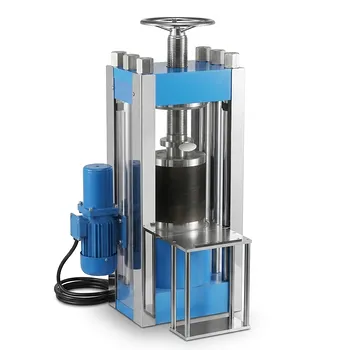
A pellet press is a precision machine designed to convert powdered or granular raw materials into solid, uniform pellets or tablets through high-force compression and extrusion. Often referred to as a tablet press, this equipment is fundamental in manufacturing pharmaceutical products and preparing standardized samples for scientific research.
At its core, a pellet press is about material standardization; it eliminates the variability of loose powders by compacting them into consistent, solid forms required for accurate analytical testing or reliable mass production.
The Physics of Pellet Formation
To understand how a pellet press works, you must look beyond simple squeezing. The process relies on mechanical compression and plastic deformation.
Gap Reduction and Deformation
Initially, the press applies pressure to the raw powder loaded in the die. This forces the particles closer together, significantly reducing the air gaps between them.
Bonding Through Friction
As the pressure intensifies, the material undergoes plastic deformation. The friction and deformation cause the particles to bond tightly, transforming loose dust into a cohesive solid structure.
Final Consolidation
Continuous pressure is applied until the material reaches the desired density and shape. Once the pressure is released, the solid pellet is ejected, retaining its new form.
Operational Types and Applications
Pellet presses are versatile tools used in settings ranging from industrial pharmaceutical plants to small research laboratories.
Manual Hydraulic Presses
These are typically used in laboratories for small-scale or occasional sample preparation. While they are cost-effective, they are labor-intensive and rely on the operator to manually pump the hydraulic system to reach pressures (often up to 250 kN).
Automatic and Hydraulic Presses
Found in both research and industrial environments, these presses are designed for consistency and efficiency. They allow operators to preset critical parameters like pressure and holding time, ensuring high reproducibility for tasks like XRF analysis or FTIR spectroscopy.
Specialized Die Shapes
The "die" is the mold that determines the pellet's final form. While circular dies are the industry standard, presses can utilize square/rectangular dies for geometric needs or annular (ring) dies to create hollow pellets.
Understanding the Trade-offs
While pellet presses are essential for consistency, choosing the wrong configuration can lead to operational bottlenecks.
Consistency vs. Cost
Manual presses are durable and affordable, but they introduce human error. Slight variations in how an operator applies pressure can affect the density of the sample, potentially skewing sensitive analytical results.
Setup Complexity
Automatic systems eliminate operator variability and save time during batch production. However, they are significantly more complex to maintain and require a higher initial investment compared to their manual counterparts.
Making the Right Choice for Your Goal
Selecting a pellet press depends entirely on the volume of work and the precision required by your end application.
- If your primary focus is occasional laboratory testing: A manual hydraulic press offers a cost-effective solution for preparing small batches where high throughput is not critical.
- If your primary focus is high-precision analysis (e.g., XRF/FTIR): An automatic press is essential to ensure the exact pressure and holding time are applied to every sample for reproducible results.
- If your primary focus is pharmaceutical manufacturing: Prioritize a high-throughput tablet press capable of utilizing specific custom dies to produce caplets or block-shaped products efficiently.
The right pellet press turns variable raw materials into the reliable foundation of your research or product line.
Summary Table:
| Feature | Manual Hydraulic Press | Automatic Hydraulic Press |
|---|---|---|
| Primary Use | Small-scale lab testing | High-precision analysis (XRF/FTIR) |
| Pressure Control | Manual pumping (Up to 250 kN) | Programmable presets (Holding time/Pressure) |
| Consistency | Variable (Operator dependent) | High (Repeatable results) |
| Ideal Environment | Occasional sample prep | High-throughput / Industrial labs |
| Cost Profile | Economical initial investment | Higher investment, lower labor cost |
Elevate Your Material Research with KINTEK Precision
Consistency is the foundation of reliable data. At KINTEK, we specialize in comprehensive laboratory pressing solutions designed to meet the rigorous demands of battery research and pharmaceutical analysis. Whether you need the simplicity of a manual press, the precision of an automatic/heated model, or specialized cold/warm isostatic presses, our equipment ensures perfect sample uniformity every time.
Ready to optimize your lab's performance? Contact KINTEK today to discover the ideal pressing solution for your specific application.
Related Products
- Automatic XRF Pellet Press for Laboratory Spectrometry Sample Preparation
- Laboratory Hydraulic Split Electric Lab Pellet Press
- Manual Laboratory Hydraulic Pellet Press Lab Hydraulic Press
- Laboratory Hydraulic Pellet Press for XRF KBR FTIR Lab Press
- Automatic Laboratory Hydraulic Press Lab Pellet Press Machine
People Also Ask
- How can contamination occur during the preparation of pressed pellets for XRF analysis? Expert Prevention Guide
- How does the sample material influence the required pressing load for making an XRF pellet? Find the Optimal Pressure
- What are the different methods for preparing a sample pellet for XRF analysis? Expert Guide to Superior XRF Results
- What are the advantages of preparing a sample as a dense pellet for XRF? Unlock High-Precision Trace Element Analysis
- What is the primary purpose of using an automatic pellet press? Achieve Precise Geopolymer Analysis Results