
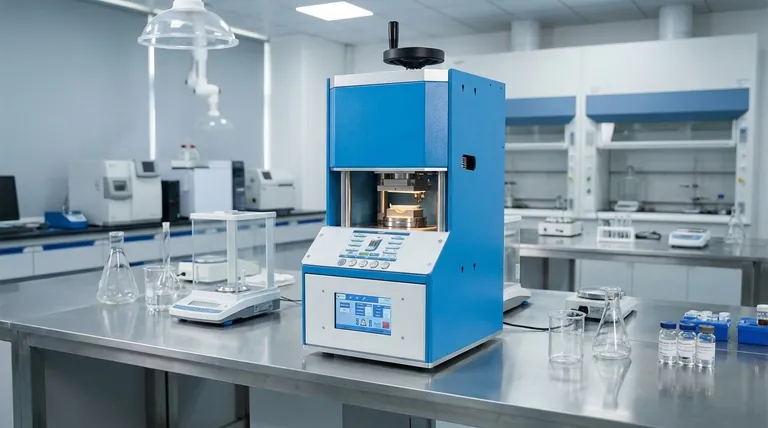
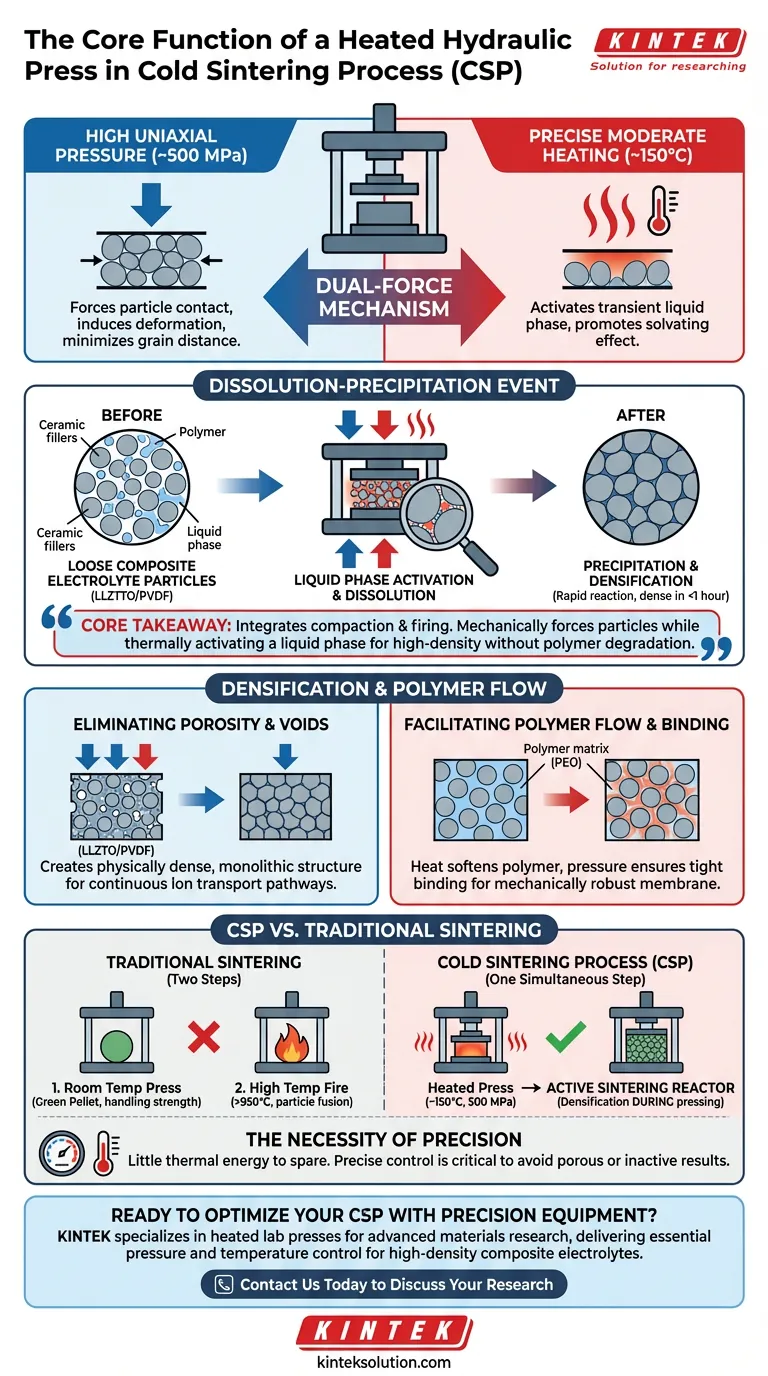
The heated hydraulic press is the central engine of the Cold Sintering Process (CSP), acting as a dual-force mechanism that simultaneously applies high uniaxial pressure (up to approximately 500 MPa) and precise, moderate heating (typically around 150°C). This synchronous application drives the densification of composite solid electrolytes by activating liquid-phase transport mechanisms at temperatures significantly lower than traditional ceramic sintering.
Core Takeaway Unlike traditional ceramic processing which separates compaction and firing, the heated hydraulic press integrates these steps to trigger a dissolution-precipitation event. By mechanically forcing particles together while thermally activating a transient liquid phase, the press achieves high-density composite structures without thermally degrading sensitive polymer components.
The Mechanics of Cold Sintering
Synergistic Application of Heat and Pressure
The defining feature of a heated hydraulic press in CSP is the simultaneous control of two physical variables.
While traditional sintering relies on extreme heat (>950°C) to fuse particles, CSP relies on high uniaxial pressure (often 500 MPa) combined with low temperatures (~150°C). The pressure forces powder particles into intimate contact, inducing plastic deformation and minimizing the distance between grain boundaries.
Triggering the Dissolution-Precipitation Process
The moderate heat applied by the press serves a specific chemical function beyond simple melting.
It activates the solvating effect of a transient liquid phase (often water or a solvent like DMF) located at the particle interfaces. This promotes a dissolution-precipitation mechanism where material dissolves at particle contact points and reprecipitates to form solid "necks" between grains.
This reaction occurs rapidly, typically densifying the material within one hour.
Densification in Composite Electrolytes
Eliminating Porosity and Voids
In composite electrolytes (such as LLZTO/PVDF or LATP-Li₃InCl₆), the primary role of the press is to eliminate internal voids that inhibit performance.
Solvent evaporation during initial preparation often leaves large pores in the material. The high pressure of the press collapses these voids, creating a physically dense, monolithic structure. This density is critical for creating continuous pathways for ion transport.
Facilitating Polymer Flow and Binding
For composites involving a polymer matrix (like PEO or PVDF), the heated press plays a crucial role in rheology.
The heat softens the polymer matrix, allowing it to flow and fill the interstitial spaces between ceramic filler particles. Concurrently, the pressure ensures the polymer binds tightly to the ceramic, creating a mechanically robust membrane with uniform dispersion.
Understanding the Trade-offs
CSP vs. Traditional Sintering
It is vital to distinguish the function of the press in CSP versus traditional methods.
In traditional sintering, a press is used at room temperature merely to form a "green pellet" with enough strength to be handled before high-temperature firing. In CSP, the press is the active sintering reactor; the densification happens during the pressing stage, not after.
The Necessity of Precision
The effectiveness of the heated hydraulic press relies entirely on the precision of its control systems.
Because CSP operates at low temperatures, there is little thermal energy to spare. Deviations in temperature can fail to activate the liquid phase, while insufficient pressure will result in a porous, low-conductivity electrolyte.
Making the Right Choice for Your Goal
The heated hydraulic press is a versatile tool, but its application depends on the specific performance metrics you prioritize for your solid electrolyte.
- If your primary focus is Ionic Conductivity: The press must be optimized to maximize pressure (reducing voids), ensuring intimate particle-to-particle contact for uninterrupted ion transport channels.
- If your primary focus is Mechanical Flexibility: The thermal parameters must be tuned to the polymer's flow characteristics, ensuring the matrix fully encapsulates the ceramic fillers without degrading the polymer chain.
Ultimately, the heated hydraulic press transforms the sintering process from a thermal challenge into a mechano-chemical solution, enabling the fabrication of dense, high-performance composites at energy-efficient temperatures.
Summary Table:
| Key Function | Benefit in CSP |
|---|---|
| Applies High Uniaxial Pressure (up to ~500 MPa) | Eliminates porosity, forces particle contact for ion transport |
| Provides Precise, Moderate Heating (~150°C) | Activates dissolution-precipitation without degrading polymers |
| Synchronous Heat & Pressure Application | Enables densification in one step at low temperatures |
| Facilitates Polymer Flow | Creates a dense, monolithic, and mechanically robust composite structure |
Ready to optimize your Cold Sintering Process with precision equipment?
KINTEK specializes in laboratory press machines, including automatic lab presses, isostatic presses, and heated lab presses designed for advanced materials research like composite solid electrolytes. Our equipment delivers the precise pressure and temperature control essential for successful CSP, helping you achieve high-density, high-performance materials efficiently.
Contact us today to discuss how our lab presses can enhance your research and development. Let's build the future of solid-state batteries together.
Visual Guide
Related Products
- Automatic High Temperature Heated Hydraulic Press Machine with Heated Plates for Lab
- Automatic Heated Hydraulic Press Machine with Hot Plates for Laboratory
- Automatic Heated Hydraulic Press Machine with Heated Plates for Laboratory
- 24T 30T 60T Heated Hydraulic Lab Press Machine with Hot Plates for Laboratory
- Heated Hydraulic Press Machine With Heated Plates For Vacuum Box Laboratory Hot Press
People Also Ask
- Function of a Laboratory Hydraulic Press with Heated Platens in SSE? Enhance Battery Density & Conductivity
- What are the requirements for electrode pressing with high-viscosity ionic liquids like EMIM TFSI? Optimize Performance
- How does a laboratory heated hydraulic press facilitate PBN sample prep for WAXS? Achieve Precise X-Ray Scattering
- What are the industrial applications of heated hydraulic presses? Master Heat & Force for Precision Manufacturing
- Why is a laboratory hydraulic press with heating plates required for PLA/TEC films? Achieve Precise Sample Integrity



















