
The primary function of hot pressing is to achieve rapid, high-level densification of Li6SrLa2Bi2O12 (LSLBO) powder at temperatures significantly lower than those required for conventional sintering.
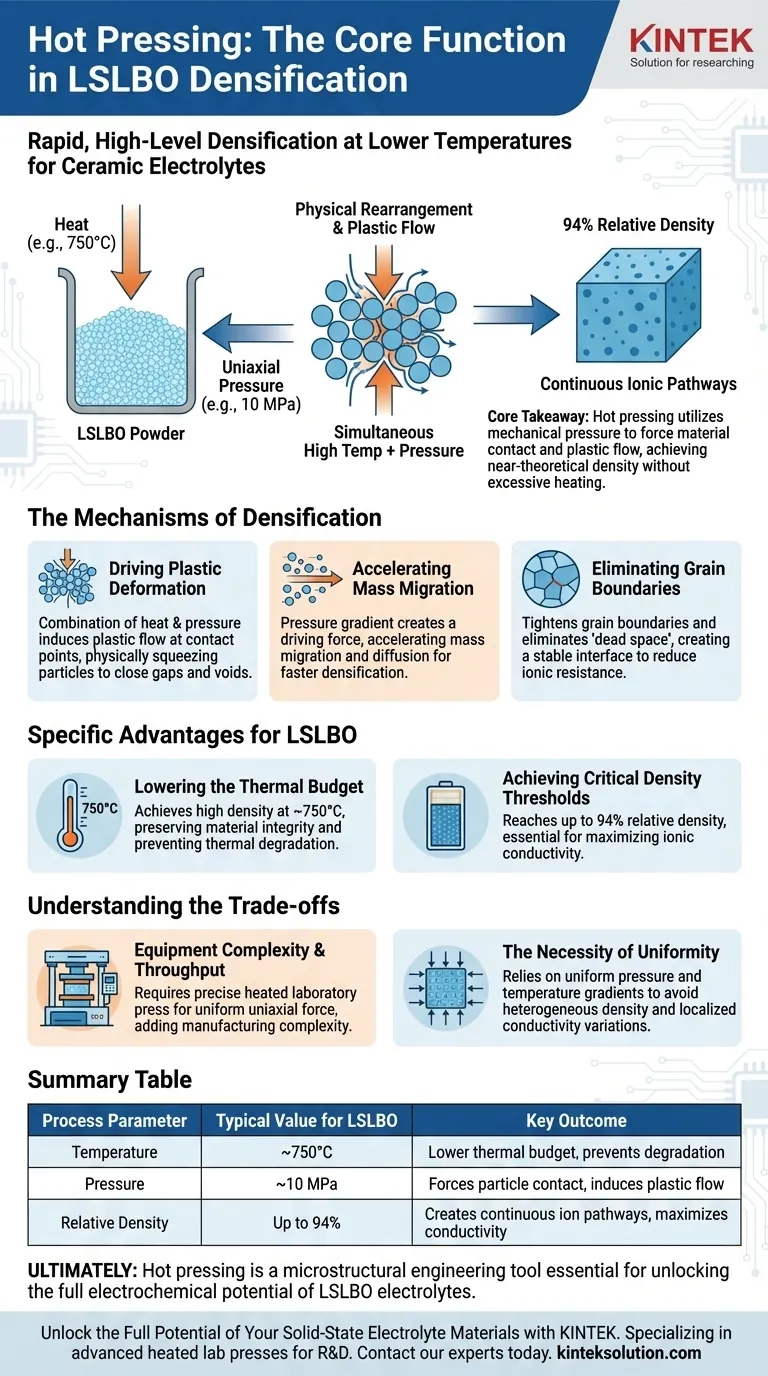
By applying simultaneous high temperature (e.g., 750°C) and uniaxial pressure (e.g., 10 MPa), the process forces the powder particles to undergo physical rearrangement and diffusion. This results in a ceramic structure with a relative density of up to 94%, which is an absolute requirement for establishing the continuous pathways necessary for excellent ionic conductivity.
Core Takeaway While traditional sintering relies solely on heat to fuse particles, hot pressing utilizes mechanical pressure to force material contact and plastic flow. This allows LSLBO electrolytes to eliminate internal voids and achieve near-theoretical density without the risk of thermal degradation associated with excessive heating.
The Mechanisms of Densification
To understand why hot pressing is superior for LSLBO ceramics, one must look at the physical changes occurring at the particle level. The application of pressure fundamentally alters the sintering kinetics.
Driving Plastic Deformation
The combination of heat and pressure lowers the material's resistance to deformation.
Unlike free sintering, hot pressing induces plastic flow at the contact points between powder particles. This mechanical force physically squeezes particles together, effectively closing the gaps and voids that heat alone often fails to eliminate.
Accelerating Mass Migration
The process creates a pressure gradient across the material.
This gradient acts as a driving force to accelerate mass migration and diffusion between particles. It allows the material to densify much faster than it would under static heating, reducing the overall processing time.
Eliminating Grain Boundaries
A major barrier to performance in ceramic electrolytes is the "dead space" between grains.
Hot pressing effectively eliminates these voids and tightens grain boundaries. This results in a mechanically stable solid-solid interface, which is critical for reducing the resistance that ions face when moving from one particle to the next.
Specific Advantages for LSLBO
The references highlight specific operational parameters that make this process vital for Li6SrLa2Bi2O12 specifically.
Lowering the Thermal Budget
Conventional sintering often requires extreme heat to achieve density, which can lead to unwanted side reactions or grain growth.
For LSLBO, hot pressing achieves high density at 750°C, a significantly lower temperature than traditional methods. This preserves the integrity of the material phase while still achieving solid-state fusion.
Achieving Critical Density Thresholds
For a ceramic electrolyte to function effectively in a battery, it must be nearly non-porous.
Hot pressing enables LSLBO to reach a relative density of up to 94%. Surpassing this density threshold is essential for maximizing ionic conductivity, as it ensures there are continuous channels for lithium-ion transport.
Understanding the Trade-offs
While hot pressing is highly effective, it introduces specific constraints compared to pressure-less methods.
Equipment Complexity and Throughput
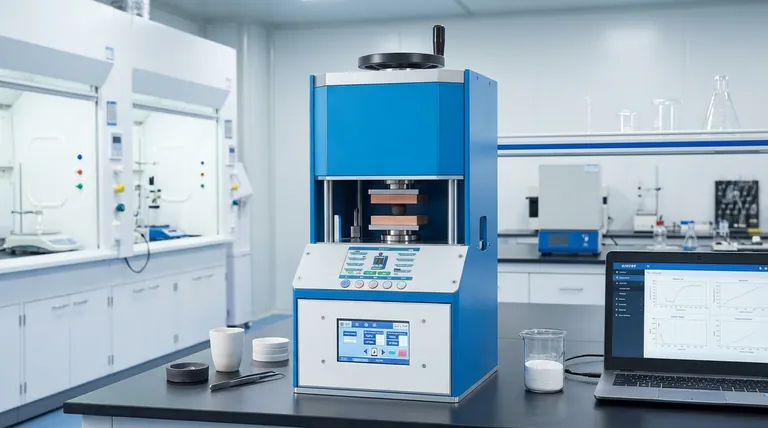
Unlike a standard furnace which can sinter many batches loosely, hot pressing requires a heated laboratory press capable of delivering precise uniaxial force.
This adds complexity to the manufacturing process. The system must maintain strict control over both temperature and pressure simultaneously to ensure the "compacted solid-state electrolyte powder" densifies uniformly without cracking.
The Necessity of Uniformity
The process relies on a uniform pressure gradient.
If the pressure is not applied evenly (uniaxially), or if the temperature fluctuates across the sample, the resulting pellet may have heterogeneous density. This can lead to localized variations in ionic conductivity, undermining the overall performance of the electrolyte sheet.
Making the Right Choice for Your Goal
When integrating hot pressing into your LSLBO fabrication workflow, align your process parameters with your specific performance targets.
- If your primary focus is Maximizing Ionic Conductivity: Prioritize parameters that push relative density above 94% to minimize internal porosity and grain boundary resistance.
- If your primary focus is Material Stability: Utilize the lower temperature capabilities (approx. 750°C) to densify the ceramic without triggering high-temperature phase decomposition or excessive grain growth.
Ultimately, hot pressing is not just a shaping technique; it is a microstructural engineering tool essential for unlocking the full electrochemical potential of LSLBO electrolytes.
Summary Table:
| Process Parameter | Typical Value for LSLBO | Key Outcome |
|---|---|---|
| Temperature | ~750°C | Lower thermal budget, prevents degradation |
| Pressure | ~10 MPa | Forces particle contact, induces plastic flow |
| Relative Density | Up to 94% | Creates continuous ion pathways, maximizes conductivity |
Unlock the Full Potential of Your Solid-State Electrolyte Materials
Achieving the high density and microstructural perfection required for next-generation batteries like LSLBO electrolytes demands precise control over heat and pressure. KINTEK specializes in advanced heated lab presses and isostatic presses designed specifically for these challenging R&D and production environments.
Our expertise in automatic lab press technology ensures the uniform pressure and temperature gradients critical for producing consistent, high-performance ceramic pellets. Let us help you optimize your densification process to maximize ionic conductivity and material stability.
Contact our experts today to discuss how a KINTEK laboratory press can accelerate your solid-state battery development.
Visual Guide
Related Products
- Lab Heat Press Special Mold
- Automatic High Temperature Heated Hydraulic Press Machine with Heated Plates for Lab
- Automatic Heated Hydraulic Press Machine with Hot Plates for Laboratory
- 24T 30T 60T Heated Hydraulic Lab Press Machine with Hot Plates for Laboratory
- Laboratory Manual Heated Hydraulic Press Machine with Hot Plates
People Also Ask
- How is a laboratory heat press used to evaluate bio-based aliphatic polyesters? Prepare Reliable Samples for Analysis
- How is a laboratory heat press utilized in MEA preparation? Achieve High-Efficiency Iron-Chromium Redox Flow Batteries
- Why is a laboratory heat press necessary for biodegradable films? Unlock Precision Bonding and Barrier Performance
- What is the purpose of incorporating cartridge heaters into a lab press mold for MLCC block compression? Optimize Results
- Why is a high-precision laboratory heated press essential for MEA fabrication? Unlock Peak Fuel Cell Performance



















