
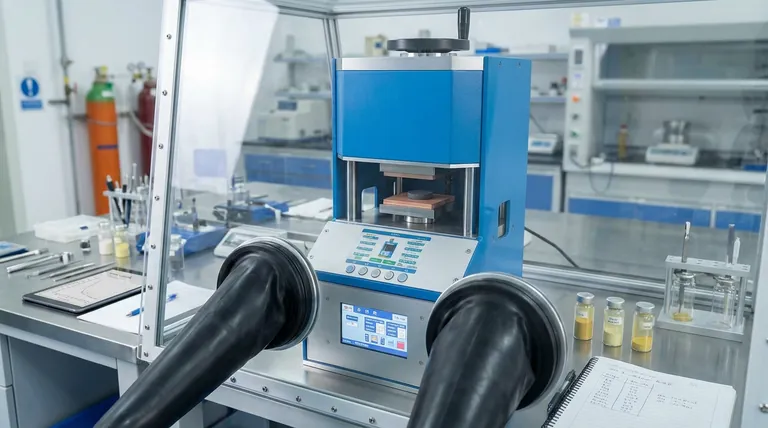
The primary function of a hot plate or heated press in processing Li2S–GeSe2–P2S5 electrolytes is to provide a precise, uniform thermal environment for annealing pre-pressed pellets. By strictly controlling temperature and duration, this equipment facilitates the critical crystallization process that transforms the material from an amorphous state into a highly conductive glass-ceramic phase.
The heat treatment step is not merely about solidification; it is the "activation" stage where the material’s microstructure is tuned. This thermal processing unlocks the high ionic conductivity required for the electrolyte to function effectively in a solid-state battery.
Driving the Phase Transition
From Amorphous to Glass-Ceramic
The raw Li2S–GeSe2–P2S5 material typically starts as an amorphous (glassy) solid. The heated press or hot plate provides the energy required to rearrange the atomic structure.
This controlled heating induces crystallization, converting the amorphous glass into a glass-ceramic phase. This specific phase transition is the defining factor in the material's final electrochemical identity.
Enhancing Ionic Conductivity
The microstructure resulting from this heat treatment is directly responsible for the electrolyte's performance. The glass-ceramic phase typically possesses significantly higher ionic conductivity compared to its purely amorphous counterpart.
By optimizing the thermal parameters, you ensure the material achieves the specific crystalline structure that allows lithium ions to move most freely.
Densification and Interface Quality
Eliminating Voids and Defects
While mechanical pressing compacts the powder, heat treatment reinforces this densification. High temperatures help eliminate residual microscopic voids between particles that mere cold pressing cannot remove.
A heated press is particularly effective here, as it can apply simultaneous pressure and heat to create a dense, non-porous membrane. This reduction in porosity is vital for preventing dendrite growth and ensuring mechanical stability.
Surface Purification
High-temperature treatment, particularly when performed in a controlled atmosphere (like Argon), serves a purification role.
Heating helps remove residual impurities, such as carbonates and hydroxides, that may linger on the surface after mechanical processing. A clean, active surface significantly lowers interfacial impedance when the electrolyte eventually contacts the lithium metal anode.
Understanding the Trade-offs
The Precision of Temperature Control
While heat is necessary, the margin for error is often slim. The equipment must deliver uniform heat distribution; uneven heating can lead to a heterogeneous microstructure, where some regions are crystalline and others remain amorphous.
Risk of Impurity Formation
If the environment is not strictly controlled (e.g., exposure to air during heating), the high reactivity of sulfide-based electrolytes can lead to degradation. The heat treatment equipment must often be integrated with a glovebox or an inert gas system to prevent the formation of unwanted byproducts that ruin conductivity.
Making the Right Choice for Your Goal
To maximize the potential of your Li2S–GeSe2–P2S5 electrolyte, align your equipment usage with your specific processing targets.
- If your primary focus is maximizing ionic conductivity: Prioritize precise temperature stability to ensure the material reaches a uniform, high-conductivity glass-ceramic phase without overheating.
- If your primary focus is reducing interfacial resistance: Utilize a heated press to simultaneously densify the pellet and remove surface impurities, creating a pristine contact surface for the electrodes.
Mastering the heat treatment process is the final, decisive step in bridging the gap between raw powder and a high-performance solid-state battery component.
Summary Table:
| Function | Key Benefit |
|---|---|
| Annealing & Crystallization | Transforms amorphous material into a high-conductivity glass-ceramic phase. |
| Densification | Eliminates microscopic voids, creating a dense, non-porous membrane. |
| Surface Purification | Removes impurities to lower interfacial resistance with electrodes. |
| Microstructure Tuning | Optimizes the atomic structure for maximum lithium-ion mobility. |
Ready to perfect your solid-state electrolyte synthesis?
KINTEK's precision lab presses, including our automatic and heated models, are engineered to deliver the exact thermal control and uniform pressure required for developing high-performance Li2S–GeSe2–P2S5 electrolytes. Our equipment helps you achieve the critical crystallization and densification steps that define battery success.
Contact our experts today to discuss how our solutions can enhance your laboratory's research and development capabilities.
Visual Guide

Related Products
- Warm Isostatic Press for Solid State Battery Research Warm Isostatic Press
- Lab Heat Press Special Mold
- Automatic High Temperature Heated Hydraulic Press Machine with Heated Plates for Lab
- 24T 30T 60T Heated Hydraulic Lab Press Machine with Hot Plates for Laboratory
- Automatic Heated Hydraulic Press Machine with Heated Plates for Laboratory
People Also Ask
- Why must composite cathodes be sealed in vacuum lamination bags for WIP? Ensure Battery Stability and Density
- What is the function of elastic molds in warm isostatic pressing? Achieve Uniform Density in Composite Particles
- How do sacrificial volume materials (SVM) maintain microchannels in isostatic pressing? Ensure Structural Integrity
- What is the mechanism of a Warm Isostatic Press (WIP) on cheese? Master Cold Pasteurization for Superior Safety
- What is the function of hydraulic pressure in warm isostatic pressing? Achieve Uniform Material Density


















