
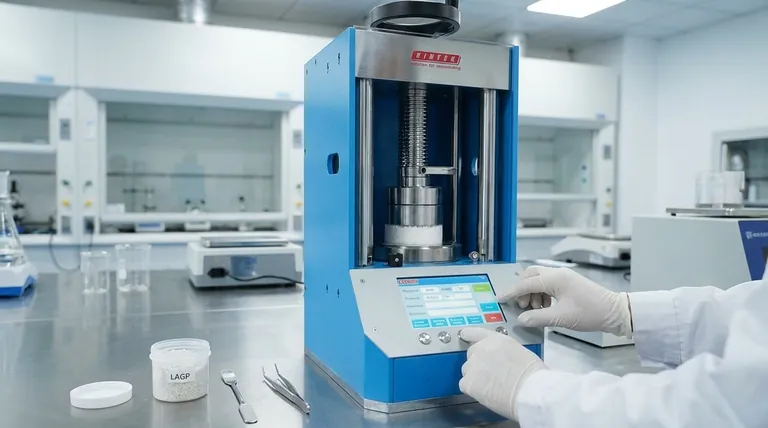
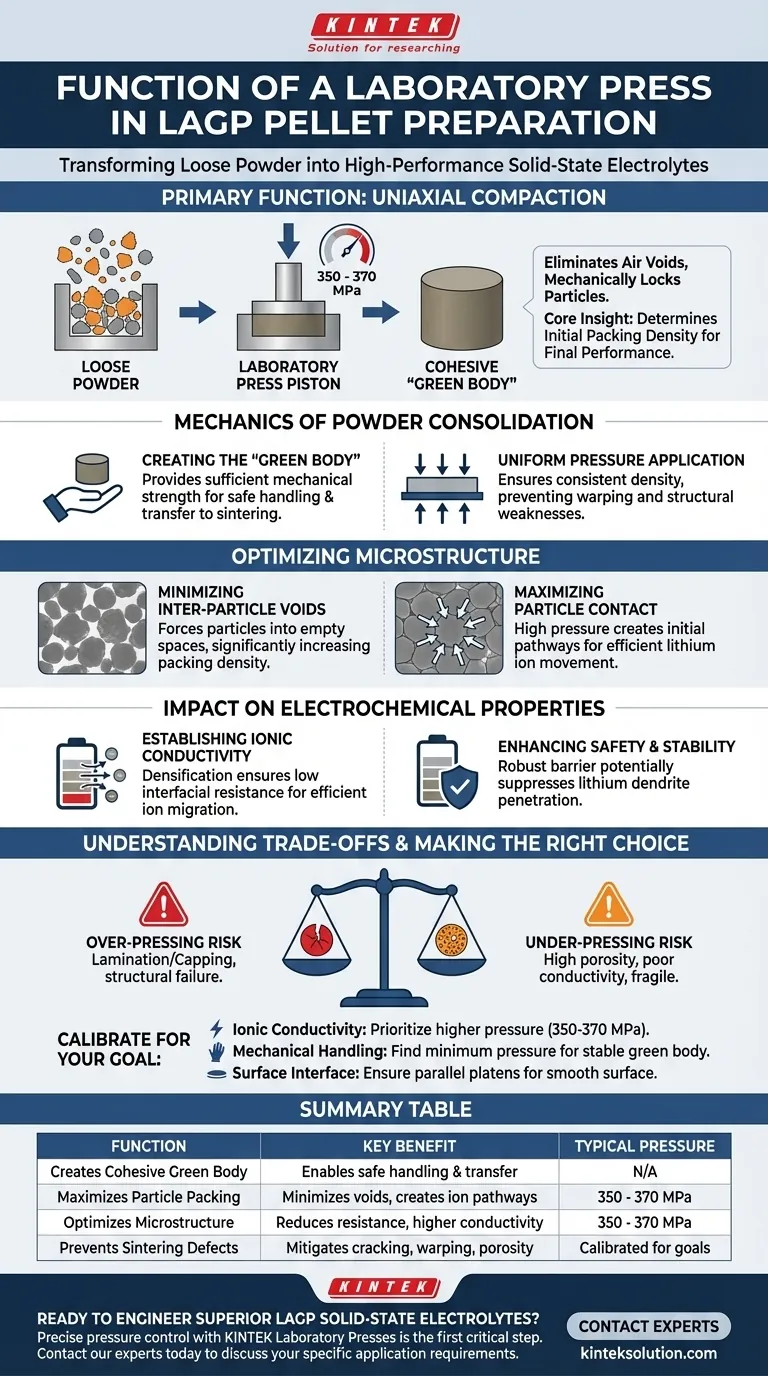
The primary function of a laboratory press machine in the preparation of Li1.5Al0.5Ge1.5(PO4)3 (LAGP) pellets is to uniaxially compact loose glass powder into a cohesive "green body." By applying precise, high pressure (often ranging between 350 and 370 MPa), the machine eliminates air voids and mechanically locks particles together. This step is the fundamental prerequisite for transforming a loose powder into a dense, conductive ceramic electrolyte capable of surviving high-temperature sintering.
Core Insight: The laboratory press does not merely shape the LAGP powder; it determines the initial packing density. A poorly pressed green body will inevitably lead to a porous, low-conductivity electrolyte, regardless of how well the subsequent sintering process is performed.
Mechanics of Powder Consolidation
The first level of functionality addresses the physical transformation of the material. The press acts as the bridge between raw synthesis and final ceramic processing.
Creating the "Green Body"
The immediate output of the press is a green pellet—a pre-sintered compact with sufficient mechanical strength to be handled. Without this consolidation, the loose LAGP powder would lack the structural integrity to maintain its shape during transfer to a sintering furnace.
Uniform Pressure Application
The press must deliver uniaxial pressure that is both stable and uniform across the surface of the mold. This ensures that the density of the pellet is consistent from the center to the edges, preventing warping or structural weaknesses that could lead to cracking later.
Optimizing Microstructure for Performance
Beyond simple shaping, the press modifies the microscopic arrangement of the LAGP particles. This creates the internal architecture necessary for the battery to function.
Minimizing Inter-Particle Voids
Loose powder contains significant empty space (porosity). The press forces particles into these voids, significantly increasing the packing density. Reducing these internal voids is critical to preventing the formation of pores that would block ion movement in the final ceramic.
Maximizing Particle Contact
High-pressure compaction, often utilizing forces up to 370 MPa, maximizes the physical contact area between individual LAGP grains. This tight packing creates the initial pathways required for lithium ions to move through the material.
The Impact on Electrochemical Properties
The ultimate goal of using the press is to influence the final performance metrics of the solid-state battery.
Establishing Ionic Conductivity
High ionic conductivity relies on continuous transport channels. By densifying the green body, the press ensures that after sintering, the ceramic has low interfacial resistance between grains. This allows lithium ions to migrate efficiently through the electrolyte.
Enhancing Safety and Stability
A dense, low-porosity pellet is more resistant to physical degradation. Proper pressing helps create a barrier that is robust enough to potentially suppress lithium dendrite penetration, a key safety concern in solid-state batteries.
Understanding the Trade-offs
While pressure is essential, it is a variable that requires careful calibration. Applying maximum force is not always the correct strategy.
The Risk of Over-Pressing
Applying excessive pressure can lead to lamination or capping, where the pellet fractures horizontally due to trapped air or elastic rebound of the particles. This ruins the structural integrity of the green body before sintering even begins.
The Risk of Under-Pressing
Insufficient pressure results in a "soft" green body with low packing density. This leads to high porosity after sintering, resulting in poor ionic conductivity and a fragile ceramic that may crumble during cell assembly.
Making the Right Choice for Your Goal
The specific pressure and pressing duration you choose should align with your specific research objectives for the LAGP electrolyte.
- If your primary focus is Ionic Conductivity: Prioritize higher pressures (e.g., 350–370 MPa) to maximize particle contact and minimize the grain boundary resistance that impedes ion flow.
- If your primary focus is Mechanical Handling: Focus on finding the minimum pressure required to achieve a stable green body that does not chip or dust, ensuring the sample remains intact during transfer to the furnace.
- If your primary focus is Surface Interface: Ensure the press platens are perfectly parallel to create a smooth, uniform surface, which is critical for lowering resistance when the pellet is later contacted with electrodes.
Success in LAGP preparation relies on viewing the press not as a simple shaping tool, but as a critical instrument for microstructural engineering.
Summary Table:
| Function | Key Benefit | Typical Pressure Range |
|---|---|---|
| Creates a Cohesive Green Body | Enables safe handling and transfer to the sintering furnace. | N/A |
| Maximizes Particle Packing Density | Minimizes voids, creating pathways for lithium-ion conduction. | 350 - 370 MPa |
| Optimizes Microstructure | Reduces grain boundary resistance, leading to higher ionic conductivity. | 350 - 370 MPa |
| Prevents Sintering Defects | Mitigates risks of cracking, warping, and high porosity in the final ceramic. | Calibrated for specific goals |
Ready to Engineer Superior LAGP Solid-State Electrolytes?
The precise pressure control of a KINTEK laboratory press is the first critical step in developing high-performance, safe solid-state batteries. Our automatic lab presses, isostatic presses, and heated lab presses are engineered to deliver the uniform, high-pressure compaction (up to 370 MPa) required to achieve the dense, low-porosity microstructures essential for optimal ionic conductivity.
Don't let inconsistent pressing compromise your research. Let KINTEK's expertise in lab press machines help you optimize your LAGP pellet preparation process.
Contact our experts today to discuss your specific application requirements and discover the perfect press for your laboratory's needs.
Visual Guide
Related Products
- Laboratory Hydraulic Split Electric Lab Pellet Press
- Laboratory Hydraulic Press Lab Pellet Press Machine for Glove Box
- Automatic Laboratory Hydraulic Press Lab Pellet Press Machine
- Manual Laboratory Hydraulic Pellet Press Lab Hydraulic Press
- Laboratory Hydraulic Press Lab Pellet Press Button Battery Press
People Also Ask
- What are the emerging trends in the design and materials of lab pellet presses? Modernize Your Lab Efficiency
- How do lab pellet presses support customization and flexibility? Optimize Your Sample Prep for Any Material
- What are common lab pellet press issues? Expert Troubleshooting Guide for Reliable Material Research
- What are the common operational types of lab pellet presses? Choosing the Right Manual, Automatic, or Hydraulic System
- Why use a laboratory pellet press for solid-state battery evaluation? Ensure Accuracy in Interface Stability Testing



















