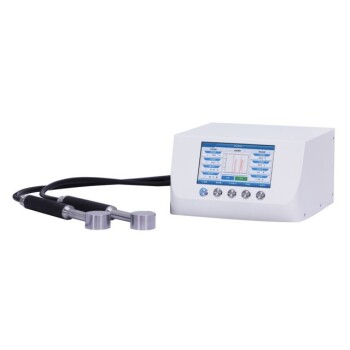
The primary function of a temperature-controlled heating device in this context is to provide a precise, stable thermal environment—specifically at 90°C—to drive the initial cross-linking of precursors. By subjecting cyclohexanehexone and urea to this controlled energy, the device facilitates the pre-organization of the material, establishing a robust aromatic framework before high-temperature processing occurs.
The success of the final catalyst depends on the stability of its initial formation. This heating step acts as a structural "locking mechanism," ensuring the material builds a stable framework that can withstand subsequent pyrolysis without collapsing or reorganizing unpredictably.
The Mechanism of Precursor Pre-organization
Facilitating the Cross-Linking Reaction
The heating device is essential for initiating the chemical interaction between the monomers, cyclohexanehexone and urea. By maintaining a constant temperature of 90°C, the device supplies the specific thermal energy required to trigger the cross-linking reaction. This controlled environment ensures the monomers bond effectively rather than remaining as separate components.
Establishing the Aromatic Framework
As the cross-linking occurs, the precursors organize themselves into a stable structure. This process creates a defined aromatic framework which serves as the foundational skeleton of the material. This organized state is the direct result of the sustained, regulated heat provided during the synthesis.
Ensuring Structural Integrity for Pyrolysis
Preventing Drastic Reorganization
The ultimate goal of this pre-organization is to prepare the material for the harsh conditions of high-temperature pyrolysis. Without the stable framework established at 90°C, the material would be susceptible to chaotic structural changes later in the process.
Maintaining Material Fidelity
The heating device ensures that the SeM-C2N maintains its structural integrity throughout the entire synthesis workflow. By "setting" the structure early, the process prevents drastic reorganization that would otherwise degrade the quality of the final catalyst.
Understanding the Trade-offs
Sensitivity to Thermal Fluctuations
The reliance on a temperature-controlled device introduces a variable of precision. If the device fails to maintain the strict 90°C environment, the cross-linking may be incomplete, leading to a weak framework.
Process Complexity vs. Stability
Implementing a specific pre-organization step adds time and complexity to the synthesis compared to a direct pyrolysis approach. However, this is a necessary trade-off; bypassing this controlled heating phase sacrifices the structural stability required for a high-performance catalyst.
Optimizing the Synthesis Workflow
To ensure the successful preparation of SeM-C2N, consider the following based on your specific objectives:
- If your primary focus is Structural Quality: rigorous calibration of the heating device at 90°C is non-negotiable to ensure the aromatic framework is fully established.
- If your primary focus is Process Troubleshooting: investigate the consistency of the pre-organization phase first, as instability here is the likely cause of failure during pyrolysis.
Precise thermal control in the early stages is the key to preventing structural failure in the final material.
Summary Table:
| Stage | Temperature | Primary Function | Impact on Catalyst Structure |
|---|---|---|---|
| Pre-organization | 90°C | Initiates cross-linking of precursors | Establishes a stable aromatic framework (locking mechanism) |
| Framework Setting | 90°C (Stable) | Maintains material fidelity | Prevents structural collapse during high-temp pyrolysis |
| Pyrolysis Prep | Controlled Heat | Prevents drastic reorganization | Ensures integrity and high performance of final SeM-C2N |
Elevate Your Material Research with KINTEK Precision
Achieving the perfect aromatic framework for SeM-C2N catalysts requires uncompromising thermal stability. KINTEK specializes in comprehensive laboratory solutions, offering high-precision heating and pressing equipment—including manual, automatic, and multifunctional models—designed to meet the rigorous demands of battery research and advanced chemical synthesis.
Don't let thermal fluctuations compromise your structural integrity. Contact KINTEK today to discover how our specialized lab equipment can ensure the success of your next synthesis project.
References
- Xiaochen Wang, Wenxing Chen. Precisely designing asymmetrical selenium-based dual-atom sites for efficient oxygen reduction. DOI: 10.1038/s41467-025-55862-6
This article is also based on technical information from Kintek Solution Knowledge Base .
Related Products
- Infrared Heating Quantitative Flat Plate Mold for Precise Temperature Control
- Automatic High Temperature Heated Hydraulic Press Machine with Heated Plates for Lab
- Automatic Heated Hydraulic Press Machine with Hot Plates for Laboratory
- Automatic Heated Hydraulic Press Machine with Heated Plates for Laboratory
- Lab Double Plate Heating Mold for Laboratory Use
People Also Ask
- How do precision temperature-controlled heating plates function in electrolyte thermal stability storage experiments?
- What is the importance of a precision temperature-controlled heating module? Ensure Aluminum-Cadmium Thermal Stability
- How does heating platen precision affect rubber specimens? Achieve uniform density and reliable testing results.
- How are thin polymer films produced for spectroscopic analysis? Expert Guide to Heat and Low-Pressure Methods
- What accessories and field services can be used to optimize the capabilities of presses? Maximize Your Lab Performance