
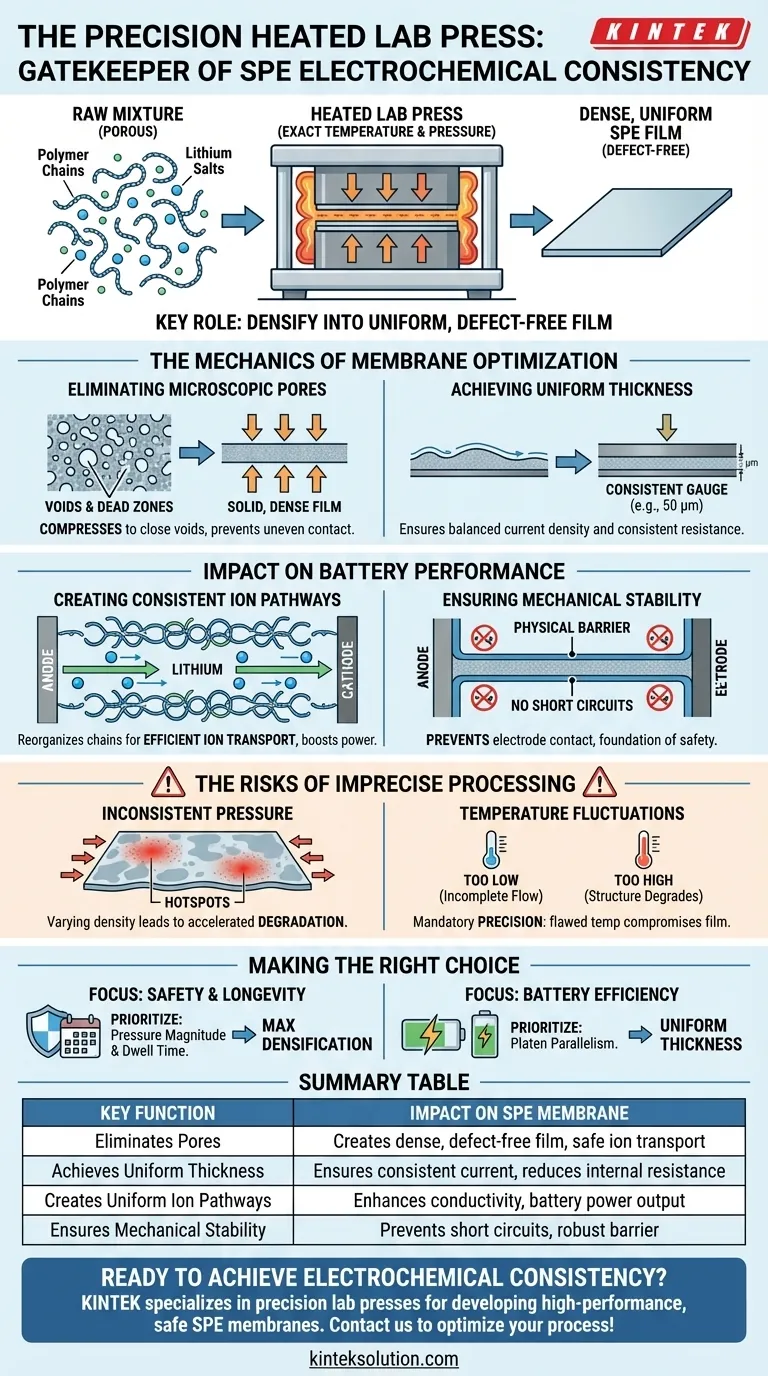
The primary function of a precision heated lab press in the preparation of solid-state polymer electrolyte membranes (SPEs) is to densify the material into a uniform, defect-free film. By applying exact temperature and pressure to a polymer and lithium salt mixture, the press eliminates voids left after solvent evaporation to create a mechanically stable electrolyte.
While mixing chemistry is important, the heated press acts as the definitive quality control step. It converts a raw mixture into a functional electrochemical component by eliminating porosity and enforcing uniform thickness, which are prerequisites for safe and efficient ion transport.
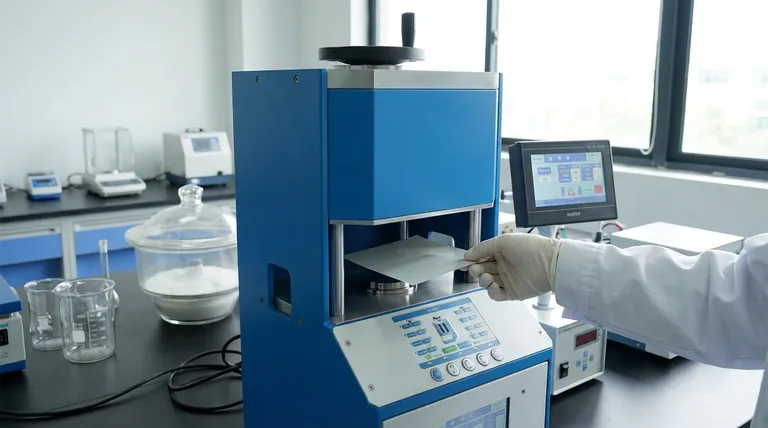
The Mechanics of Membrane Optimization
Eliminating Microscopic Pores
After the solvent evaporates from the polymer/lithium salt mixture, the material is often porous. The heated press applies force to compress the material into a dense film, effectively closing these voids.
Eliminating these pores is critical. A porous membrane leads to uneven contact and creates "dead zones" where ions cannot travel, significantly degrading battery performance.
Achieving Uniform Thickness
The press is responsible for molding the membrane to a specific, consistent gauge, such as 50 micrometers.
Precision is vital here because variations in thickness lead to inconsistent resistance across the cell. A uniform film ensures that the current density remains balanced throughout the battery operation.
Impact on Battery Performance
Creating Consistent Ion Pathways
The combination of heat and pressure reorganizes the polymer chains into a cohesive structure. This creates uniform ion transport pathways throughout the membrane.
When these pathways are consistent, lithium ions move efficiently between the anode and cathode. This directly improves the conductivity and overall power output of the all-solid-state battery.
Ensuring Mechanical Stability
The electrolyte acts as the physical barrier between electrodes. The molding process significantly enhances the mechanical stability of the membrane.
A physically robust membrane prevents the electrodes from touching, which is the primary cause of short circuits. This structural integrity is the foundation of battery safety.
The Risks of Imprecise Processing
Inconsistent Pressure Application
If the pressure is not applied uniformly, the membrane will have areas of varying density. This results in localized hotspots of high resistance or current density, which can accelerate degradation.
Temperature Fluctuations
The "precision" in the heated press is mandatory, not optional. If the temperature is too low, the polymer will not flow sufficiently to fill voids; if it is too high, the polymer structure may degrade before the film is formed.
Making the Right Choice for Your Goal
To maximize the effectiveness of your solid-state electrolytes, align your pressing parameters with your specific performance targets.
- If your primary focus is Safety and Longevity: Prioritize pressure magnitude and dwell time to maximize densification, ensuring no pores remain to compromise mechanical separation.
- If your primary focus is Battery Efficiency: Prioritize the precision of the platen parallelism to guarantee uniform thickness, which minimizes internal resistance and optimizes ion flow.
The heated lab press is not just a molding tool; it is the gatekeeper of electrochemical consistency in solid-state battery manufacturing.
Summary Table:
| Key Function | Impact on SPE Membrane |
|---|---|
| Eliminates Microscopic Pores | Creates a dense, defect-free film for safe ion transport |
| Achieves Uniform Thickness | Ensures consistent current density and reduces internal resistance |
| Creates Uniform Ion Pathways | Enhances ionic conductivity and battery power output |
| Ensures Mechanical Stability | Prevents short circuits by acting as a robust electrode barrier |
Ready to achieve electrochemical consistency in your solid-state battery research? KINTEK specializes in precision lab press machines, including automatic, isostatic, and heated lab presses, designed to meet the exacting demands of laboratory environments. Our equipment ensures the uniform densification and thickness control critical for developing high-performance, safe polymer electrolyte membranes. Let us help you optimize your SPE preparation process. Contact us today to discuss your specific application needs!
Visual Guide
Related Products
- Lab Heat Press Special Mold
- Warm Isostatic Press for Solid State Battery Research Warm Isostatic Press
- Automatic Laboratory Hydraulic Press for XRF and KBR Pellet Pressing
- Lab Polygon Press Mold
- Automatic High Temperature Heated Hydraulic Press Machine with Heated Plates for Lab
People Also Ask
- How is a laboratory heat press used to evaluate bio-based aliphatic polyesters? Prepare Reliable Samples for Analysis
- How is a laboratory heat press utilized in MEA preparation? Achieve High-Efficiency Iron-Chromium Redox Flow Batteries
- Why is a laboratory heat press necessary for biodegradable films? Unlock Precision Bonding and Barrier Performance
- What is the purpose of incorporating cartridge heaters into a lab press mold for MLCC block compression? Optimize Results
- What is the purpose of using a laboratory heated press for IN 718 green bodies? Enhance 3D Printed Part Density



















