
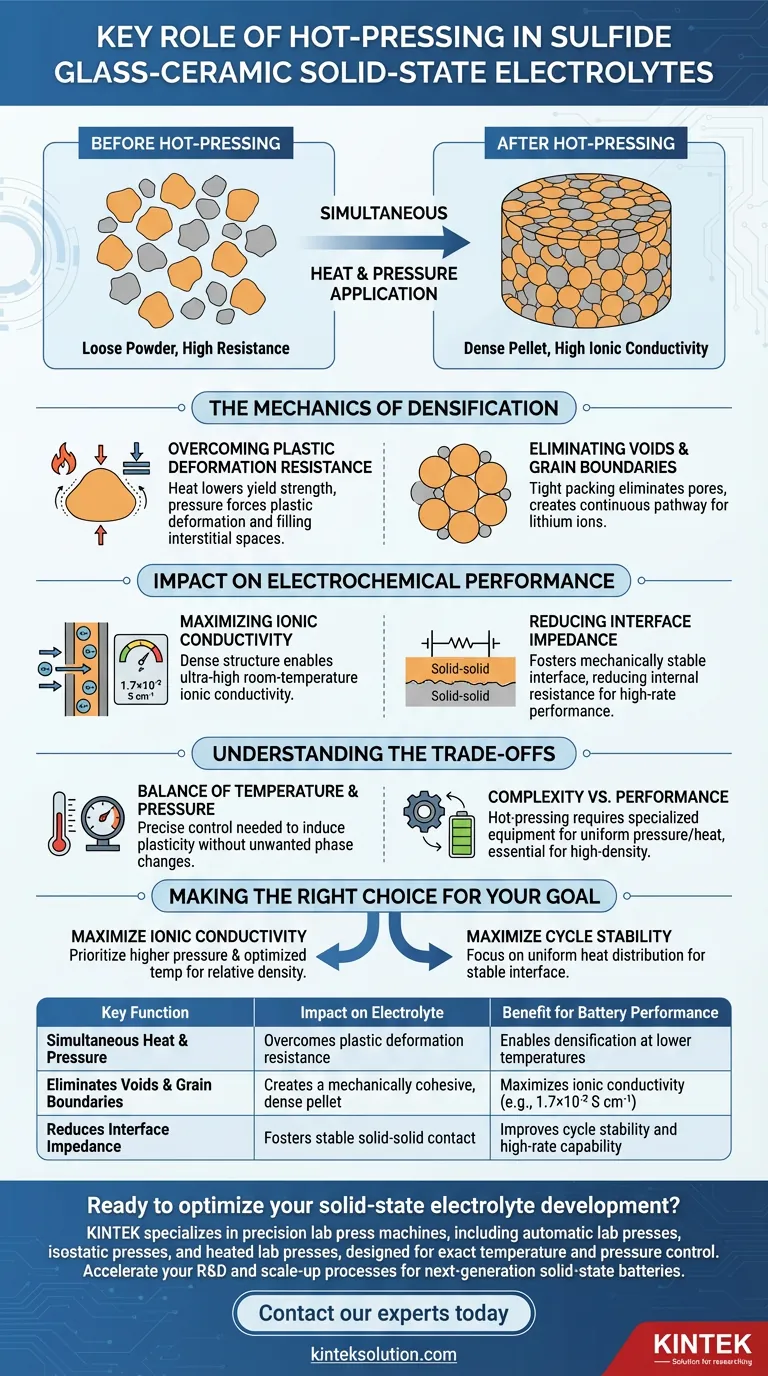
The primary role of the hot-pressing process in the preparation of sulfide glass-ceramic electrolytes is to overcome the material's natural resistance to plastic deformation through the simultaneous application of heat and pressure. By coordinating these two forces, the process effectively eliminates voids and grain boundaries between powder particles to form a mechanically cohesive, highly dense pellet. This structural density is the prerequisite for achieving ultra-high room-temperature ionic conductivity, such as 1.7×10⁻² S cm⁻¹.
The hot-pressing process serves as a critical densification mechanism that forces particle rearrangement and bonding at temperatures lower than conventional sintering. It transforms loose powder into a unified solid-state membrane, significantly reducing internal resistance and enabling high-performance battery operation.
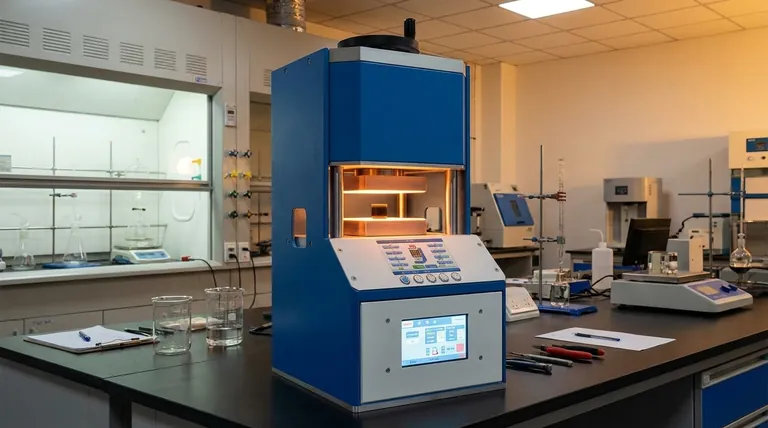
The Mechanics of Densification
Overcoming Plastic Deformation Resistance
Sulfide glass-ceramic powders naturally resist changing shape at room temperature. The core function of applying heat during pressing is to lower the material's yield strength.
This thermal assistance allows the applied pressure to force the particles into a state of plastic deformation. As the material deforms, it fills the interstitial spaces that usually exist between loose powder granules.
Eliminating Voids and Grain Boundaries
The simultaneous application of pressure ensures that as the particles soften, they are packed tightly together.
This action eliminates internal pores (voids) and minimizes the boundaries between grains. The result is a structure with significantly reduced porosity, which is essential for creating a continuous pathway for lithium ions.
Impact on Electrochemical Performance
Maximizing Ionic Conductivity
The direct output of a successful hot-pressing process is a dramatic increase in ionic conductivity.
References indicate that achieving a highly dense structure is critical for reaching conductivity benchmarks as high as 1.7×10⁻² S cm⁻¹. Without the densification provided by hot-pressing, the electrolyte would remain porous, severely impeding ion transport.
Reducing Interface Impedance
Beyond the bulk material, hot-pressing plays a vital role in stabilizing interfaces.
The process fosters a mechanically stable solid-solid interface, which leads to a substantial reduction in interface impedance. This is particularly important for ensuring low internal resistance and supporting high-rate performance in the final battery cell.
Understanding the Trade-offs
The Balance of Temperature and Pressure
While hot-pressing is effective, it requires precise control over the operating parameters.
The temperature must be high enough to induce plasticity and diffusion but controlled enough to prevent unwanted phase changes or degradation. In glass-ceramics, heat treatment is often linked to crystallization; therefore, the hot-pressing temperature can inadvertently alter the glass-ceramic phase if not carefully managed.
Complexity vs. Performance
Hot-pressing adds complexity compared to simple cold-pressing.
Cold-pressing establishes a physical foundation but often leaves internal porosity that limits performance. Hot-pressing solves this but introduces the need for specialized equipment capable of maintaining uniform pressure and heat, making the fabrication process more demanding but necessary for high-density results.
Making the Right Choice for Your Goal
To leverage hot-pressing effectively, align the process parameters with your specific performance targets.
- If your primary focus is maximizing Ionic Conductivity: Prioritize higher pressure and optimized temperatures to maximize relative density and eliminate all internal voids that block ion flow.
- If your primary focus is Cycle Stability: Focus on the uniformity of the heat distribution to ensure a consistent, mechanically stable interface that prevents delamination during battery cycling.
The hot-pressing process is not merely a shaping step; it is the fundamental enabler of high-efficiency ion transport in solid-state sulfide electrolytes.
Summary Table:
| Key Function | Impact on Electrolyte | Benefit for Battery Performance |
|---|---|---|
| Simultaneous Heat & Pressure | Overcomes plastic deformation resistance | Enables densification at lower temperatures |
| Eliminates Voids & Grain Boundaries | Creates a mechanically cohesive, dense pellet | Maximizes ionic conductivity (e.g., 1.7×10⁻² S cm⁻¹) |
| Reduces Interface Impedance | Fosters stable solid-solid contact | Improves cycle stability and high-rate capability |
Ready to optimize your solid-state electrolyte development?
KINTEK specializes in precision lab press machines, including automatic lab presses, isostatic presses, and heated lab presses, designed to deliver the exact temperature and pressure control required for preparing high-performance sulfide glass-ceramic electrolytes. Our equipment helps researchers like you achieve the critical densification needed for ultra-high ionic conductivity and stable battery interfaces.
Contact our experts today to discuss how our lab press solutions can accelerate your R&D and scale-up processes for next-generation solid-state batteries.
Visual Guide
References
- Dabing Li, Li‐Zhen Fan. Challenges and Developments of High Energy Density Anode Materials in Sulfide‐Based Solid‐State Batteries. DOI: 10.1002/celc.202200923
This article is also based on technical information from Kintek Solution Knowledge Base .
Related Products
- Automatic High Temperature Heated Hydraulic Press Machine with Heated Plates for Lab
- Heated Hydraulic Press Machine with Heated Plates for Vacuum Box Laboratory Hot Press
- Automatic Heated Hydraulic Press Machine with Hot Plates for Laboratory
- Heated Hydraulic Press Machine With Heated Plates For Vacuum Box Laboratory Hot Press
- Laboratory Split Manual Heated Hydraulic Press Machine with Hot Plates
People Also Ask
- Function of a Laboratory Hydraulic Press with Heated Platens in SSE? Enhance Battery Density & Conductivity
- What are the requirements for electrode pressing with high-viscosity ionic liquids like EMIM TFSI? Optimize Performance
- How does a laboratory heated hydraulic press facilitate PBN sample prep for WAXS? Achieve Precise X-Ray Scattering
- What are the industrial applications of heated hydraulic presses? Master Heat & Force for Precision Manufacturing
- Why is a laboratory hydraulic press with heating plates required for PLA/TEC films? Achieve Precise Sample Integrity



















