
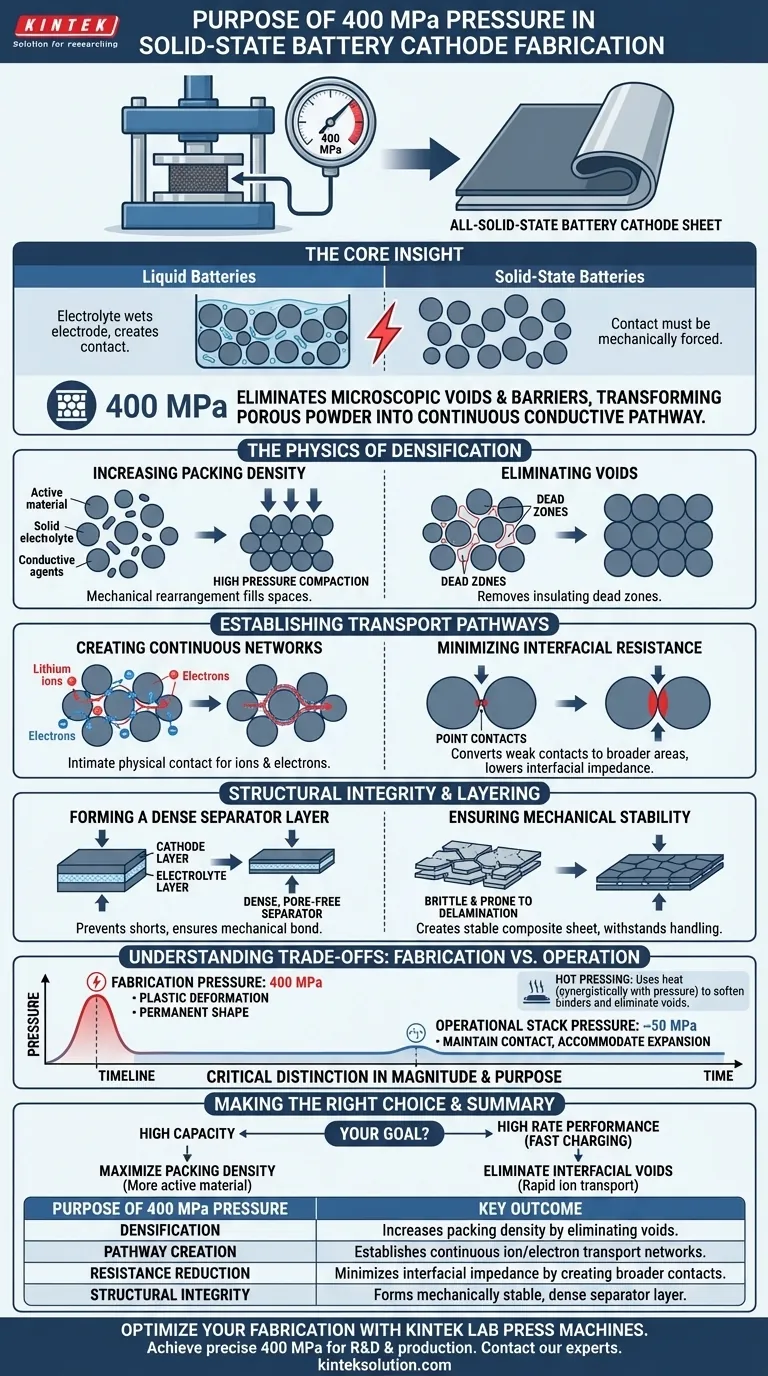
Applying a mechanical pressure of 400 MPa represents a critical densification step designed to overcome the inherent physical limitations of solid-solid interfaces. This process forces the loose powder mixture of the cathode—comprising active materials, solid electrolytes, and conductive agents—into a unified, dense composite structure with maximized particle-to-particle contact.
The Core Insight In liquid batteries, the electrolyte naturally wets the electrode to create contact; in solid-state batteries, this contact must be mechanically forced. Applying 400 MPa eliminates the microscopic voids that act as barriers to ion flow, transforming a porous powder mixture into a continuous, conductive pathway essential for minimizing internal resistance.

The Physics of Densification
Increasing Packing Density
The primary mechanical function of applying 400 MPa is to drastically increase the packing density of the cathode mixture.
Loose powders naturally contain significant gaps. High-pressure compaction mechanically rearranges and deforms particles to fill these spaces, ensuring the active material and solid electrolyte are tightly packed.
Eliminating Voids
At 400 MPa, the process effectively drives out air pockets and eliminates internal voids between particles.
This is vital because voids are electrically insulating "dead zones." By removing them, you ensure the electrode structure is solid and uniform, rather than porous and disconnected.
Establishing Transport Pathways
Creating Continuous Networks
For a solid-state battery to function, lithium ions and electrons must travel physically from particle to particle.
The high pressure ensures intimate physical contact among the active material, the solid-state electrolyte, and the conductive agent. This creates continuous, uninterrupted transport pathways for both ions and electrons throughout the electrode.
Minimizing Interfacial Resistance
The greatest bottleneck in solid-state batteries is often the resistance at the grain boundaries (where two particles meet).
By forcing particles together at 400 MPa, you convert weak "point contacts" into broader area contacts. This significantly lowers the interfacial impedance, allowing ions to move freely between the cathode material and the electrolyte.
Structural Integrity and Layering
Forming a Dense Separator Layer
When applying this pressure to solid-state electrolyte powder (such as LPSCl) layered onto a pre-formed cathode, the goal is to create a dense, pore-free separator.
This prevents physical shorts and ensures a robust mechanical bond between the cathode and the electrolyte layer.
Ensuring Mechanical Stability
The fabrication pressure creates a mechanically stable composite sheet that can withstand handling and assembly.
Without sufficient compaction pressure, the electrode would remain brittle and prone to delamination, severing the ionic pathways necessary for battery operation.
Understanding the Trade-offs: Fabrication vs. Operation
It is critical to distinguish between fabrication pressure and operational stack pressure.
The Distinction in Magnitude
The 400 MPa cited is a plastic deformation pressure used during manufacturing to permanently shape the microstructure.
In contrast, operational stack pressure is typically much lower (e.g., 50 MPa). Its purpose is to maintain the contact established during fabrication and accommodate volumetric expansion/contraction during charge cycles, ensuring the battery creates a durable interface over a long cycle life.
The Role of Temperature
While pressure alone is effective, some processes utilize hot pressing.
This introduces heat to soften polymeric binders or electrolytes, allowing them to "wet" the active material more effectively. However, the fundamental goal remains the same: using pressure (synergistically with heat) to eliminate voids that hinder performance.
Making the Right Choice for Your Goal
When determining the specific pressure protocols for your fabrication process, consider your primary performance metrics:
- If your primary focus is High Capacity: Ensure the pressure is sufficient to maximize packing density, as this increases the amount of active material per unit volume and ensures all material is electrochemically active.
- If your primary focus is High Rate Performance (Fast Charging): Prioritize the elimination of interfacial voids, as this directly reduces impedance and allows for rapid lithium-ion transport.
Ultimately, the application of 400 MPa is not merely about compaction; it is the prerequisite for establishing the continuous ionic highway required for a functional all-solid-state battery.
Summary Table:
| Purpose of 400 MPa Pressure | Key Outcome |
|---|---|
| Densification | Increases packing density by eliminating microscopic voids and air pockets. |
| Pathway Creation | Establishes continuous ion and electron transport networks. |
| Resistance Reduction | Minimizes interfacial impedance by creating broader particle contacts. |
| Structural Integrity | Forms a mechanically stable, dense separator layer to prevent shorts. |
Ready to optimize your solid-state battery electrode fabrication? KINTEK specializes in high-performance lab press machines, including automatic and heated presses, designed to deliver the precise 400 MPa pressure required for R&D and production. Our equipment ensures you achieve the critical densification and void-free interfaces necessary for high-capacity, fast-charging batteries. Contact our experts today to discuss how our solutions can accelerate your research and improve your battery performance.
Visual Guide
References
- Seungwoo Lee, Ungyu Paik. Stabilized Conductive Agent/Sulfide Solid Electrolyte Interface via a Halide Solid Electrolyte Coating for All‐Solid‐State Batteries. DOI: 10.1002/cey2.70051
This article is also based on technical information from Kintek Solution Knowledge Base .
Related Products
- 24T 30T 60T Heated Hydraulic Lab Press Machine with Hot Plates for Laboratory
- Manual Heated Hydraulic Lab Press with Integrated Hot Plates Hydraulic Press Machine
- Laboratory Split Manual Heated Hydraulic Press Machine with Hot Plates
- Automatic Heated Hydraulic Press Machine with Hot Plates for Laboratory
- Automatic High Temperature Heated Hydraulic Press Machine with Heated Plates for Lab
People Also Ask
- Function of a Laboratory Hydraulic Press with Heated Platens in SSE? Enhance Battery Density & Conductivity
- Why is a laboratory hydraulic press with heating plates required for PLA/TEC films? Achieve Precise Sample Integrity
- What role does a laboratory heated hydraulic press play in LTCC? Essential for High-Density Ceramic Lamination
- Why reduce load when applying composite strengthening tabs? Protect Specimen Integrity and Data Accuracy
- Why is a laboratory heated hydraulic press required? Ensure Precise Vulcanization for NBR/EPDM Nanocomposites



















