
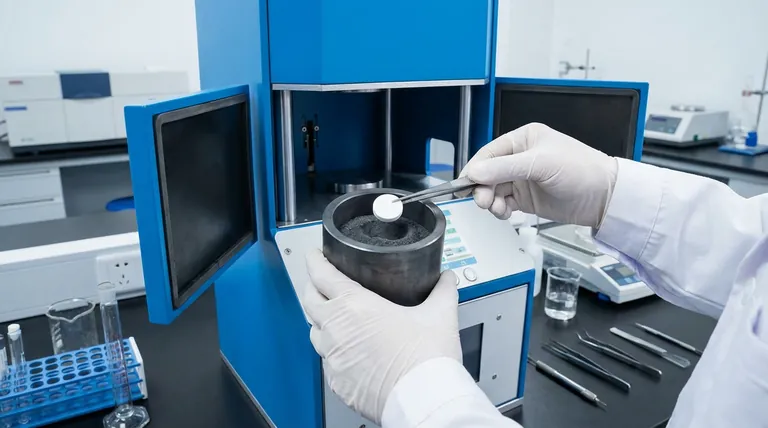
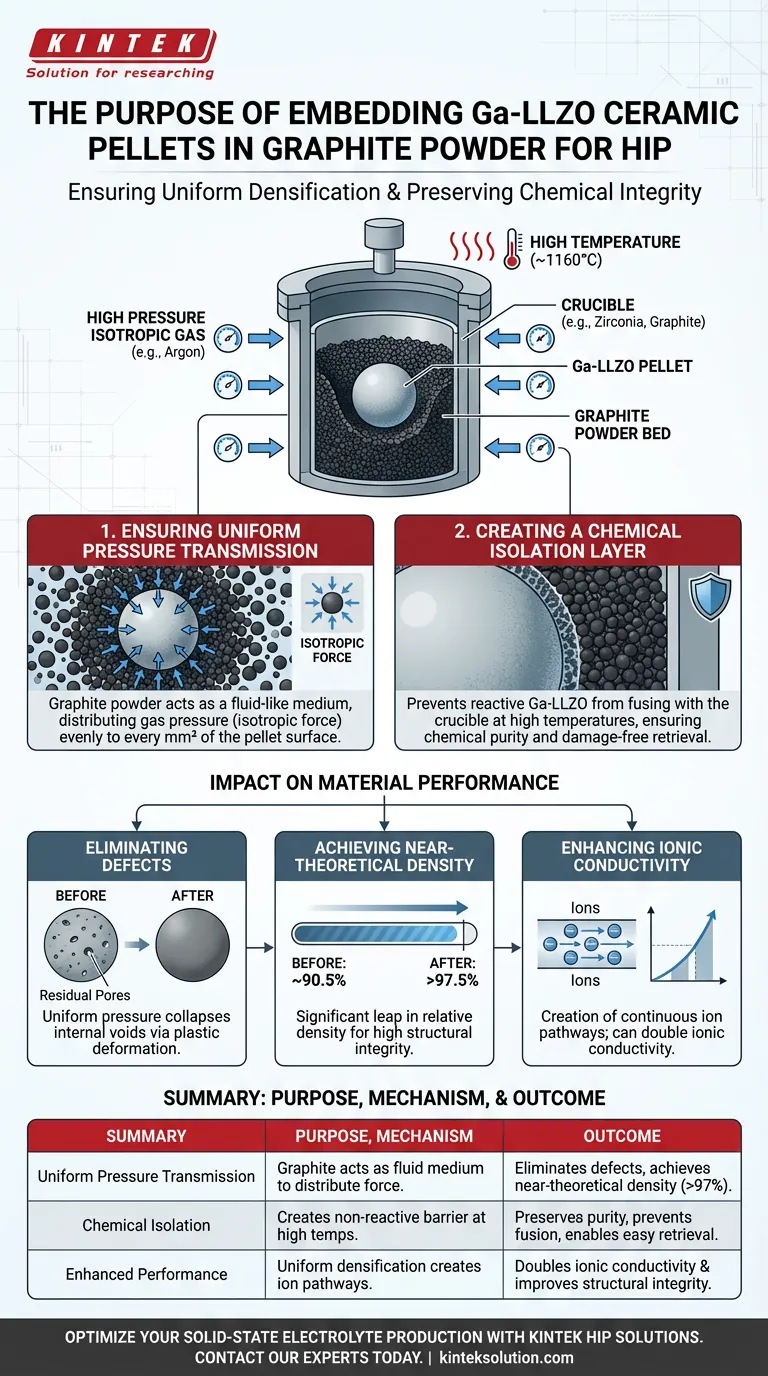
Embedding Ga-LLZO ceramic pellets in graphite powder is a mandatory protective strategy that serves two simultaneous functions: ensuring uniform densification and preserving the sample's chemical integrity. Specifically, the graphite powder acts as a pressure-transmitting medium to distribute force evenly across the pellet's surface, while also creating a physical isolation layer that prevents the ceramic from fusing with the crucible under extreme heat and pressure.
Core Insight: Successful Hot Isostatic Pressing (HIP) requires decoupling the mechanical force from the containment vessel. Graphite powder bridges this gap, translating gas pressure into uniform densification force without allowing the sensitive Ga-LLZO material to react with or bond to its surroundings.
The Dual Mechanism of Graphite Embedding
Ensuring Uniform Pressure Transmission
The Hot Isostatic Pressing (HIP) process relies on applying immense pressure, often exceeding 120 MPa. For this force to be effective, it must be isotropic, meaning it hits the sample equally from every direction.
Graphite powder acts as a fluid-like medium in this environment. It fills the voids around the pellet, ensuring that the isostatic gas pressure is transferred directly and uniformly to every square millimeter of the Ga-LLZO surface.
Creating a Chemical Isolation Layer
At processing temperatures around 1160°C, Ga-LLZO ceramics become highly reactive. Without a barrier, the pellet would likely react chemically or bond physically with the crucible walls.
The graphite powder creates a non-reactive "buffer zone." This isolation ensures the sample remains chemically pure and prevents it from sticking to the containment vessel, allowing for easy, damage-free retrieval after the cycle.
Impact on Material Performance
Eliminating Microscopic Defects
The primary goal of the HIP process is to close residual pores and microscopic defects left over from initial sintering. The uniform pressure transmitted by the graphite forces these internal voids to collapse via plastic deformation and diffusion bonding.
Achieving Near-Theoretical Density
By effectively transmitting pressure, the graphite setup enables a significant leap in relative density, often moving a sample from ~90.5% to 97.5%. This transformation is critical for creating a solid-state electrolyte with high structural integrity.
Enhancing Ionic Conductivity
The elimination of pores does more than just harden the material; it creates a continuous pathway for ions. A fully densified Ga-LLZO pellet, processed correctly in graphite powder, can exhibit double the ionic conductivity of a non-HIPed sample.
Operational Constraints and Material Compatibility
The Necessity of Inert Materials
While the graphite powder protects the sample, the crucible holding the powder (often Zirconia or Graphite) must also be robust. It is chosen specifically for thermal stability to withstand temperatures up to 1160°C without degrading.
Preventing Secondary Contamination
The entire assembly—crucible, powder, and pellet—must be chemically stable relative to one another. The graphite powder is selected because it does not react with the Ga-LLZO, ensuring the final electrolyte remains free of impurities or secondary phases.
Managing Thermal Expansion
The use of a powder bed also helps accommodate slight differences in thermal expansion between the sample and the rigid crucible. This prevents mechanical stress that could otherwise crack the ceramic during the rapid cooling phases.
Making the Right Choice for Your Goal
When designing your HIP protocols for solid-state electrolytes, consider the following prioritization:
- If your primary focus is Sample Integrity: Ensure your graphite powder layer is thick enough to prevent any contact with the crucible walls, as direct contact at 1160°C will lead to fusion and sample loss.
- If your primary focus is Electrochemical Performance: Prioritize the uniformity of the powder packing to guarantee isotropic pressure, which is the key factor in suppressing lithium dendrite penetration and maximizing critical current density.
Summary: The graphite powder bed is not merely a packing material; it is an active component of the thermal process that guarantees the physical densification of the ceramic while strictly guarding its chemical purity.
Summary Table:
| Purpose | Mechanism | Outcome |
|---|---|---|
| Uniform Pressure Transmission | Graphite powder acts as a fluid-like medium to distribute force isotropically. | Eliminates microscopic defects, achieves near-theoretical density (>97%). |
| Chemical Isolation | Creates a non-reactive barrier between the pellet and crucible at high temperatures (1160°C). | Preserves chemical purity, prevents fusion, and enables damage-free retrieval. |
| Enhanced Performance | Uniform densification creates continuous ion pathways. | Doubles ionic conductivity and improves structural integrity for solid-state batteries. |
Ready to Optimize Your Solid-State Electrolyte Production?
Achieving uniform densification and preserving chemical integrity during Hot Isostatic Pressing is critical for high-performance materials like Ga-LLZO. The right equipment and process knowledge are essential for success.
KINTEK specializes in advanced laboratory press machines, including isostatic presses and heated lab presses, designed to meet the precise demands of materials research and development.
Our expertise can help you:
- Eliminate Defects: Achieve near-theoretical density with uniform pressure application.
- Ensure Purity: Maintain sample integrity with controlled, contaminant-free environments.
- Scale Your Research: From lab-scale development to pilot-scale production.
Let's discuss how our HIP solutions can enhance your solid-state electrolyte development. Contact our experts today for a personalized consultation!
Visual Guide
Related Products
- Warm Isostatic Press for Solid State Battery Research Warm Isostatic Press
- Electric Lab Cold Isostatic Press CIP Machine
- Electric Split Lab Cold Isostatic Pressing CIP Machine
- Lab Isostatic Pressing Molds for Isostatic Molding
- Manual Cold Isostatic Pressing CIP Machine Pellet Press
People Also Ask
- Why must composite cathodes be sealed in vacuum lamination bags for WIP? Ensure Battery Stability and Density
- How do sacrificial volume materials (SVM) maintain microchannels in isostatic pressing? Ensure Structural Integrity
- What is the function of elastic molds in warm isostatic pressing? Achieve Uniform Density in Composite Particles
- What is the mechanism of a Warm Isostatic Press (WIP) on cheese? Master Cold Pasteurization for Superior Safety
- What is the function of hydraulic pressure in warm isostatic pressing? Achieve Uniform Material Density



















