
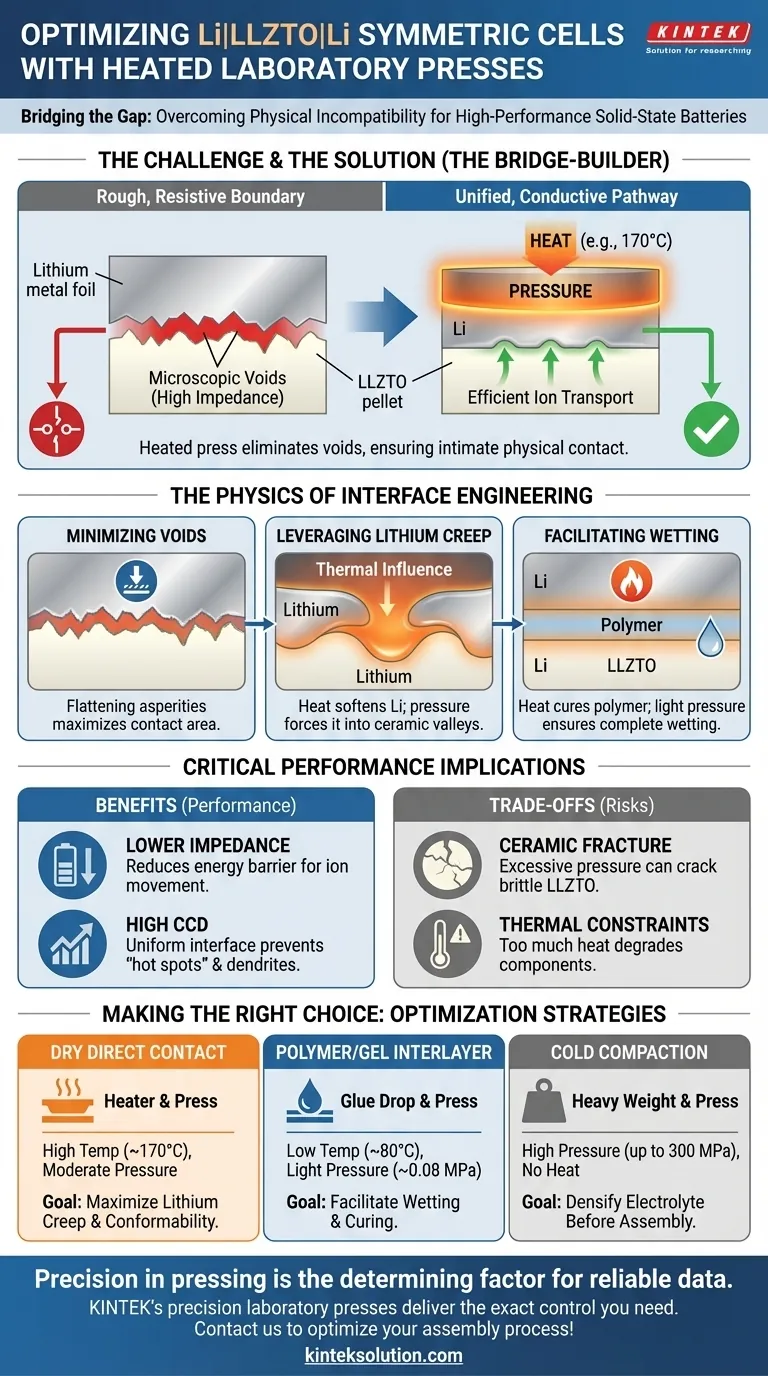
The primary function of using a heated laboratory press in this context is to overcome the inherent physical incompatibility between rigid ceramic electrolytes and solid metal electrodes. By simultaneously applying precise mechanical force and thermal energy, the press eliminates microscopic voids and ensures intimate physical contact between the Lithium (Li) and the LLZTO electrolyte. This process is the single most critical step in minimizing interfacial resistance to enable efficient ion transport.
The Core Insight A solid-state battery fails or succeeds at the interface. The heated press acts as a bridge-builder, utilizing heat to soften the lithium (enhancing creep) and pressure to force it into the ceramic's surface topography, transforming a rough, resistive boundary into a unified, conductive pathway.
The Physics of Interface Engineering
Minimizing Interfacial Voids
Solid surfaces, even when polished, possess microscopic roughness. When a lithium foil is simply placed against an LLZTO pellet, contact only occurs at a few high points (asperities).
A precision press applies uniform stack pressure to flatten these asperities. This maximizes the effective contact area, which is directly proportional to ionic conductivity.
Leveraging Lithium Creep
Lithium metal is malleable, but it requires energy to deform perfectly into a ceramic surface. Heating the assembly—often to temperatures like 170°C—significantly lowers the yield strength of the lithium.
Under this thermal influence, the lithium exhibits "creep" behavior. It softens and flows like a viscous fluid into the microscopic valleys of the LLZTO surface, creating a seamless, void-free interface.
Facilitating Interlayer Wetting
In some assembly protocols, a polymer glue or interlayer is used between the Li and LLZTO to further reduce resistance.
Here, the heated press serves a dual purpose: the heat (e.g., 80°C) cures the polymer, while slight pressure (e.g., 0.08 MPa) ensures the interlayer wets the surface completely before solidifying.
Critical Performance Implications
Lowering Impedance
The immediate result of this "hot pressing" technique is a drastic reduction in interfacial impedance. High impedance generates heat and voltage drops that render the cell unusable.
By ensuring atomic-level contact, the press reduces the energy barrier lithium ions must overcome to move from the electrode into the electrolyte.
Enabling High Critical Current Density (CCD)
A uniform interface is essential for high CCD—the maximum current the battery can handle before shorting.
If pressure is uneven, current concentrates at the few points of contact ("hot spots"). The heated press ensures uniform current distribution, preventing the localized stress that leads to dendrite formation and cell failure.
Understanding the Trade-offs
The Risk of Ceramic Fracture
While high pressure is beneficial for contact, LLZTO is a brittle ceramic. Excessive force—referencing pressures as high as 71 MPa in dry assembly contexts—must be applied with extreme caution.
Imprecise pressure control can crack the electrolyte pellet. Even micro-cracks can serve as pathways for lithium dendrites, leading to immediate short circuits.
Thermal Constraints
Heat aids adhesion, but excessive temperatures can degrade certain cell components or induce unwanted chemical reactions at the interface.
The process requires a delicate balance. You must apply enough heat to soften the lithium, but not enough to compromise the chemical stability of the assembly.
Making the Right Choice for Your Goal
To optimize your symmetric cell assembly, align your pressing parameters with your specific interface strategy:
- If your primary focus is a "Dry" Direct Contact Interface: Prioritize higher temperatures (approx. 170°C) and moderate pressure to maximize lithium creep and conformability.
- If your primary focus is a Polymer/Gel Interlayer: Utilize lower temperatures (approx. 80°C) and lighter pressure (approx. 0.08 MPa) to facilitate wetting and curing without squeezing out the interlayer.
- If your primary focus is High-Pressure Cold Compaction: Ensure your press can deliver high loads (up to 300 MPa) uniformly to density the electrolyte before electrode attachment, ensuring mechanical robustness.
Precision in the pressing stage is not just a procedural step; it is the determining factor in the reliability of your electrochemical data.
Summary Table:
| Pressing Parameter | Purpose & Benefit |
|---|---|
| Heat Application | Softens lithium for enhanced creep, promoting seamless contact with the ceramic electrolyte (LLZTO). |
| Precise Pressure Control | Ensures uniform contact, maximizes interfacial area, and prevents brittle ceramic fracture. |
| Combined Heat & Pressure | Creates a void-free, low-resistance interface, enabling high critical current density (CCD) and reliable cell performance. |
Ready to build reliable solid-state battery cells with perfect interfaces?
KINTEK's precision laboratory presses are engineered for the exacting demands of battery research. Our automatic lab presses, heated lab presses, and isostatic presses deliver the precise temperature and pressure control you need to minimize interfacial resistance and achieve reproducible results in your Li|LLZTO|Li symmetric cells.
We specialize in serving laboratory needs, providing the robust tools required to push the boundaries of energy storage. Let us help you optimize your assembly process.
Contact KINTEK today to discuss your specific application and find the ideal press for your research!
Visual Guide
Related Products
- 24T 30T 60T Heated Hydraulic Lab Press Machine with Hot Plates for Laboratory
- Heated Hydraulic Press Machine with Heated Plates for Vacuum Box Laboratory Hot Press
- Laboratory Split Manual Heated Hydraulic Press Machine with Hot Plates
- Automatic Heated Hydraulic Press Machine with Hot Plates for Laboratory
- Automatic Heated Hydraulic Press Machine with Heated Plates for Laboratory
People Also Ask
- Function of a Laboratory Hydraulic Press with Heated Platens in SSE? Enhance Battery Density & Conductivity
- Why is a laboratory hydraulic press with heating plates required for PLA/TEC films? Achieve Precise Sample Integrity
- What role does a laboratory heated hydraulic press play in LTCC? Essential for High-Density Ceramic Lamination
- Why reduce load when applying composite strengthening tabs? Protect Specimen Integrity and Data Accuracy
- Why is a laboratory heated hydraulic press utilized during the lamination stage of NASICON green tapes?



















