
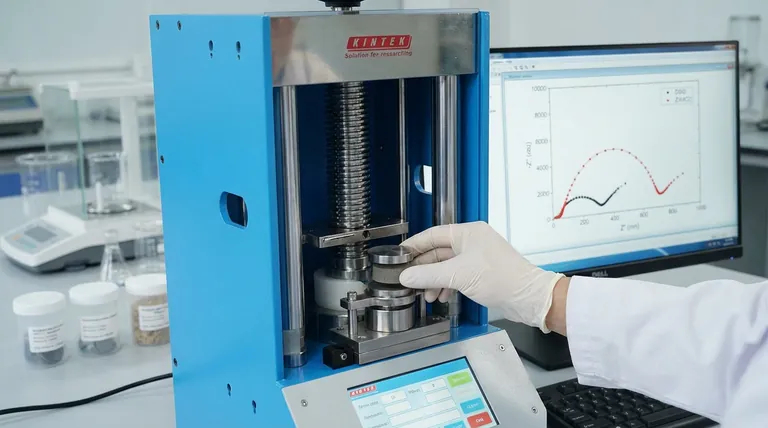
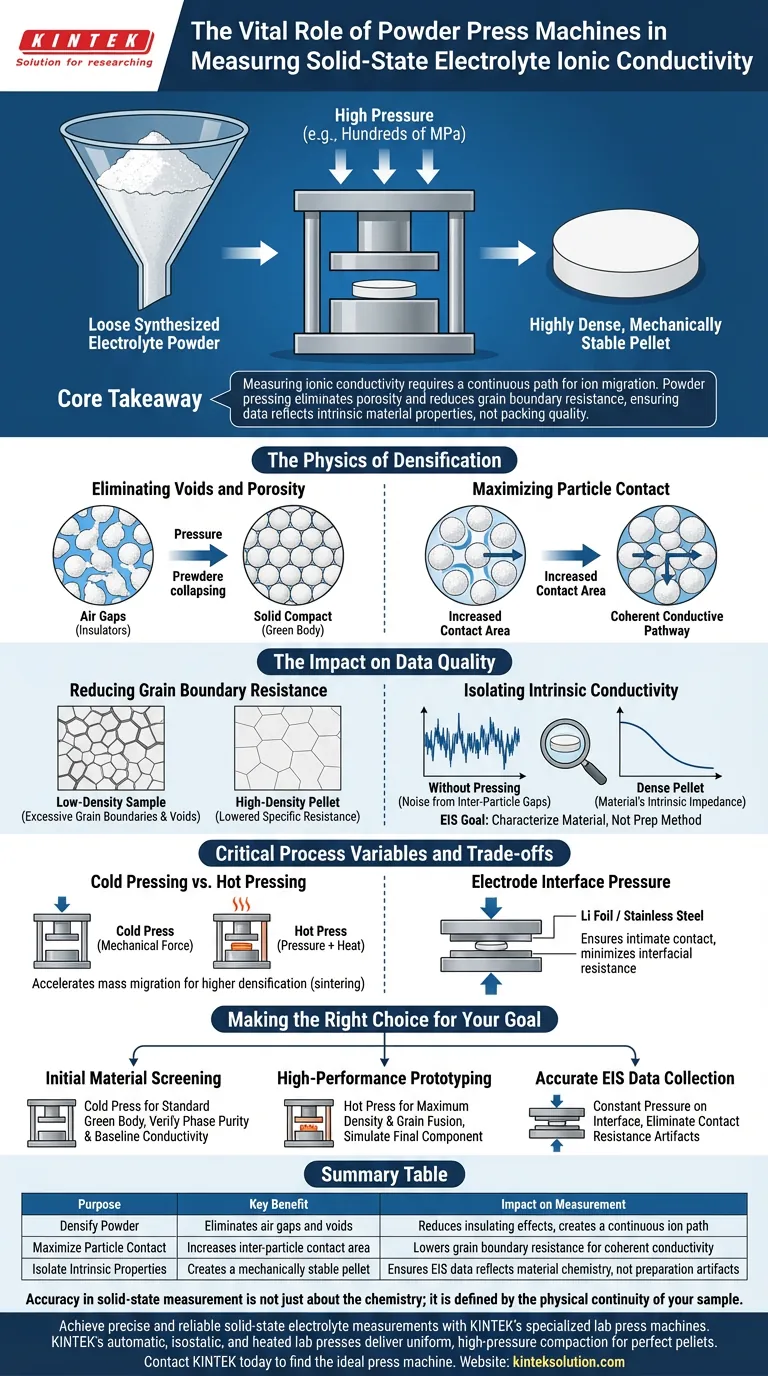
The primary purpose of a powder press machine in this context is to transform loose synthesized electrolyte powder into a highly dense, mechanically stable solid pellet. By applying significant pressure (often hundreds of megapascals), the machine minimizes physical voids and air gaps that would otherwise distort electrochemical measurements.
Core Takeaway Measuring ionic conductivity requires a continuous path for ion migration. Powder pressing eliminates porosity and reduces grain boundary resistance, ensuring that your data reflects the material's intrinsic properties rather than the quality of its packing.
The Physics of Densification
Eliminating Voids and Porosity
Loose powder is filled with air gaps, which act as insulators.
A powder press applies uniform high pressure to collapse these voids. This creates a "green body" or a solid compact where the material density approaches its theoretical maximum.
Maximizing Particle Contact
For ions to move, particles must physically touch.
Pressure increases the contact area between individual powder grains. This intimacy is critical for establishing a coherent conductive pathway throughout the sample.
The Impact on Data Quality
Reducing Grain Boundary Resistance
In solid-state electrolytes, resistance occurs not just within the crystal lattice (bulk), but also where crystals meet (grain boundaries).
Low-density samples have excessive grain boundaries and voids. By compacting the sample, you significantly lower this specific resistance, preventing it from dominating your measurement.
Isolating Intrinsic Conductivity
The ultimate goal of Electrochemical Impedance Spectroscopy (EIS) is to characterize the material, not the sample preparation method.
A dense pellet ensures the measured impedance is due to the material's chemistry and structure. Without pressing, the data would falsely suggest lower conductivity due to the "noise" of inter-particle gaps.
Critical Process Variables and Trade-offs
Cold Pressing vs. Hot Pressing
While a standard hydraulic press (cold press) creates a dense shape, it relies purely on mechanical force.
A hot press machine introduces heat alongside pressure. This accelerates mass migration and diffusion, allowing for higher densification (sintering) at lower temperatures and shorter times, particularly for ceramics like LLZO.
Electrode Interface Pressure
It is not enough to simply press the pellet; the connection to the testing equipment matters.
Applying constant pressure during the actual testing phase ensures intimate contact between the electrolyte and the electrodes (e.g., lithium foil or stainless steel). This minimizes interfacial resistance, which is distinct from the bulk resistance of the pellet.
Making the Right Choice for Your Goal
To ensure your conductivity measurements are valid, match your pressing strategy to your specific objective.
- If your primary focus is initial material screening: Use a cold press to create a standard "green body" pellet to quickly verify phase purity and baseline conductivity.
- If your primary focus is high-performance prototyping: Utilize hot pressing to achieve maximum theoretical density and grain fusion, simulating the performance of a final ceramic component.
- If your primary focus is accurate EIS data collection: Ensure your test fixture applies constant pressure to the electrode-electrolyte interface to eliminate contact resistance artifacts.
Accuracy in solid-state measurement is not just about the chemistry; it is defined by the physical continuity of your sample.
Summary Table:
| Purpose | Key Benefit | Impact on Measurement |
|---|---|---|
| Densify Powder | Eliminates air gaps and voids | Reduces insulating effects, creates a continuous ion path |
| Maximize Particle Contact | Increases inter-particle contact area | Lowers grain boundary resistance for coherent conductivity |
| Isolate Intrinsic Properties | Creates a mechanically stable pellet | Ensures EIS data reflects material chemistry, not preparation artifacts |
Achieve precise and reliable solid-state electrolyte measurements with KINTEK's specialized lab press machines.
Accurate ionic conductivity data starts with a perfectly prepared pellet. KINTEK's automatic lab presses, isostatic presses, and heated lab presses are engineered to deliver the uniform, high-pressure compaction required to eliminate porosity and minimize grain boundary resistance, ensuring your EIS results reflect the true properties of your material.
Whether you are conducting initial material screening with cold pressing or pursuing high-density prototyping with hot pressing, our machines provide the control and consistency your laboratory needs. Don't let sample preparation compromise your research.
Contact KINTEK today to discuss your specific application and find the ideal press machine to enhance your lab's capabilities and data accuracy.
Visual Guide
Related Products
- XRF KBR Plastic Ring Lab Powder Pellet Pressing Mold for FTIR
- Lab Polygon Press Mold
- Lab XRF Boric Acid Powder Pellet Pressing Mold for Laboratory Use
- Lab Round Bidirectional Press Mold
- Automatic High Temperature Heated Hydraulic Press Machine with Heated Plates for Lab
People Also Ask
- What is the purpose of making KBr pellets for FTIR? Achieve Precise Molecular Analysis with Solid Samples
- What factors should be considered when choosing a lab press for XRF pellet preparation? Ensure Accurate and Consistent Results
- Why are pellets used in XRF analysis, and what is their limitation? Boost Accuracy and Speed in Your Lab
- How are pellets prepared for XRF analysis and what is a potential drawback? Master XRF Sample Prep and Accuracy
- What are the different types of XRF pellet preparation methods available? Manual, Hydraulic, and Automated Presses Explained



















