
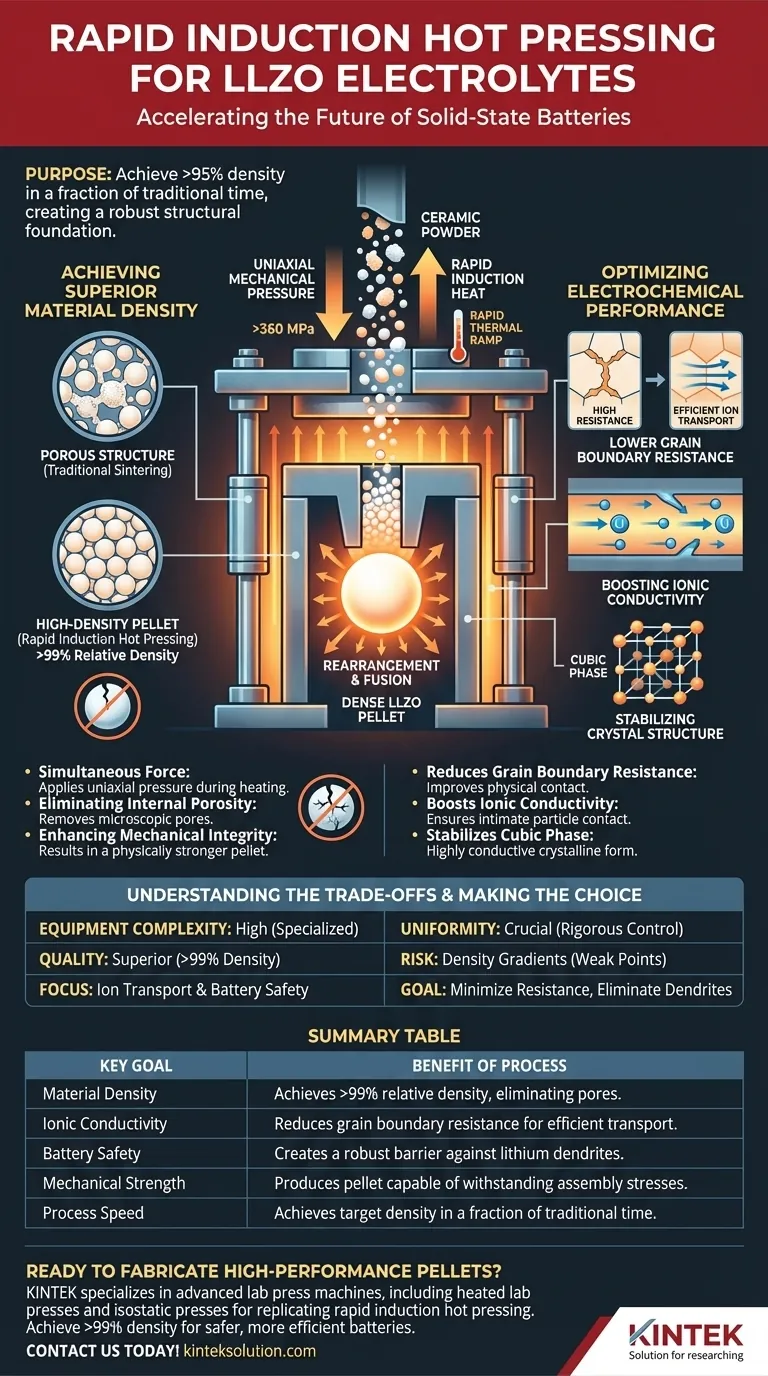
Rapid induction hot pressing is a critical fabrication technique designed to produce high-density ceramic electrolyte pellets by subjecting LLZO powder to high temperature and mechanical pressure simultaneously. Its primary purpose is to achieve a relative density exceeding 95% in a fraction of the time required by traditional methods, creating the structural foundation necessary for solid-state batteries.
By forcing ceramic particles to rearrange and fuse under mechanical stress, this process eliminates the internal voids that plague conventional sintering. The result is a mechanically robust electrolyte with optimized ionic conductivity and a physical barrier against lithium dendrite penetration.
Achieving Superior Material Density
The Mechanics of Simultaneous Force
Unlike traditional pressureless sintering, which relies solely on heat, hot pressing applies uniaxial mechanical pressure while the material is heated. This combined action forces the LLZO powder particles into a tighter arrangement, significantly accelerating the densification process.
Eliminating Internal Porosity
A primary goal of this process is to remove microscopic pores between particles. Reference data indicates that rapid induction hot pressing can achieve relative densities exceeding 99%. Eliminating these pores is vital, as they can otherwise act as low-resistance pathways for lithium dendrite growth, which leads to battery short circuits.
Enhancing Mechanical Integrity
The application of high pressure results in a physically stronger pellet. This superior mechanical strength is essential for the electrolyte to withstand the internal stresses of battery assembly and the volume changes that occur during long-term cycling.
Optimizing Electrochemical Performance
Reducing Grain Boundary Resistance
High-density compaction improves the physical contact between grain boundaries. This reduction in interstitial voids lowers the grain boundary resistance, creating continuous pathways for lithium ions to move freely through the ceramic structure.
Boosting Ionic Conductivity
By ensuring intimate particle contact and reducing porosity, the overall ionic conductivity of the pellet is significantly increased. High ionic conductivity is the defining metric for the performance of a solid-state battery, determining how efficiently it can charge and discharge.
Stabilizing the Crystal Structure
The specific conditions of rapid induction hot pressing help stabilize the cubic phase of LLZO. The cubic phase is the highly conductive crystalline form required for effective battery operation, ensuring the material retains its performance characteristics after cooling.
Understanding the Trade-offs
Equipment Complexity vs. Material Quality
While traditional sintering is simpler, it often fails to achieve the high densities required for viable solid-state electrolytes. The trade-off is that rapid induction hot pressing requires specialized equipment capable of delivering precise high loads (e.g., 360 MPa) and rapid thermal ramp rates, representing a higher complexity in the manufacturing workflow.
The Necessity of Uniformity
The process demands rigorous control over the applied pressure to ensure the pellet is uniform. Inconsistent pressure distribution can lead to density gradients, which undermines the benefits of the process by creating localized weak points where dendrites could still penetrate.
Making the Right Choice for Your Goal
When evaluating fabrication methods for LLZO electrolytes, consider your specific performance targets:
- If your primary focus is Ion Transport: Prioritize this method to minimize grain boundary resistance and maximize total ionic conductivity through densification.
- If your primary focus is Battery Safety: Use this process to achieve >99% density, effectively eliminating the pores that allow lithium dendrites to cause short circuits.
Rapid induction hot pressing acts as the definitive processing step to transform loose ceramic powder into a safe, conductive, and mechanically stable solid-state electrolyte.
Summary Table:
| Key Goal | Benefit of Rapid Induction Hot Pressing |
|---|---|
| Material Density | Achieves >99% relative density, eliminating internal pores. |
| Ionic Conductivity | Reduces grain boundary resistance for efficient ion transport. |
| Battery Safety | Creates a robust physical barrier against lithium dendrites. |
| Mechanical Strength | Produces a pellet capable of withstanding assembly and cycling stresses. |
| Process Speed | Achieves target density in a fraction of the time of traditional sintering. |
Ready to fabricate high-performance solid-state electrolyte pellets?
KINTEK specializes in advanced lab press machines, including the precise heated lab presses and isostatic presses essential for replicating the rapid induction hot pressing process in your R&D. Our equipment delivers the controlled high pressure and temperature required to achieve >99% density in LLZO and other ceramic materials, helping you develop safer, more efficient batteries.
Contact us today to discuss how our solutions can enhance your laboratory's capabilities and accelerate your solid-state battery research.
Get in touch with our experts →
Visual Guide
Related Products
- Automatic Heated Hydraulic Press Machine with Hot Plates for Laboratory
- Heated Hydraulic Press Machine with Heated Plates for Vacuum Box Laboratory Hot Press
- Laboratory Manual Heated Hydraulic Press Machine with Hot Plates
- Automatic High Temperature Heated Hydraulic Press Machine with Heated Plates for Lab
- Warm Isostatic Press for Solid State Battery Research Warm Isostatic Press
People Also Ask
- Function of a Laboratory Hydraulic Press with Heated Platens in SSE? Enhance Battery Density & Conductivity
- Why is a laboratory hydraulic press with heating plates required for PLA/TEC films? Achieve Precise Sample Integrity
- What are the requirements for electrode pressing with high-viscosity ionic liquids like EMIM TFSI? Optimize Performance
- How does a laboratory heated hydraulic press facilitate PBN sample prep for WAXS? Achieve Precise X-Ray Scattering
- What are the industrial applications of heated hydraulic presses? Master Heat & Force for Precision Manufacturing

















