
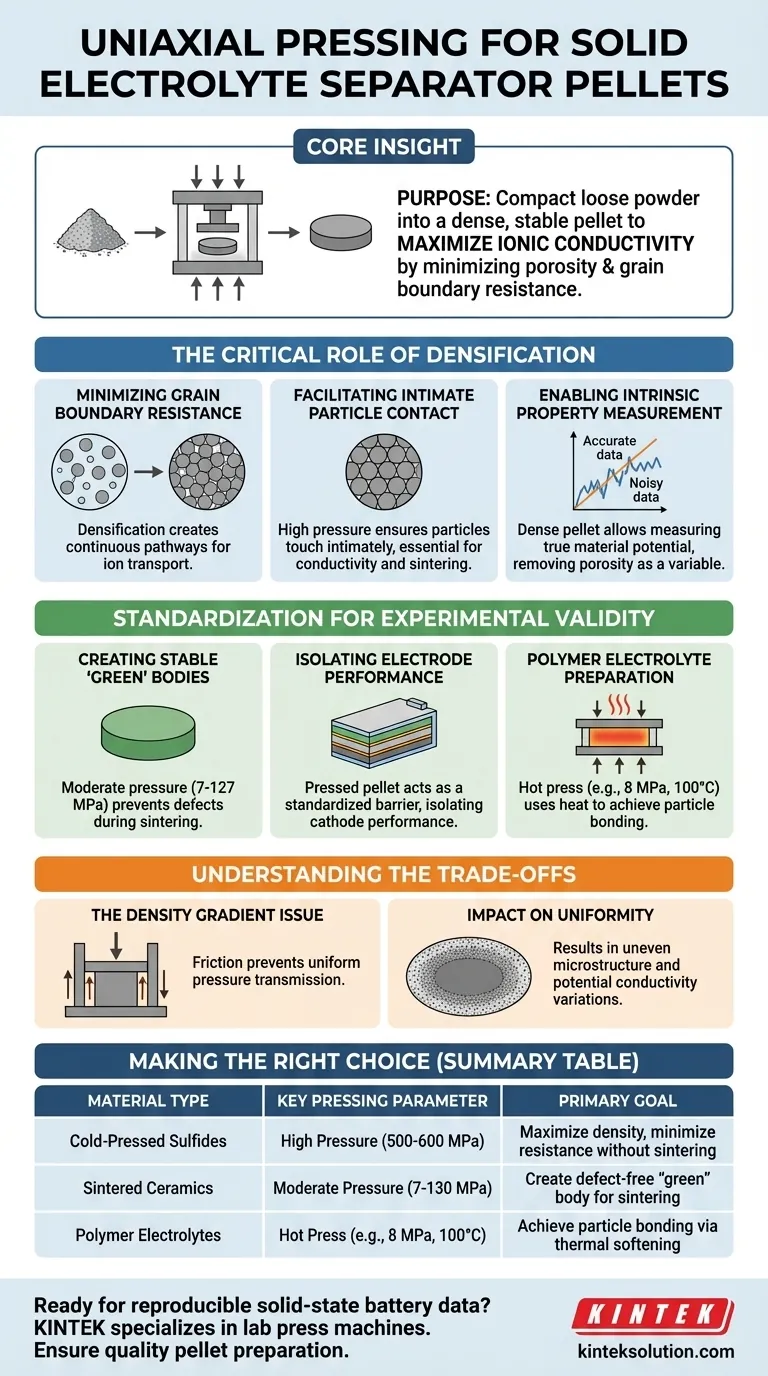
The primary purpose of using a uniaxial press is to compact loose solid electrolyte powder into a dense, mechanically stable pellet. By applying precise, often high-magnitude pressure (ranging from 7 MPa to over 600 MPa), you eliminate inter-particle voids and force solid particles into intimate contact. This creates a standardized separator component essential for assembling reliable electrochemical test cells.
Core Insight: While the visible output is a shaped pellet, the functional goal is maximizing ionic conductivity by minimizing porosity and grain boundary resistance. A properly pressed pellet ensures that test results reflect the material's true chemistry rather than physical defects introduced during sample preparation.
The Critical Role of Densification
Minimizing Grain Boundary Resistance
Loose electrolyte powder cannot effectively conduct ions due to air gaps and poor particle contact.
A uniaxial press applies high pressure (often hundreds of megapascals) to drastically reduce these inter-particle pores. This densification creates continuous pathways for ion transport, which is fundamental to lowering the internal resistance of the cell.
Facilitating Intimate Particle Contact
For materials like Li-argyrodite or NASICON, physical proximity between grains is mandatory.
High pressure ensures that particles touch intimately. This is not only required for immediate conductivity in cold-pressed pellets but is also a prerequisite for solid-state reactions if the material undergoes subsequent sintering.
Enabling Intrinsic Property Measurement
To evaluate a material's true potential, you must remove external variables.
A dense, pressed pellet allows you to measure the intrinsic ionic conductivity of the material. Without sufficient densification, your data will measure the resistance of the voids (porosity) rather than the electrolyte itself.
Standardization for Experimental Validity
Creating Stable "Green" Bodies
For ceramic electrolytes that require high-temperature sintering (such as NZSP), the press serves a specific pre-processing role.
It compacts the powder into a "green pellet"—a solid but unfired shape—using moderate pressure (e.g., 7–127 MPa). Achieving a defect-free green pellet is critical to preventing cracking, warping, or deformation during the final sintering stage.
Isolating Electrode Performance
In full-cell testing, the separator must be mechanically robust enough to stand alone.
A pressed pellet acts as a standardized barrier. This allows you to couple it with a composite cathode to isolate and evaluate the cathode's specific electrochemical performance without interference from a weak or conductive separator.
Polymer Electrolyte Preparation
Not all pressing involves massive pressure; some applications require heat.
For polymer-based electrolytes like PEO, a uniaxial hot press is used. By combining moderate pressure (e.g., 8 MPa) with heat (e.g., 100°C), the press softens the polymer to achieve particle bonding and film densification.
Understanding the Trade-offs
The Density Gradient Issue
Uniaxial pressing has a distinct physical limitation: friction.
Friction between the powder and the metallic mold walls often prevents pressure from transmitting uniformly throughout the pellet. This results in an uneven microstructure, where the center of the pellet is denser than the edges.
Impact on Uniformity
This density gradient can lead to variations in ionic conductivity across a single sample.
While often acceptable for small-scale laboratory testing, this non-uniformity poses a significant bottleneck for large-scale production, where consistent mechanical strength and conductivity are required across larger surface areas.
Making the Right Choice for Your Goal
To ensure your assembly process yields valid data, match your pressing strategy to your material type:
- If your primary focus is Cold-Pressed Sulfides: Apply extremely high pressure (approx. 500–600 MPa) to maximize density and minimize grain boundary resistance without sintering.
- If your primary focus is Sintered Ceramics: Apply moderate, uniform pressure (approx. 7–130 MPa) to create a defect-free green body that will survive high-temperature firing.
- If your primary focus is Polymer Electrolytes: Utilize a hot press with lower pressure (approx. 8 MPa) to leverage thermal softening for particle bonding.
The quality of your mechanical pressing is the single most significant variable in ensuring the reproducibility of your solid-state battery data.
Summary Table:
| Material Type | Key Pressing Parameter | Primary Goal |
|---|---|---|
| Cold-Pressed Sulfides | High Pressure (500-600 MPa) | Maximize density, minimize grain boundary resistance |
| Sintered Ceramics | Moderate Pressure (7-130 MPa) | Create a defect-free 'green' body for sintering |
| Polymer Electrolytes | Hot Press (e.g., 8 MPa, 100°C) | Achieve particle bonding via thermal softening |
Ready to ensure the reproducibility of your solid-state battery data? The quality of your pellet preparation is critical. KINTEK specializes in lab press machines, including automatic, isostatic, and heated lab presses, designed to meet the precise demands of solid electrolyte research. Let our expertise help you achieve dense, standardized pellets for reliable electrochemical testing. Contact us today to discuss your specific laboratory needs!
Visual Guide
Related Products
- Lab Round Bidirectional Press Mold
- Lab Polygon Press Mold
- Lab Cylindrical Press Mold with Scale
- Split Automatic Heated Hydraulic Press Machine with Heated Plates
- Lab Cylindrical Press Mold for Laboratory Use
People Also Ask
- What is the purpose of incorporating cartridge heaters into a lab press mold for MLCC block compression? Optimize Results
- Why is precise cooling management of the lab press mold necessary? Protect Core Integrity in Thermoforming
- What is the function of a pressing tool in thermoplastic panels? Master Precision Shaping & Fusion Bonding
- Why is a high-performance laboratory molding press critical for in-situ electrolyte formation? Unlock Battery Success
- How do the design and geometric precision of pressing molds and mandrels affect the quality of PTFE composite samples?



















