
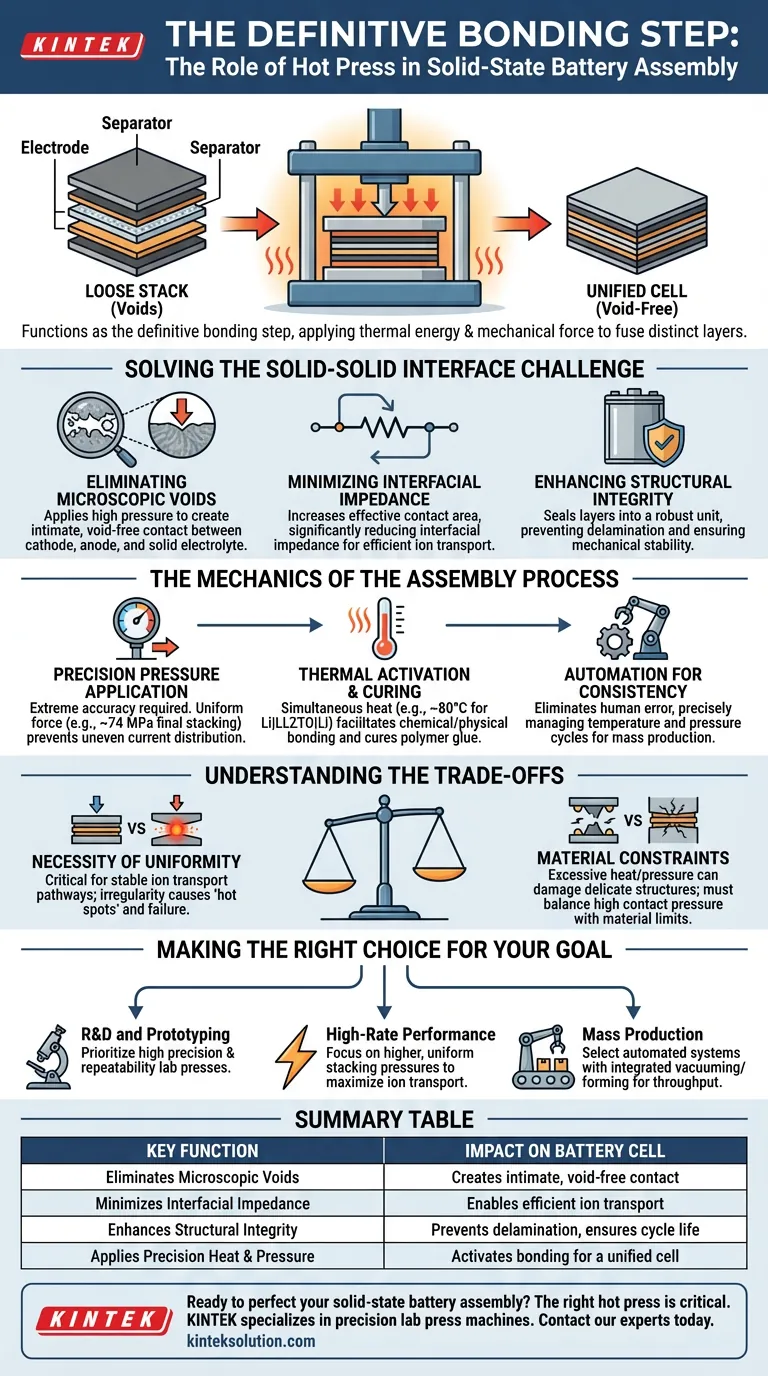
The hot press machine functions as the definitive bonding step in the manufacturing of solid-state battery cells. It applies a calculated combination of thermal energy and mechanical force to a stack of electrodes and separators, fusing these distinct layers into a unified electrochemical device with optimized physical contact.
By eliminating microscopic voids between solid components, the hot press transforms a loose stack of materials into a high-performance cell. This process is the primary mechanism for lowering internal resistance and ensuring the efficient ion transport necessary for a viable solid-state battery.
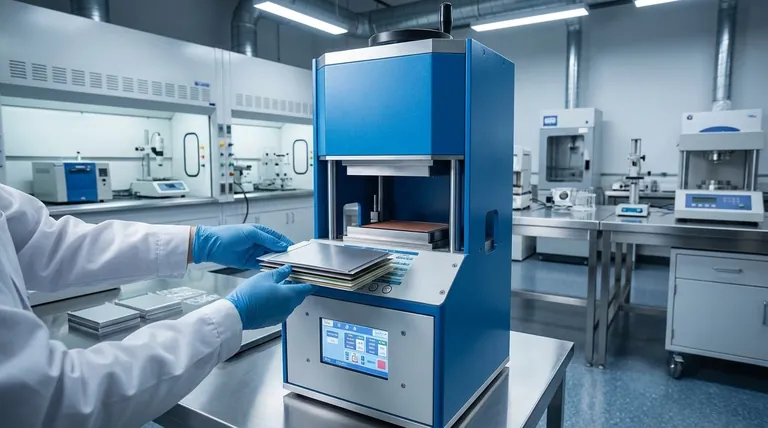
Solving the Solid-Solid Interface Challenge
Eliminating Microscopic Voids
Unlike liquid electrolytes, which naturally flow into gaps, solid-state materials have rough surfaces that create microscopic voids when stacked.
A hot press addresses this by applying high pressure to force materials together. This creates intimate, void-free physical contact between the cathode, anode, and solid electrolyte.
Without this step, surface roughness acts as a barrier, preventing the necessary connection between particles.
Minimizing Interfacial Impedance
The physical contact created by the press directly correlates to electrochemical performance.
By increasing the effective contact area, the machine significantly reduces interfacial impedance (resistance).
A low-impedance interface is a prerequisite for rapid lithium-ion transport. This ensures the battery can charge and discharge efficiently without significant energy loss.
Enhancing Structural Integrity
Beyond electrical performance, the hot press ensures the mechanical stability of the cell.
It seals the anode, cathode, and separator layers into a robust unit.
This structural integrity is critical for maintaining performance over the battery's lifespan, preventing delamination or physical degradation during cycling.
The Mechanics of the Assembly Process
Precision Pressure Application
The press must deliver force with extreme accuracy to achieve results.
References indicate pressures can vary widely depending on the stage and material, from final stacking pressures around 74 MPa to lighter bonding pressures.
This force must be uniform; even minor deviations can lead to uneven current distribution and cell failure.
Thermal Activation and Curing
Heat is applied simultaneously with pressure to facilitate chemical and physical bonding.
For example, in specific setups like Li|LLZTO|Li cells, temperatures around 80°C help wet and cure polymer glue layers.
This thermal step ensures seamless bonding at the boundary layers, further reducing resistance.
Automation for Consistency
Modern manufacturing relies on automated hot press machines to eliminate human error.
These systems control variables such as table feeding, vacuuming, and demolding.
By precisely managing temperature and pressure cycles, automation ensures that every cell meets the strict tolerances required for mass production.
Understanding the Trade-offs
The Necessity of Uniformity
The most critical factor in hot pressing is not just the amount of pressure, but its uniformity.
Applying pressure via a mold or pressing device (e.g., 200 kPa) creates a seamless bond, but any irregularity can create "hot spots" of high resistance.
If the pressure is not applied evenly across the entire surface, the ion transport pathway becomes unstable, compromising cycle life.
Material constraints
The settings for the hot press are strictly dictated by the chemistry of the battery components.
Excessive heat or pressure can damage delicate solid electrolyte structures or degrade electrode materials.
Operators must balance the need for high contact pressure against the mechanical limits of the materials being used.
Making the Right Choice for Your Goal
Whether you are in a research setting or establishing a production line, the role of the hot press varies slightly based on your specific objectives.
- If your primary focus is R&D and Prototyping: Prioritize a laboratory press that offers high precision and repeatability to ensure your test data accurately reflects material performance, not assembly errors.
- If your primary focus is High-Rate Performance: Focus on machines capable of delivering higher, uniform stacking pressures (e.g., ~74 MPa) to aggressively minimize impedance and maximize ion transport.
- If your primary focus is Mass Production: Select automated systems that integrate vacuuming and forming steps to maximize throughput while maintaining consistent quality control.
Ultimately, the hot press is not merely a tool for assembly; it is the critical instrument that activates the battery's potential by bridging the gap between raw materials and a functional energy storage device.
Summary Table:
| Key Function | Impact on Battery Cell |
|---|---|
| Eliminates Microscopic Voids | Creates intimate, void-free contact between components |
| Minimizes Interfacial Impedance | Enables efficient ion transport for fast charging/discharging |
| Enhances Structural Integrity | Prevents delamination, ensuring long-term cycle life |
| Applies Precision Heat & Pressure | Activates bonding and curing for a seamless, unified cell |
Ready to perfect your solid-state battery assembly? The right hot press is critical for achieving low impedance and high performance. KINTEK specializes in precision lab press machines, including automatic, isostatic, and heated lab presses, designed to meet the exacting demands of battery R&D and production. Contact our experts today to discuss how our solutions can enhance your process and accelerate your development timeline.
Visual Guide
Related Products
- Automatic High Temperature Heated Hydraulic Press Machine with Heated Plates for Lab
- Heated Hydraulic Press Machine with Heated Plates for Vacuum Box Laboratory Hot Press
- Automatic Heated Hydraulic Press Machine with Hot Plates for Laboratory
- Laboratory Split Manual Heated Hydraulic Press Machine with Hot Plates
- Heated Hydraulic Press Machine With Heated Plates For Vacuum Box Laboratory Hot Press
People Also Ask
- Function of a Laboratory Hydraulic Press with Heated Platens in SSE? Enhance Battery Density & Conductivity
- What are the requirements for electrode pressing with high-viscosity ionic liquids like EMIM TFSI? Optimize Performance
- How does a laboratory heated hydraulic press facilitate PBN sample prep for WAXS? Achieve Precise X-Ray Scattering
- What are the industrial applications of heated hydraulic presses? Master Heat & Force for Precision Manufacturing
- Why is a laboratory hydraulic press with heating plates required for PLA/TEC films? Achieve Precise Sample Integrity



















