
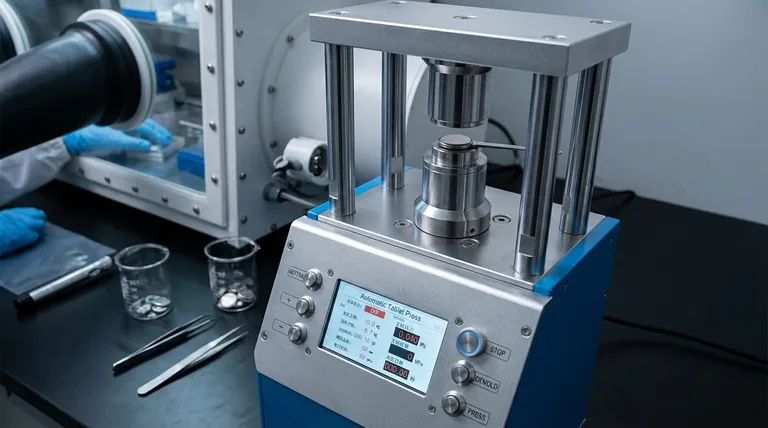
In the context of 2032-type coin cell assembly, the lab press functions as the critical mechanism for environmental isolation and structural integrity. It applies a calculated, uniform force to plastically deform the metal casing, creating an airtight (hermetic) seal that locks internal components in place and permanently separates them from the outside atmosphere.
The lab press ensures the validity of your electrochemical data by performing two simultaneous actions: compacting the internal stack to minimize resistance and crimping the outer casing to prevent atmospheric contamination.
The Mechanics of the Hermetic Seal
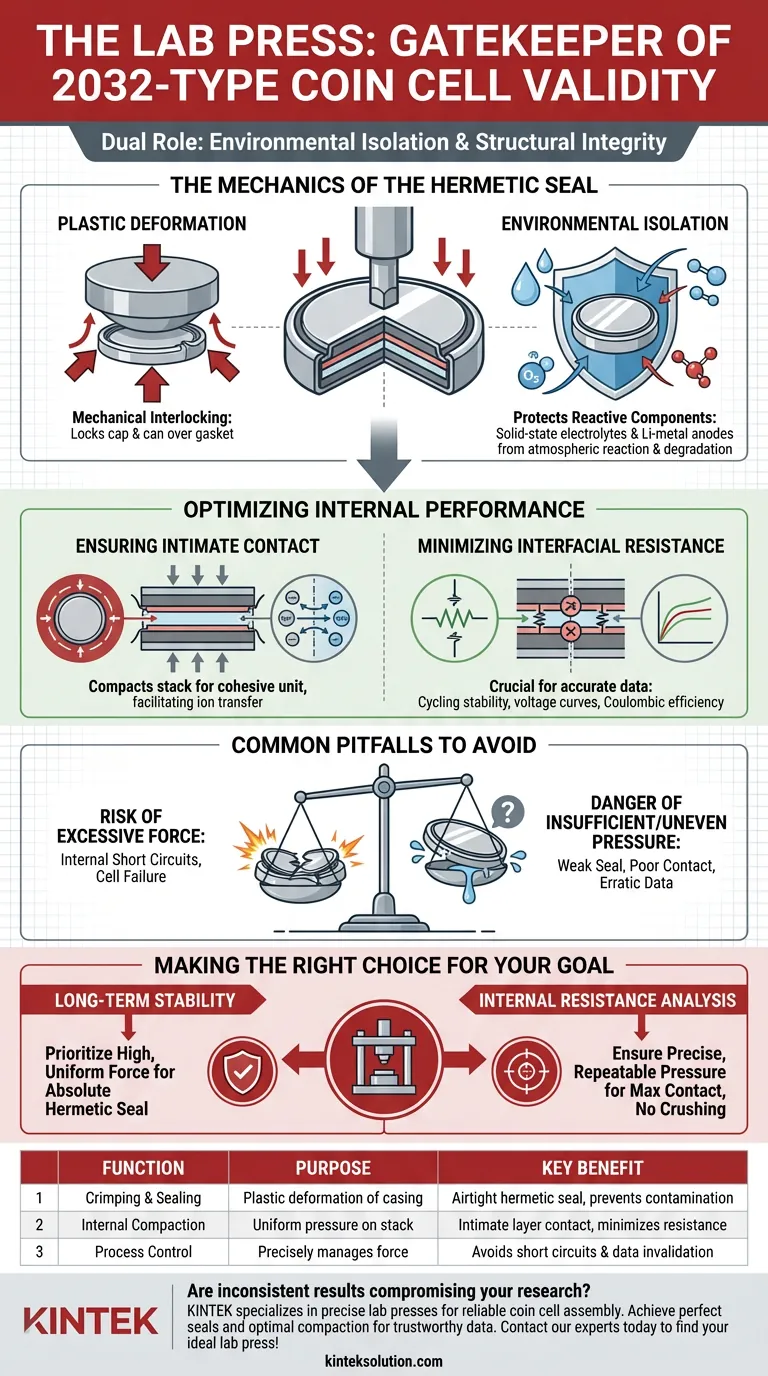
Plastic Deformation of the Casing
To create a true hermetic seal, the coin cell casing requires significant mechanical force. A lab press, specifically configured with a crimping die, applies this force to the edges of the coin cell case.
This pressure causes the metal to undergo plastic deformation, bending and locking the cap and can together over a gasket. This mechanical interlocking is the only barrier preventing the ingress of external elements.
Environmental Isolation
The primary purpose of this seal is the complete isolation of the cell's internal environment. 2032-type cells often contain highly reactive components, such as solid-state electrolytes and lithium metal anodes.
Without a hermetic seal provided by the press, these materials would instantly react with atmospheric moisture and oxygen. This exposure leads to immediate material degradation, rendering the battery unsafe and the test results useless.
Optimizing Internal Performance
Ensuring Intimate Contact
Beyond sealing, the lab press plays a vital role in the internal architecture of the battery. The machine applies pressure to tightly compact the stack of components, including the electrodes, separator, and electrolyte.
This compaction forces the layers into intimate physical contact. This is essential for facilitating ion transfer and ensuring the battery functions as a cohesive unit rather than a loose stack of materials.
Minimizing Interfacial Resistance
The quality of the pressure applied directly correlates to the cell's electrochemical performance. Proper compaction minimizes interfacial resistance between the layers.
By reducing this resistance, the press ensures that measurements regarding cycling stability, voltage curves, and Coulombic efficiency are accurate reflections of the material's properties, rather than artifacts of poor assembly.
Common Pitfalls to Avoid
The Risk of Excessive Force
While pressure is necessary, applying too much force via the lab press can be destructive. Excessive pressure can crush delicate internal structures or pierce the separator.
This physical damage frequently leads to internal short circuits, causing immediate cell failure before testing even begins.
The Danger of Insufficient or Uneven Pressure
Conversely, if the press applies insufficient or non-uniform force, the crimp will fail. A weak seal allows air to leak in, degrading the electrolyte.
Furthermore, uneven pressure leads to poor contact between layers in specific areas of the cell. This results in erratic, non-reproducible data that invalidates the research.
Making the Right Choice for Your Goal
To ensure reliable data, you must balance mechanical sealing with internal structural integrity.
- If your primary focus is Long-Term Stability: Prioritize a press that delivers high, uniform force to ensure the hermetic seal is absolute, preventing degradation over weeks of cycling.
- If your primary focus is Internal Resistance Analysis: Ensure your press settings allow for precise, repeatable pressure application to maximize layer contact without crushing the separator.
The lab press is not just an assembly tool; it is the gatekeeper of your experimental validity.
Summary Table:
| Function | Purpose | Key Benefit |
|---|---|---|
| Crimping & Sealing | Plastic deformation of the metal casing | Creates an airtight, hermetic seal to prevent atmospheric contamination |
| Internal Compaction | Applies uniform pressure to the internal stack | Ensures intimate contact between layers, minimizing interfacial resistance |
| Process Control | Precisely manages applied force | Avoids short circuits from excessive pressure or data invalidation from weak seals |
Are inconsistent coin cell results compromising your battery research?
KINTEK specializes in lab press machines, including automatic and heated lab presses, designed to deliver the precise, uniform pressure required for reliable 2032-type coin cell assembly. Our presses help researchers like you achieve perfect hermetic seals and optimal internal compaction, ensuring your electrochemical data is valid and reproducible.
Contact our experts today to find the ideal lab press for your laboratory's specific needs and start generating trustworthy data.
Visual Guide
Related Products
- Button Battery Sealing Press Machine for Lab
- Lab Button Battery Tablet Press Sealing Mold
- Lab Cylindrical Press Mold for Laboratory Use
- Assemble Lab Cylindrical Press Mold for Laboratory Use
- Special Shape Lab Press Mold for Laboratory Applications
People Also Ask
- Why use standardized CR2032 components & high-precision presses? Ensure reliability in lithium metal battery research.
- Why is a laboratory battery sealing press essential for desolvation energy testing? Ensure Reliable Kinetic Data
- Why is a laboratory hydraulic press or battery sealing machine essential? Ensure Coin Cell Data Integrity
- How do laboratory battery sealing machines ensure performance consistency? Master Your Lithium and LFP Battery Assembly
- What role does a laboratory sealing press play in thermal analysis of solid dispersion films? Ensure Data Integrity














