
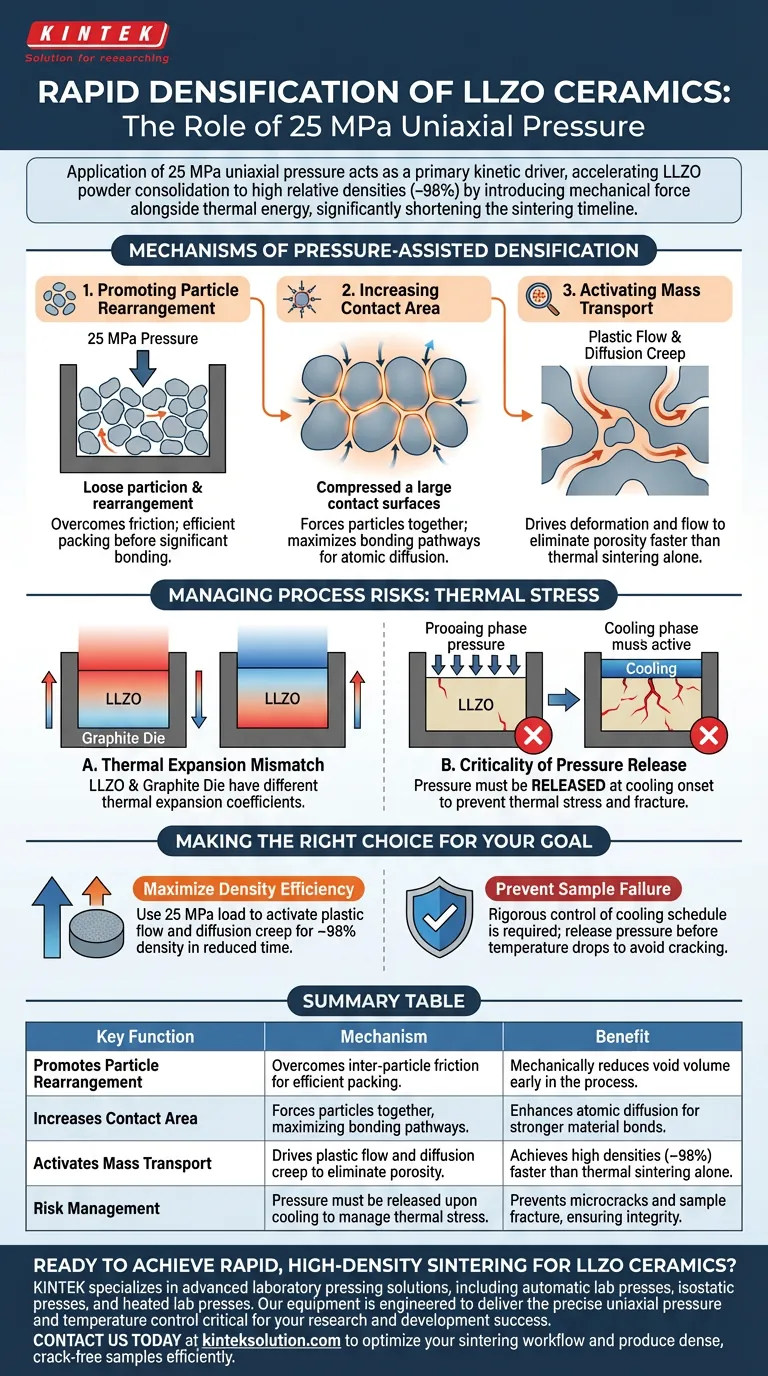
The application of 25 MPa of uniaxial pressure functions as a primary kinetic driver that accelerates the consolidation of LLZO powder into a solid ceramic. By introducing a mechanical force alongside thermal energy, this process significantly shortens the sintering timeline while enabling the material to achieve high relative densities, often approaching 98% of the theoretical maximum.
The core role of this pressure is to mechanically activate mass transport mechanisms that heat alone triggers inefficiently. It converts a passive thermal soaking process into an active consolidation event, forcing particle contact and flow to eliminate porosity rapidly.
Mechanisms of Pressure-Assisted Densification
Promoting Particle Rearrangement
In the initial stages of sintering, the applied pressure exerts a physical force on the loose powder particles.
This force overcomes friction between particles, causing them to slide past one another.
The result is a more efficient packing arrangement that mechanically reduces the volume of voids before significant bonding begins.
Increasing Contact Area
The 25 MPa load forces individual particles against their neighbors, significantly increasing the inter-particle contact area.
This is critical because sintering is a surface-dependent process.
By maximizing the area where particles touch, the system creates more pathways for atomic diffusion, which is necessary to bond the material together.
Activating Mass Transport
Beyond simple packing, the pressure activates specific deformation mechanisms such as plastic flow and diffusion creep.
These mechanisms allow the solid material to deform and flow into remaining pores under stress.
This effectively squeezes out porosity that would otherwise require much higher temperatures or longer hold times to eliminate through simple diffusion.
Managing Process Risks: Thermal Stress
The Thermal Expansion Mismatch
While pressure drives density, it introduces risks during the interaction between the LLZO ceramic and the sintering mold (typically a graphite die).
These two materials have different coefficients of thermal expansion.
This means they expand and contract at different rates when subjected to heating and cooling cycles.
The Criticality of Pressure Release
To maintain the structural integrity of the ceramic, the applied pressure must be managed carefully during the cooling phase.
If the 25 MPa pressure is maintained while the system cools, the mismatched contraction rates create severe internal thermal stress.
Pressure must be released at the onset of cooling to prevent these stresses from causing microcracks or complete fracture of the densified sample.
Making the Right Choice for Your Goal
To successfully leverage uniaxial pressure in your sintering workflow, you must balance the drive for density with mechanical stress management.
- If your primary focus is maximizing density efficiency: Utilize the 25 MPa load to activate plastic flow and diffusion creep, reducing the total sintering time required to reach ~98% density.
- If your primary focus is preventing sample failure: rigorous control of the cooling schedule is required, specifically ensuring pressure is fully released before the temperature drops to avoid fracture due to thermal expansion mismatches.
By treating pressure as a dynamic variable that must be applied to drive flow and removed to prevent stress, you ensure the production of a dense, crack-free LLZO electrolyte.
Summary Table:
| Key Function | Mechanism | Benefit |
|---|---|---|
| Promotes Particle Rearrangement | Overcomes inter-particle friction for efficient packing. | Mechanically reduces void volume early in the process. |
| Increases Contact Area | Forces particles together, maximizing bonding pathways. | Enhances atomic diffusion for stronger material bonds. |
| Activates Mass Transport | Drives plastic flow and diffusion creep to eliminate porosity. | Achieves high densities (~98%) faster than thermal sintering alone. |
| Risk Management | Pressure must be released upon cooling to manage thermal stress. | Prevents microcracks and sample fracture, ensuring integrity. |
Ready to achieve rapid, high-density sintering for your LLZO ceramics or other advanced materials?
KINTEK specializes in advanced laboratory pressing solutions, including automatic lab presses, isostatic presses, and heated lab presses. Our equipment is engineered to deliver the precise uniaxial pressure and temperature control critical for your research and development success.
Contact us today using the form below to discuss how our lab press machines can optimize your sintering workflow and help you produce dense, crack-free ceramic samples efficiently.
Visual Guide
Related Products
People Also Ask
- What is the purpose of incorporating cartridge heaters into a lab press mold for MLCC block compression? Optimize Results
- What is the function of a pressing tool in thermoplastic panels? Master Precision Shaping & Fusion Bonding
- Why is precise cooling management of the lab press mold necessary? Protect Core Integrity in Thermoforming
- Why is a high-performance laboratory molding press critical for in-situ electrolyte formation? Unlock Battery Success
- How do the design and geometric precision of pressing molds and mandrels affect the quality of PTFE composite samples?
