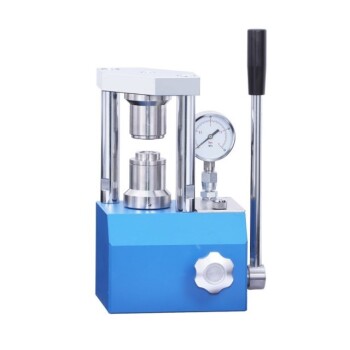
The application of 5 MPa pressure during sodium-ion button cell assembly is the critical mechanical threshold required to create a hermetically sealed and electrically efficient system. This specific pressure level serves a dual purpose: it permanently deforms the cell casing to prevent environmental contamination and compresses the internal stack to ensure reliable electron flow.
The constant application of 5 MPa pressure transforms a stack of loose components into a unified electrochemical device. It ensures the physical integrity required for accurate data by simultaneously eliminating internal contact resistance and isolating the reactive sodium chemistry from the external atmosphere.
The Role of Pressure in Electrical Performance
Minimizing Contact Resistance
The primary function of the 5 MPa pressure is to force the internal components into tight physical contact. Without sufficient pressure, microscopic gaps remain between the cathode, separator, and sodium metal anode.
These gaps act as barriers to electron and ion flow. By applying 5 MPa, you ensure the layers adhere closely to one another, significantly reducing the internal impedance of the cell.
Ensuring Component Connectivity
Beyond the active materials, the pressure ensures connectivity with the hardware. The force is transferred through the current collectors and any internal springs or spacers.
This compression creates a continuous electrical pathway from the internal chemistry to the external battery case. This is vital for maintaining the accuracy of electrochemical performance tests, such as cyclic voltammetry.
Environmental Isolation and Sealing
Deforming the Sealing Ring
Sodium-ion chemistry is highly sensitive. The 5 MPa pressure is specifically calibrated to mechanically deform the sealing ring (gasket) located within the button cell case.
This deformation creates a permanent, airtight seal. If the pressure is too low, the gasket will not expand correctly to fill the voids between the cap and the can.
Preventing Electrolyte Leakage
A proper seal is the only barrier keeping the liquid electrolyte inside the cell. The 5 MPa load ensures the crimp is tight enough to prevent liquid from seeping out during operation.
Blocking Air Entry
Sodium metal is highly reactive to air and moisture. The hydraulic pressure ensures the cell is hermetically isolated from the glove box atmosphere once removed.
This prevents the degradation of the sodium anode and ensures that any capacity loss observed during testing is due to electrochemical behavior, not environmental contamination.
Understanding the Trade-offs
The Risk of Inconsistency
While 5 MPa is the target, achieving this with a manual hydraulic machine introduces a variable: the operator. Unlike digital electric presses, manual presses rely on the user to apply and hold the pressure steadily.
Inconsistent application—fluctuating forces or releasing the pressure too quickly—can lead to "spring-back" in the casing, resulting in a compromised seal or variable contact resistance between different cells in the same batch.
Dangers of Over-Pressure
While the primary reference highlights 5 MPa, significantly exceeding this limit can be detrimental. Excessive force can crush the separator or puncture the delicate sodium foil.
This physical damage often leads to internal short circuits, rendering the cell useless before testing even begins. Adhering strictly to the recommended pressure is a safety constraint as much as a performance requirement.
Ensuring Assembly Success
Depending on your specific research goals, the role of this pressure changes slightly in importance.
- If your primary focus is Rate Capability: Ensure the 5 MPa pressure is held constantly to minimize contact resistance, which is the main bottleneck for high-current performance.
- If your primary focus is Long-Term Cycling: Prioritize the uniformity of the crimp (seal) to prevent electrolyte dry-out or air infiltration over weeks of testing.
- If your primary focus is Reproducibility: Use the exact same pressure duration and release speed for every cell to eliminate assembly variables from your dataset.
The 5 MPa standard is not just a manufacturing step; it is the baseline requirement for generating valid, reproducible scientific data.
Summary Table:
| Factor | Role of 5 MPa Pressure | Impact on Cell Performance |
|---|---|---|
| Electrical | Minimizes internal contact resistance | Improves electron/ion flow and data accuracy |
| Mechanical | Deforms the sealing ring (gasket) | Creates a hermetic, airtight seal for reactive sodium |
| Structural | Compresses the internal component stack | Ensures continuous electrical pathways and connectivity |
| Chemical | Prevents electrolyte leakage & air entry | Protects sodium anode from degradation and moisture |
| Safety | Prevents over-pressure damage | Avoids separator puncturing and internal short circuits |
Elevate Your Battery Research with KINTEK Precision
Consistency is the backbone of reproducible scientific data. KINTEK specializes in comprehensive laboratory pressing solutions designed specifically for the rigorous demands of battery assembly. From manual and automatic presses to heated, multifunctional, and glovebox-compatible models, our equipment ensures you hit the exact 5 MPa threshold every time.
Whether you are working on sodium-ion research, cold isostatic pressing, or advanced material synthesis, KINTEK provides the reliability your lab deserves. Contact us today to find the perfect pressing solution for your research!
References
- Xue Zhang, Hua Zhang. Enhancement of Electrochemical Performance for Sodium-Ion Batteries by Eu-doped Na12(NbO)3(PO4)7 Anode Material. DOI: 10.21203/rs.3.rs-7600500/v1
This article is also based on technical information from Kintek Solution Knowledge Base .
Related Products
- Manual Laboratory Hydraulic Press Lab Pellet Press
- Laboratory Manual Heated Hydraulic Press Machine with Hot Plates
- Laboratory Split Manual Heated Hydraulic Press Machine with Hot Plates
- Manual Laboratory Hydraulic Pellet Press Lab Hydraulic Press
- Manual Heated Hydraulic Lab Press with Integrated Hot Plates Hydraulic Press Machine
People Also Ask
- How does a laboratory manual hydraulic press assist in powder canning? Maximize Density and Structural Integrity
- What is the primary objective of using a laboratory manual hydraulic press at 20 MPa? Achieve Perfect Green Body Shaping
- What is the primary purpose of a manual lab hydraulic pellet press? Ensure Accurate Sample Prep for XRF and FTIR
- What is the primary purpose of manual lab hydraulic pellet presses? Achieve High-Precision Sample Preparation for Spectroscopy
- What are common lab pellet press issues? Expert Troubleshooting Guide for Reliable Material Research