
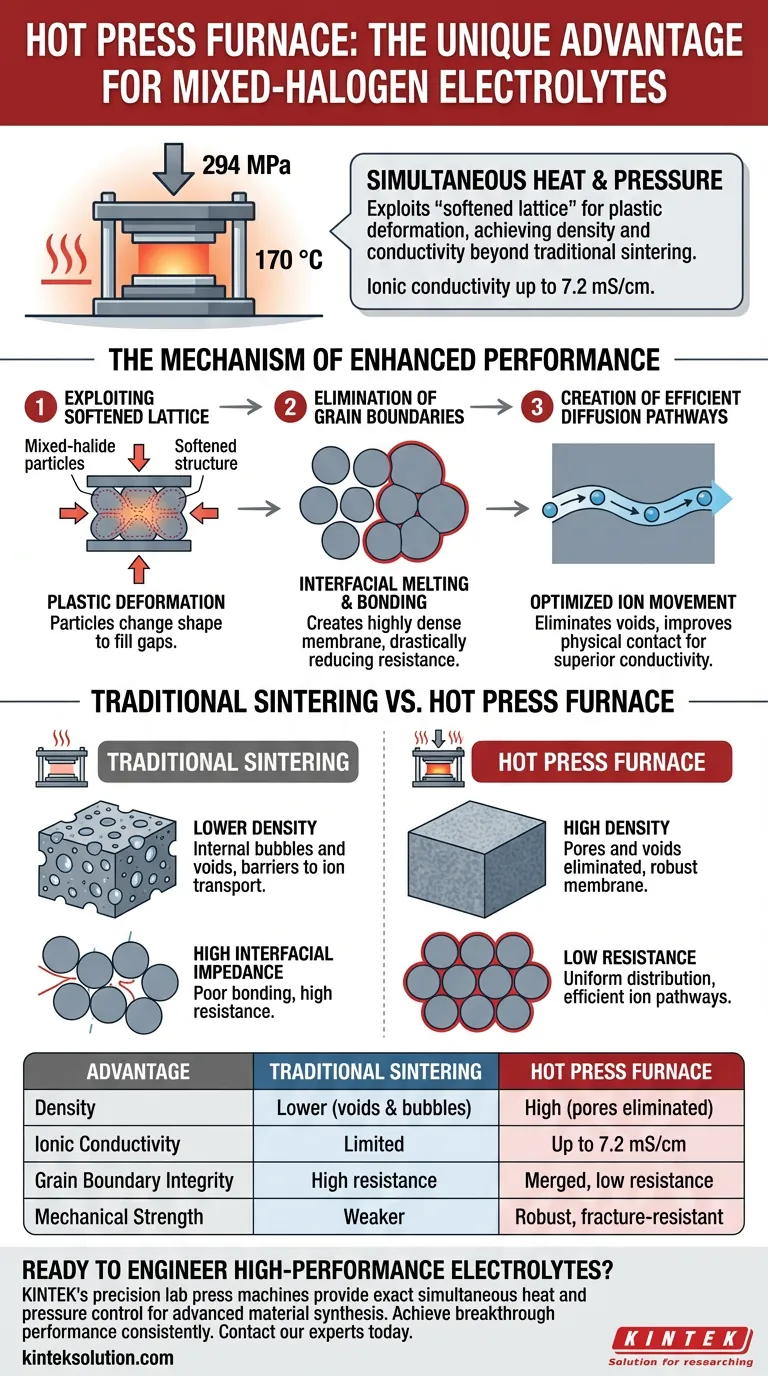
The unique advantage of a hot press furnace in synthesizing mixed-halogen electrolytes is the simultaneous application of high mechanical pressure (e.g., 294 MPa) and thermal energy (e.g., 170 °C). This dual action exploits the "softened lattice" nature of mixed-halide materials to induce plastic deformation, resulting in a density and conductivity level that traditional thermal sintering cannot achieve.
By forcing particles to bond physically while the lattice is thermally softened, hot pressing effectively eliminates pores and merges grain boundaries, enabling ionic conductivity rates as high as 7.2 mS/cm.
The Mechanism of Enhanced Performance
The efficacy of the hot press furnace stems from its ability to manipulate the microstructure of the electrolyte on a granular level.
Exploiting the Softened Lattice
Mixed-halide materials possess a specific characteristic known as a softened lattice.
A hot press furnace leverages this by applying heat to lower the material's yield strength while simultaneously applying pressure.
This combination forces the particles to undergo plastic deformation, changing their shape to fill gaps rather than simply touching at tangent points.
Elimination of Grain Boundaries
In solid-state electrolytes, the interface between grains (the grain boundary) is often the point of highest resistance to ion flow.
The hot press process promotes interfacial melting and bonding, effectively merging these distinct particles into a continuous solid.
This creates a highly dense membrane where the "grain boundary resistance" is drastically reduced or eliminated.
Creation of Efficient Diffusion Pathways
The primary goal of any electrolyte synthesis is to facilitate the movement of ions.
By eliminating voids and improving physical contact, hot pressing creates additional, highly efficient diffusion pathways.
This direct structural improvement is what drives the room-temperature ionic conductivity up to benchmarks like 7.2 mS/cm.
The Limitations of Traditional Sintering
To understand the value of hot pressing, one must recognize the pitfalls of the alternative: standard pressureless sintering.
Inability to Achieve Full Density
Traditional methods rely solely on heat to fuse particles.
Without the assistance of mechanical pressure, these methods frequently leave behind internal bubbles and voids.
These defects act as barriers to ion transport and weaken the mechanical integrity of the ceramic or composite.
The "Contact" Problem
In pressureless systems, particles may touch, but they often fail to bond intimately.
This results in high interfacial impedance, as ions must struggle to jump across imperfect connections between grains.
Hot pressing solves this by mechanically forcing the issue, ensuring uniform distribution and wetting of particles, even in composite polymer matrices.
Making the Right Choice for Your Goal
While a hot press furnace adds a layer of operational complexity requiring precise control, the performance gains for specific materials are non-negotiable.
- If your primary focus is Maximum Conductivity: Use hot pressing to achieve high density and reduce impedance, aiming for targets near 7.2 mS/cm.
- If your primary focus is Mechanical Integrity: Utilize the simultaneous pressure to eliminate pores and voids, ensuring a robust, fracture-resistant electrolyte membrane.
- If your primary focus is Process Consistency: Leverage the precision of the hot press to ensure minimal variation between batches, which is critical for high-quality manufacturing.
For mixed-halogen electrolytes, the hot press is not just a heating tool; it is the definitive method for engineering the microstructure required for high-performance ion transport.
Summary Table:
| Advantage | Traditional Sintering | Hot Press Furnace |
|---|---|---|
| Density | Lower (voids & bubbles) | High (pores eliminated) |
| Ionic Conductivity | Limited | Up to 7.2 mS/cm |
| Grain Boundary Integrity | High resistance | Merged, low resistance |
| Mechanical Strength | Weaker | Robust, fracture-resistant |
Ready to engineer high-performance electrolytes with superior density and conductivity? KINTEK's precision lab press machines, including automatic and heated lab presses, are engineered to provide the exact simultaneous heat and pressure control required for synthesizing advanced materials like mixed-halogen electrolytes. Our solutions help you eliminate microstructural defects and achieve breakthrough performance consistently. Contact our experts today to discuss how our specialized lab press technology can accelerate your R&D and manufacturing success.
Visual Guide
Related Products
- Heated Hydraulic Press Machine with Heated Plates for Vacuum Box Laboratory Hot Press
- Automatic High Temperature Heated Hydraulic Press Machine with Heated Plates for Lab
- Heated Hydraulic Press Machine With Heated Plates For Vacuum Box Laboratory Hot Press
- Automatic Heated Hydraulic Press Machine with Hot Plates for Laboratory
- Laboratory Manual Heated Hydraulic Press Machine with Hot Plates
People Also Ask
- What are the requirements for electrode pressing with high-viscosity ionic liquids like EMIM TFSI? Optimize Performance
- How does a laboratory heated hydraulic press facilitate PBN sample prep for WAXS? Achieve Precise X-Ray Scattering
- What are the industrial applications of heated hydraulic presses? Master Heat & Force for Precision Manufacturing
- Function of a Laboratory Hydraulic Press with Heated Platens in SSE? Enhance Battery Density & Conductivity
- How are heated hydraulic presses utilized in the preparation of thin films? Key Mechanisms and Applications



















