
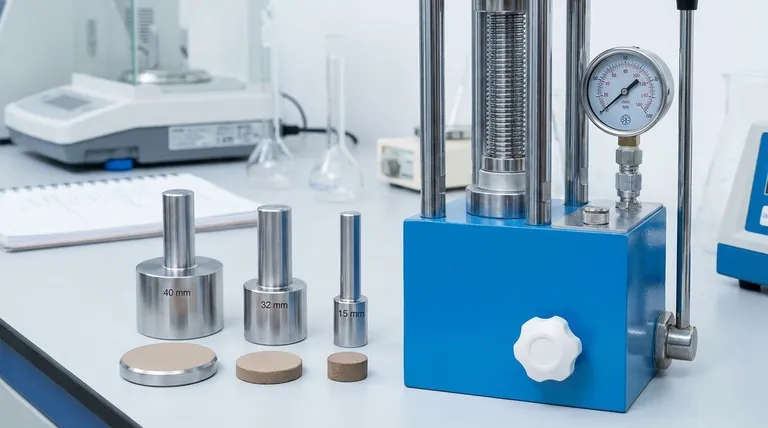
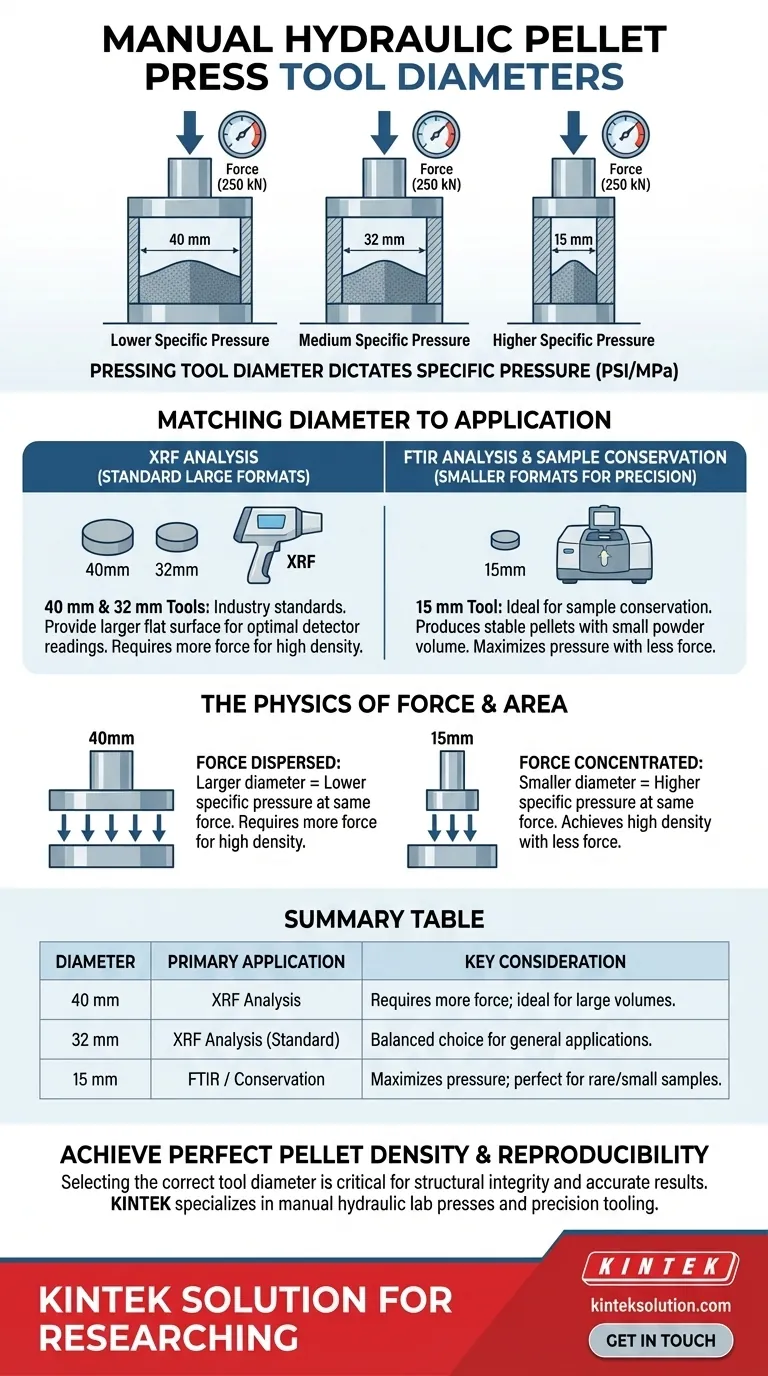
Manual hydraulic pellet presses typically utilize pressing tools in three primary diameters: 40 mm, 32 mm, and 15 mm. These standard sizes provide the flexibility needed to accommodate varying sample quantities and meet the dimensional requirements of downstream analytical techniques like XRF and FTIR.
The diameter of your pressing tool dictates more than just the physical size of the pellet; it acts as the primary variable for determining the specific pressure (PSI/MPa) applied to your sample for a given force.
Matching Diameter to Application
Standard Large Formats
The 40 mm and 32 mm pressing tools are the industry standards for general laboratory applications. These diameters are particularly favored for X-Ray Fluorescence (XRF) analysis, where a larger flat surface area is necessary for optimal detector readings.
Smaller Formats for Precision
The 15 mm pressing tool is designed for scenarios where sample conservation is critical. This size allows users to produce a stable pellet using a significantly smaller volume of powder. It is often utilized for FTIR analysis or when working with rare, high-value materials.
The Physics of Force and Area
Variable Pressure Capabilities
Manual hydraulic presses are capable of applying high variable pressure forces, typically up to 250 kN. However, it is crucial to understand that "force" and "pressure" are not identical in this context.
Force Distribution
The force generated by the single-stage piston is distributed across the face of the pressing tool. Therefore, the smaller the diameter, the higher the specific pressure exerted on the sample granules at the same force setting.
Reproducibility
These presses are engineered to deliver accurate results without applying additional heat. By matching the correct tool diameter to the applied force, users can achieve the consistent density required for reproducible spectral data.
Understanding the Trade-offs
Sample Volume vs. Structural Integrity
A common pitfall is using a large diameter tool (e.g., 40 mm) with insufficient sample material. This results in a wafer that is too thin and mechanically fragile, often crumbling upon removal from the die.
Pressure Limitations
While larger dies provide more surface area, they disperse force. To achieve the same density in a 40 mm pellet as in a 15 mm pellet, you must apply significantly more force from the hydraulic system. Users must ensure the press's 250 kN limit is sufficient to bind their specific material at the chosen diameter.
Making the Right Choice for Your Goal
Selecting the correct pressing tool is a balance between your analytical method and your available sample volume.
- If your primary focus is XRF Analysis: Select the 32 mm or 40 mm tools to ensure a wide, uniform surface area that aligns with standard spectrometer apertures.
- If your primary focus is Sample Conservation: Opt for the 15 mm tool to generate a thick, durable pellet using minimal raw material.
By aligning the tool diameter with your analytical requirements, you ensure both the physical integrity of your sample and the accuracy of your results.
Summary Table:
| Diameter | Primary Application | Key Consideration |
|---|---|---|
| 40 mm | XRF Analysis | Requires more force for high density; ideal for large sample volumes. |
| 32 mm | XRF Analysis (Standard) | Balanced choice for most general laboratory applications. |
| 15 mm | FTIR Analysis / Sample Conservation | Maximizes pressure with less force; perfect for rare or small samples. |
Achieve perfect pellet density and reproducibility for your XRF or FTIR analysis.
Choosing the correct pressing tool diameter is critical for creating pellets with the right structural integrity and analytical surface. KINTEK specializes in manual hydraulic lab presses and precision tooling designed specifically for laboratory needs.
Our experts can help you select the ideal press and tooling combination—whether you need an automatic lab press, isostatic press, or a heated lab press—to optimize your sample preparation workflow and ensure accurate results every time.
Contact us today to discuss your application and get a personalized recommendation: Get in Touch
Visual Guide
Related Products
- Manual Heated Hydraulic Lab Press with Integrated Hot Plates Hydraulic Press Machine
- Manual Laboratory Hydraulic Press Lab Pellet Press
- Laboratory Manual Heated Hydraulic Press Machine with Hot Plates
- Manual Laboratory Hydraulic Pellet Press Lab Hydraulic Press
- Laboratory Split Manual Heated Hydraulic Press Machine with Hot Plates
People Also Ask
- Why is a laboratory hydraulic press with heating plates required for PLA/TEC films? Achieve Precise Sample Integrity
- Why is a manual hydraulic heated lab press essential for compleximer materials? Unlock Advanced Material Synthesis
- Function of a Laboratory Hydraulic Press with Heated Platens in SSE? Enhance Battery Density & Conductivity
- What role does a lab manual hydraulic press play in Li9B19S33 ionic conductivity? Optimize Pellet Characterization
- What are the main benefits of performing proper maintenance on a heated lab press? Ensure Accuracy & Safety



















